Time dilation
I was just reading something about it here, and watching a video.
http://www.thebigview.com/spacetime/timedilation.html
I am not a scientist. When I try and think about it, my brain hurts. It puzzles me. These are things I cannot grasp.
I understand the train analogy mentioned in the article, but surely that is only to do with perception. When I try and apply that theory to speed and time, to me, it doesn't make any sense. Since it is not possible for any of us to actually travel at the speed of light, how can we ever know if it's just a mistaken theory, or whether it's true?
Can anyone explain it to me in simple terms?
I'll give it a shot...
In our ordinary frame of reference, in which Newton holds sway, there is no detectable change in how time works. The overriding mass/acceleration parameter is that of Earth's gravity, which is by definition 1 g, or an acceleration of 32 feet per second per second (that is, anything falling freely in a 1-g field will accelerate by 32 feet per second for every second spent falling). However, observations of the orbit of the planet Mercury showed that its orbit was being affected as if time passed differently there. That was what led to Einstein's formulation of relativity theory.
One thing to keep in mind is that mass distorts space in exactly the same way as acceleration does - in fact, as something accelerates, it also gains mass, a matter which doesn't really factor in that much until you reach a significant fraction of the speed of light. One of the ways that mass/acceleration distorts space/time is that it affects the way in which time passes - essentially, as the mass increases, the rate at which time passes, er, slows. (That's not an elegant statement - it can't really be stated elegantly in English, because our language contains certain basic assumptions which only hold true at certain levels of perception.) From the perspective of someone on Earth, time passes more quickly for someone in deep space - a second is less "time" there. This has been experimentally confirmed several times, using cesium-decay clocks, as the change in entropy is still too small for human perception at a mere one-gravity difference. Mercury's orbit seemed odd because the time passes more slowly there, under the influence of the Sun's gravity.
Since mass and acceleration are basically the same thing in Einsteinian physics, that means that as you accelerate, you gain mass, so when you're traveling at, say, half the speed of light, your mass is much higher than it was when you were back home. Thus, time is passing much more slowly for you than for folks back on Earth - the trip to Alpha Centauri, which seemed to a Terrestrial observer to take eight years, only took five years by your shipboard timepieces. Higher acceleration leads to greater mass, and thus greater distortions in time - if you manage to get up to 99% of the speed of light, your mass will approach infinity, and you will be able to watch the rotation of the Galaxy in real time. (This is also why you can't exceed lightspeed - as you accelerate, the proportion of the energy pumped into the system that's used to increase mass becomes greater in relation to the amount that's used to increase speed; as you approach the speed of light, the mass, and thus the energy needed to accelerate that mass, approaches infinity. To go faster than light in an Einsteinian realm, you'd need to have greater-than-infinite energy. If we ever do manage to create an FTL drive, it's going to have to be by finding some way to cheat Einstein, possibly by invoking M-brane theory, which I really don't want to go into at the moment.)
Any help?
_________________
Sodium is a metal that reacts explosively when exposed to water. Chlorine is a gas that'll kill you dead in moments. Together they make my fries taste good.
Oh dear. Thank you very much for going to all the trouble of typing all that out for me, but I didn't understand it. I don't know some of the terms you're using, and even when it comes to the parts where I technically understand all the words you used perfectly well, I don't understand the concepts behind them.
I seem to have linked to the wrong article. The one with the reference to the train was this one:
http://www.thebigview.com/spacetime/relativity.html
Would you (or someone else, if you're bored of helping me now) mind trying to explain the train analogy to me, and what it's supposed to represent?
I assume the speeding train is supposed to represent a rocket travelling at near the speed of light, and the person standing watching the train is meant to be the person who's stuck at "normal" speed. But how is time dilation represented in this analagy? I don't see it.
Also, regarding blue and red shift: are these also mere theories, or has it actually been possible to view or photograph an object travelling at near the speed of light, and prove that it appears to be blue (or red)? I cannot find any photos on the web showing this.
Thank you for any help! ![]()
I've grew up familiar with Relativitiy; it's quite an intuitive theory, after while. Just deal with the math, if, you can, to get the intuition.
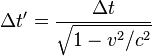
v^2 is equal to the velocity of something else relative to you (squared), c is the speed of lights squared. delta t is the time for you measure for , say, a tick of a watch (one sec), and delta t' is the time the moving observer measures, say, between a tick of a watch (different, depending on speed).
The formula says that as the moving observer gets faster, time outside seems to move slower to him (because v^2 gets bigger, and Delta t is over a number smaller than one, so it gets bigger). Hope that wasn't gibberish to you.
_________________
The scientist only imposes two things, namely truth and sincerity, imposes them upon himself and upon other scientists - Erwin Schrodinger
Member of the WP Strident Atheists
Oh dear. Thank you, Ryan, but I am HOPELESS at maths and physics, so I don't understand your formula.
I was really hoping someone could sort of explain it in really, really simple terms, as though they were talking to a child, but it seems that all the people who actually understand this stuff are so advanced that they are incapable of actually doing so.
Edit: can someone answer my question about the red and blue shift, even if you can't explain the other? Are there any actual photographs of this phenomenae, or would that be impossible due to the nature of the incredibly high speed involved?
Thank you!
I'll give it a shot.
If you accept the fact that the speed of light is the same in all reference frames (this has been experimentally shown to be the case), then you can understand time dilation by considering a light clock:
Notice how, for the stationary clock on the left, the light only has to travel over a distance of 2d to record one tick. For the moving clock, the light has to travel over a greater distance to record one tick. Since the speed of light is constant, you can see that that the moving clock will tick slower than the stationary clock.
jrjones9933
Veteran
Joined: 13 May 2011
Age: 57
Gender: Male
Posts: 13,144
Location: The end of the northwest passage
Nice one, mcg. That worked for me.
I heard on NPR that a recent experiment (Gravity Probe B) had proved frame-dragging. At the time I was confused, but I think I sort of get frame dragging, now. Gravity bends space-time, and a sufficiently massive spinning object swirls it as well?
Edit: And thanks very much for bringing this up, and for the link, all_white!
_________________
"I find that the best way [to increase self-confidence] is to lie to yourself about who you are, what you've done, and where you're going." - Richard Ayoade
Last edited by jrjones9933 on 17 May 2011, 6:59 pm, edited 1 time in total.
jrjones9933
Veteran
Joined: 13 May 2011
Age: 57
Gender: Male
Posts: 13,144
Location: The end of the northwest passage
Back to the train and bystander. The train blows its horn as it approaches, passes, and departs from the bystander. People on the train hear a horn with a steady pitch. The bystander hears a higher pitch as the train approaches, and a lower pitch as the train departs.
The same thing happens with light waves as with sound waves (at much higher speeds), and we perceive the change in light wave frequency as color. Blue for higher frequency, red for lower.
I'll leave more technical detail to others, but that's how I understand it.
_________________
"I find that the best way [to increase self-confidence] is to lie to yourself about who you are, what you've done, and where you're going." - Richard Ayoade
I was really hoping someone could sort of explain it in really, really simple terms, as though they were talking to a child, but it seems that all the people who actually understand this stuff are so advanced that they are incapable of actually doing so.
Edit: can someone answer my question about the red and blue shift, even if you can't explain the other? Are there any actual photographs of this phenomenae, or would that be impossible due to the nature of the incredibly high speed involved?
Thank you!
Sorry, I didn't notice you were eight. You wouldn't have studied algebra yet; that stuffs like gibberish until you hit sixteen.
To put time dilation really, really simply, when you are going really fast, time seems to travel very fast around you; if you are going nearly lightspeed, everyone looks like they are aging, and doing stuff a lot faster than usual.
Go fast enough, and what seems like a year to you might seem like ten years to you, so if you travelled for fifty years at a very high speed, you could travel five hundred years into the future
_________________
The scientist only imposes two things, namely truth and sincerity, imposes them upon himself and upon other scientists - Erwin Schrodinger
Member of the WP Strident Atheists
Thank you, Ryan. I am not really eight. I am thirty. But eight is the estimated age at which part of my brain stopped developing, so I still feel like a child and would rather people on here were kind and gentle to me, rather than mean and impatient. Hence I've changed my age to my "mental" age, rather than my biological one.
Your simple explanation is very interesting, but what I still don't understand is WHY. Why should (or does) time speed up around you, just because you are going faster?
Ooooh, we're talking about time speeding up around you.
Now sense is getting knocked back into my head.
I believe that when we're young we see the world around us and take notice of it, and because we pay attention to every single little thing, it could feel like 18 hours to us or more.
When people get older, they pay less attention the the bugs around them, the grass, the beautiful sky with the clouds etc.
Everyday feels like it goes for at least 15 hours or more (Depends if I am at the computer or not) it feels like about 5 hours has gone by when I am on the computer all day (Which is bad!)
I believe that time speeds up for us when we're having fun, and slows down when we're bored.
Think about it, you're paying attention to every single thing at your desk, your mind is racing. You just want to go home!
As at home playing a game or something time flies by because you're focused on one thing only.
I blab on, I'm probably incorrect
Your simple explanation is very interesting, but what I still don't understand is WHY. Why should (or does) time speed up around you, just because you are going faster?
Fair enough.
The "why" is...more difficult. The idea of the whole theory is that light seems to go at the same speed, no matter how fast you are going. Whether you are in a jet, or standing still, light still seems to be going at exactly the same speed.
After that, the math unavoidably gets heavy. But you can think of it like this; time dilates so that you can never catch up to a beam of light, and so that that beam of light always seems to be going at the same speed.
_________________
The scientist only imposes two things, namely truth and sincerity, imposes them upon himself and upon other scientists - Erwin Schrodinger
Member of the WP Strident Atheists
Only in that time dilation in the sense of physics has nothing to do with how time seems to speed up as we get older (it does).
_________________
The scientist only imposes two things, namely truth and sincerity, imposes them upon himself and upon other scientists - Erwin Schrodinger
Member of the WP Strident Atheists

I wish I understood.