Time dilation
Only in that time dilation in the sense of physics has nothing to do with how time seems to speed up as we get older (it does).
My brain just followed you up to "we get older" and I understood, and thought to myself, "I am incorrect" but then "(it does)" sent my mind flying backwards trying to understand what on earth you mean?!
Only in that time dilation in the sense of physics has nothing to do with how time seems to speed up as we get older (it does).
My brain just followed you up to "we get older" and I understood, and thought to myself, "I am incorrect" but then "(it does)" sent my mind flying backwards trying to understand what on earth you mean?!
Sorry. I meant that you were right when you said that time seems to go quicker as you get older, but that has nothing to do with time dilation in physics.
_________________
The scientist only imposes two things, namely truth and sincerity, imposes them upon himself and upon other scientists - Erwin Schrodinger
Member of the WP Strident Atheists
Only in that time dilation in the sense of physics has nothing to do with how time seems to speed up as we get older (it does).
My brain just followed you up to "we get older" and I understood, and thought to myself, "I am incorrect" but then "(it does)" sent my mind flying backwards trying to understand what on earth you mean?!
Sorry. I meant that you were right when you said that time seems to go quicker as you get older, but that has nothing to do with time dilation in physics.
Thank you for saying it more simply~♥ (:
And I understand~♥
Tollorin
Veteran
Joined: 14 Jun 2009
Age: 44
Gender: Male
Posts: 3,178
Location: Sherbrooke, Québec, Canada
I have a reason for wanting to know.
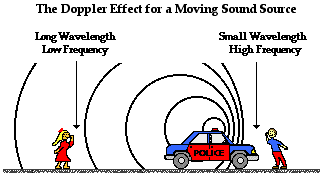
Nothing like pictures to show the Doppler effect.
The sound got a speed of about 341m/s (If I remenber correctly).
Imagine you're in car going to 50mph, from the car you on the side you launch a little motrised skateboard going to 60mph. If you launch it to go in the same direction as your car it will slowly overtake you and slowly going away at the front as it go a little bit faster. If you lauch at the direction of the rear though, it will quickly disappear as it go speedilly in the other direction.
That's also how sound work, now look at the pictures and it may make sense.
The thing to keep in mind with relativity is that there is no absolute speed except for the speed of light, which mean either something is moving or not is only a question of point of view.
From the clock point of view the clock is see as immobile, but from the outside the clock is seen as moving. As you can see from th clock the light seem to travel a shorter distance, thus it should be going slower right? No it can't, as the speed of light is constant; which is allowed by the time on the clock going slower for those who observe it as moving. (So the light go at the same speed for both the clock and those who observe it moving, as speed is a measure of distance over time. )
We don't notice it in everyday life because light go ridiculously fast, so the effects are too small to be noticable by our senses. You would need some kind of super speed to notice it.
Don't know if I made myself clear...
_________________
Down with speculators!! !
The choices of stars, though, are misleading. The redshift of the light isn't visible to the naked eye - Arcturus looks reddish because it's a K-type orange giant star, while Sirius is a binary star, consisting of one A-type blue giant star and one white dwarf companion. (Interestingly, some ancient Greek texts describe Sirius as being reddish, due in part to the fact that Sirius B used to be an M-class red giant star, which has since collapsed as a white dwarf. It is theorized that the red giant was artificially "aged" by infalling radiation from its blue giant companion.)
Arcturus also shows a variability in its redshift, leading some astrophysicists to hypothesize that the star hosts a planetary system. This was once a controversial claim; however, the recent discovery of a host of exoplanets makes this explanation seem more likely.
(Astrophysics is kind of a hobby of mine...)
_________________
Sodium is a metal that reacts explosively when exposed to water. Chlorine is a gas that'll kill you dead in moments. Together they make my fries taste good.
Pictures won't help in my case. It's comprehensive logical step by step lectures and tutorials that help.
I thought the same, hey MCalavera, PM? (:
Why not? Go ahead.
Pictures won't help in my case. It's comprehensive logical step by step lectures and tutorials that help.
I thought the same, hey MCalavera, PM? (:
Why not? Go ahead.
Yay!
I have a reason for wanting to know.
Nothing like pictures to show the Doppler effect.
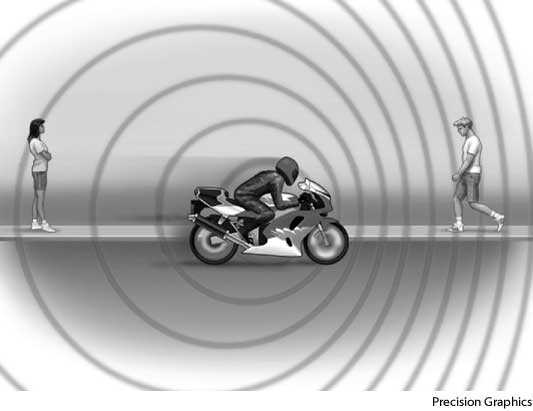
LOTS OF HELPFUL PICTURES
Don't know if I made myself clear...
Yes, you did. Thank you very much for your kind help. But that wasn't what my question was.
No one is answering my question!
Never mind. I think I know the answer by now.
http://www.thebigview.com/spacetime/timedilation.html
I am not a scientist. When I try and think about it, my brain hurts. It puzzles me. These are things I cannot grasp.
I understand the train analogy mentioned in the article, but surely that is only to do with perception. When I try and apply that theory to speed and time, to me, it doesn't make any sense. Since it is not possible for any of us to actually travel at the speed of light, how can we ever know if it's just a mistaken theory, or whether it's true?
Can anyone explain it to me in simple terms?
Travel at the speed of light? This is your question?
What were we all talking about here then? o.o
No one really didn't answer her question
Well, no, actually, I got it wrong, EgyptianCat. It should have read "at 99.99% of the speed of light."
I typed it carelessly yesterday because I was in a hurry to get my answer. You might think it wouldn't really matter, but to all these clever scientists on here, that 0.1% makes a HUGE difference.
Technically, there's allegedly a speed limit in the Universe! ![]()
I typed it carelessly yesterday because I was in a hurry to get my answer. You might think it wouldn't really matter, but to all these clever scientists on here, that 0.1% makes a HUGE difference.
Technically, there's allegedly a speed limit in the Universe!
o.o
You sound smart~♥ o.o
No, I'm not! Really!
I didn't know any of this until yesterday, when I googled it for a specific reason.
I still cannot grasp time dialtion, but I understand about the Doppler effect on both light rays and sound rays. However, my question is: would a moving object appearing to be blue (due to Doppler blueshift) be visible to the naked eye, and has any such blueshift ever been caught on a specialised camera of any kind? Also, what colour would the blue be? Would it be a sort of flourescent blue?
I have found a photo of a galaxy exhibiting Doppler blueshift, but can someone please answer me without sidetracking to stars? I know moving objects can be stars, but I am not referring to stars and galaxies. I have a very specific thing in mind: an object travelling very, very fast through the air, down here on earth.
Thank you!
The following link answers some of my queries, but not all of them.
http://uk.answers.yahoo.com/question/in ... 129AATbgCL
You sound smart~♥ o.o
No, I'm not! Really!
I didn't know any of this until yesterday, when I googled it for a specific reason.
I still cannot grasp time dialtion, but I understand about the Doppler effect on both light rays and sound rays. However, my question is: would a moving object appearing to be blue (due to Doppler blueshift) be visible to the naked eye, and has any such blueshift ever been caught on a specialised camera of any kind? Also, what colour would the blue be? Would it be a sort of flourescent blue?
I have found a photo of a galaxy exhibiting Doppler blueshift, but can someone please answer me without sidetracking to stars? I know moving objects can be stars, but I am not referring to stars and galaxies. I have a very specific thing in mind: an object travelling very, very fast through the air, down here on earth.
Thank you!
The following link answers some of my queries, but not all of them.
http://uk.answers.yahoo.com/question/in ... 129AATbgCL
I'm too tired to read all of that x_x
I'll read it tomorrow or my head will just be like, "394, 38x, =times 3 x y" and then turn off~♥
(I have no idea what I am saying)
You sound smart~♥ o.o
No, I'm not! Really!
I didn't know any of this until yesterday, when I googled it for a specific reason.
I still cannot grasp time dialtion, but I understand about the Doppler effect on both light rays and sound rays. However, my question is: would a moving object appearing to be blue (due to Doppler blueshift) be visible to the naked eye, and has any such blueshift ever been caught on a specialised camera of any kind? Also, what colour would the blue be? Would it be a sort of flourescent blue?
I have found a photo of a galaxy exhibiting Doppler blueshift, but can someone please answer me without sidetracking to stars? I know moving objects can be stars, but I am not referring to stars and galaxies. I have a very specific thing in mind: an object travelling very, very fast through the air, down here on earth.
Thank you!
The following link answers some of my queries, but not all of them.
http://uk.answers.yahoo.com/question/in ... 129AATbgCL
You would have a hard time actually seeing with an organic human eye a Doppler shift color change. but with instruments Doppler shifts are seen every where. Particularly the shift of lines in a spectrum.
ruveyn