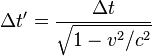
all_white wrote:
Back to time dilation: I've remembered a simple formula, one of the few ones I do actually know.
v=d/t
so
t =d/v
Is the "time" element in this equation the same sort of time being talked about in time dilation, or are they two different things?
I can see how t would be lessoned in the above equation if v were greater, so that is what is being talked about in the complex formula I don't understand?
It's a "commonsense" formula for time, but not relativistic time. Your formula doesn't take the speed of the person observing something into account; it claims that time works the same at a million miles per hour as it does at ten. The "complicated" equation says that time passes in a different way when you are going very fast

I'll try go through the formula once more; you seem to understand why increasing
v would make t smaller above, and the time dilation equation works in exactly the same way.
Quote:
I'm going to use bogus numbers, to make the result less confusing.
Examples
if we let delta t be equal to one second, and c^2 = 25 (it's much larger than that in real life), we can see how the time dilation changes as
v gets bigger (or the moving observer gets faster).

in the top example, both observers were standing still, so they both experience time passing at the same rate. there is no dialation. Notice how the "0/25" is equal to zero? This means the bottom is equal to one, cause the square root of 1 - 0 is equal to one.
In the second example, the velocity squared (the speed of the moving observer, squared) is "9/25"/ This makes the bottom part smaller. 1/0.8 is equal to 1.25.
This means, for ever second that a guy standing still counts, the moving guy counts 1 and a quarter. So we have time dilation!
I hope that helped, but I doubt it; usually people get blinded by math

_________________
The scientist only imposes two things, namely truth and sincerity, imposes them upon himself and upon other scientists - Erwin Schrodinger
Member of the WP Strident Atheists