Why can't anything go faster than the speed of light?
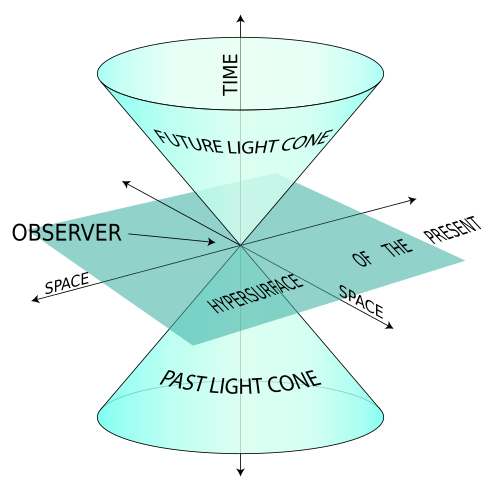
Take a look at this diagram in which the three spatial dimensions are shown as two dimensions.![]()
Imagine that you are at the origin of the axis. You can plot your position in the graph throughout a period of time by plotting your time and space coordinates on the graph. (Think of time measured in the same coordinate as space with the conversion from time to space coordinates based on the speed of light.) This is your "world line".
If you are not changing your position in space, then your world line is along the time axis. The faster you travel, the more your world line will approach a 45 degree cone at that point of your world line, but since you can never reach the speed of light, the slope of your world line would never reach 45 degrees. Thus, your future is always within the cone facing upward.
Similarly, if you were going backwards in time, i.e. you were antimatter, then your future on your world line would be inside the lower cone. Again, it could never exceed 45 degrees from the vertical.
If you were traveling faster than light, then your future would be outside of the two cones. Infinitely fast would mean that your world line would be on the region in the diagram labeled "hypersurface of the present". Your world line would always always be greater than 45 degrees from the vertical and you could freely go between forwards and backwards in time but in transitioning from one to the other you would have to travel infinitely fast at least momentarily.
The world line of a photon would be on the cone itself. It would always be 45 degrees from the vertical.
Keep mind that at every point along your world line, you would have a new space-time cone for that point.
---
I don't think that explanation comes across well at all. It's a lot easier live and with a blackboard to draw on.
Perhaps this will help. Note that the slope of the world line never deviates 45 degrees or more from the vertical. If it did, then it would be on the cone and be traveling at the speed of light or would go outside of the cone and thus be traveling faster than light.
In other words, if you wanted to travel backwards in time, it would not be sufficient to exceed the speed of light. Rather, you would have to travel faster than the speed of light to become a tachyon, then as a tachyon go infinitely fast, and then slow down again going backwards in time and then transition across the speed of light going backwards in time to become antimatter traveling backwards in time.
Nothing can move faster that the speed of light.However,under the theory of relativity,there are actually three ways that objects can move:
At the speed of light
Slower than the speed of light
Faster than the speed of the light
_________________
heavy duty lathe machine | drilling machine | [url=http://www.machinedock.net/universal-vertical-milling-machine
]milling machine[/url]
Actually tachyons would not go backward in time unless you could bring them down to below light speed.
When they move at infinite speed they are at the equivalent of their "rest mass", and time would be moving forward at its normal rate.
As tachyons slow down time for them would also slow down to approach the SOL (as it slows down for us as we speed up to approach the speed of light). Time stops for them when they hit the SOL (just as it does for us when we hit the SOL by accelerating). And they would experience reverse time if they are forced to go below the SOL by further deceleration.
Tachyons, if they exist, have an imaginary rest mass (imaginary as in complex variables). If we could magically accelerate past the speed of light (in a vacuum, of course), our rest mass would magically become imaginary. Similarly, if a tachyon could decelerate past the speed of light, it's rest mass would magically become real.
As for the direction of time, to a tachyon the direction of time would be immaterial. To an observer with real rest mass, the direction of time of a tachyon could be either forward or backward.
Or....
It could be that when tachyons are moving at infinite speed (their equivalent of being at rest) they would indeed move backward in time- but at the same normal rate that we move forward in time at rest.
But as they decelerate down to the speed of light they move backward in time at an increasingly slow rate. Until when they reach the SOL time stops. Then they would move forward in time once they are brought down to below light speed.
It could be that when tachyons are moving at infinite speed (their equivalent of being at rest) they would indeed move backward in time- but at the same normal rate that we move forward in time at rest.
But as they decelerate down to the speed of light they move backward in time at an increasingly slow rate. Until when they reach the SOL time stops. Then they would move forward in time once they are brought down to below light speed.
If you draw the particle's world line in a space-time diagram, the speed of the particle at any point is basically represented by the tangent to the curve at that point. If the tangent is vertical, it has a speed of 0. If the tangent is at 45 degrees, the speed is c. If the tangent is horizontal, it has an infinite speed.
It is literally impossible for a world line to cross the light cone. To do so, it would have to be doing the speed of light at some point in time, but only that which has zero rest mass can travel the speed of light. The mass of the particle would have to be some positive value and then zero and then imaginary.
Furthermore, whether a particle is traveling forward or backwards in time is shown by whether or not future events to the object have a higher or lower value to its time coordinate for a future event. That is, if there are two events, (t₁, x₁, y₁, z₁) and (t₂, x₂, y₂, z₂) in the order of which they appear on the world line, then if t₁<t₂ the object is traveling forward in time but if t₂<t₁ it is traveling backwards in time.
That said, there is really no indication that anything can ever travel backwards in time just as there is no evidence to suggest that tachyons exist. Antimatter may be mathematically treated as an ordinary particle traveling backwards in time but that is not the same as saying that it is traveling backwards in time.
You can go faster than light by using a wormhole.While traveling through a wormhole, subluminal (slower-than-light) speeds are used. If two points are connected by a wormhole whose length is shorter than the distance between them outside the wormhole, the time taken to traverse it could be less than the time it would take a light beam to make the journey if it took a path through the space outside the wormhole. However, a light beam traveling through the wormhole would of course beat the traveler. It would be more interesting to using a wormhole to travel to parallel universes or alternate Earth's.
Wormholes aren't faster-than-light, they are shortcuts.
You will have travelled from A to B in less time than it took light, but you didn't go beyond light-speed (that is assuming wormholes are real in the first place).
This is similar from a free-runner racing a car in a city block: the free-runner will reach the finish line quicker, but they were never faster than the car.
You are assuming, of course, that such worm holes could exist.
Wormholes might allow superluminal (faster-than-light) travel by ensuring that the speed of light is not exceeded locally at any time. While traveling through a wormhole, subluminal (slower-than-light) speeds are used. If two points are connected by a wormhole whose length is shorter than the distance between them outside the wormhole, the time taken to traverse it could be less than the time it would take a light beam to make the journey if it took a path through the space outside the wormhole.The theory of general relativity predicts that if traversable wormholes exist, they could allow time travel
You are assuming, of course, that such worm holes could exist.
If you have a civilization that technologically advanced they might exist. There are billions of stars in the Universe and there are many civilizations who have overcome the problem of travel between the stars in a short period of time.
You are assuming, of course, that such worm holes could exist.
If you have a civilization that technologically advanced they might exist. There are billions of stars in the Universe and there are many civilizations who have overcome the problem of travel between the stars in a short period of time.
I believe that the question he is asking is "does nature allows wormholes to exist?". Not whether or not there are advanced civilizations out there that could exploit them if they did exist. First things first.
I believe that an advanced civilization somewhere in our galaxy or other galaxies have developed and uses wormholes. Maybe they are visiting here today, observing our progress. To an advanced civilization we are a bacillus. There might be civilizations that can manipulate space and time. This is true of going through hidden dimensions. Remember, the Milky Way galaxy is 14 billion years old. Enough time for advanced civilizations to grow