Is Swan Hyperbolic?
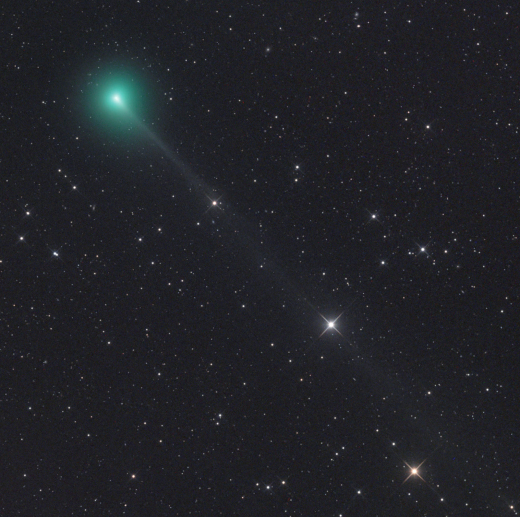
Newly-discovered Comet SWAN (C/2020 F8) is shaping up to be a beauty. It looks great through small telescopes now, and could become visible to the naked eye next month. Gerald Rhemann sends this picture taken yesterday froom Farm Tivoli, Namibia:
"The comet's tail is almost a full degree long," says Rhemann. "And it was an easy target for my 12-inch telescope at magnitude +7.5."
Where does this beautiful comet come from? SWAN's trajectory is an important clue. It's falling toward the sun for the first time, and the sun's gravity will probably slingshot Comet SWAN back into deep space. Comet SWAN may be a "hyperbolic comet"--that is, a comet whose orbit has an eccentricity greater than 1. Such comets come from the Oort Cloud or may even be interstellar.
The case for Comet SWAN being a hyperbolic comet is not ironclad. Based on an observation arc of only 3 days, JPL reports the eccentricity of SWAN's orbit as 1.1 +/- 0.2. The error bars are still large. The uncertainties will shrink, however, as more observations are added to the database. Stay tuned for updates!
Source: spaceweather.com
_________________
Author of Practical Preparations for a Coronavirus Pandemic.
A very unique plan. As Dr. Paul Thompson wrote, "This is the very best paper on the virus I have ever seen."
Comet SWAN (C/2020 F8) is brightning rapidly. "I just came in from observing it with the naked eye," reports John Drummond of Gisborne, New Zealand. "It seems to have increased in brightness dramatically since I last observed it a few nights ago." Indeed, multiple observers have now pegged the comet at magnitude +5.5, just within the range of human visibility.
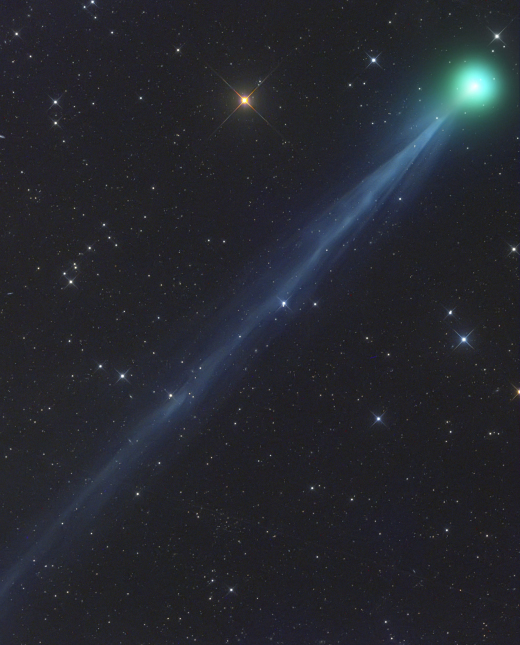
Much about Comet SWAN remains unknown. It was discovered just a few weeks ago, on April 11th, when a sudden hydrogen dump by the comet made it show up in data from the Solar and Heliospheric Observatory's SWAN instrument.
"The comet sort of appeared out of nowhere," says Karl Battams of the Naval Research Lab in Washington DC. "What made it flare up? I worry that something unpleasant happened to it, and now it's releasing (possibly exhausting) all of its fresh volatiles."
If so, it could fizzle or even fall apart like its cousin Comet ATLAS recently did. However, says Battams, "Comet SWAN seems to be holding together better than Comet ATLAS, so there's hope!"
Comet SWAN's hyperbolic orbit suggests that it might be a first-time visitor to the inner solar system. Such newcomers are notoriously unpredictable, and no one can say for sure what will happen next, so stay tuned.
Source: SpaceWeather.com of 30 April.

_________________
Author of Practical Preparations for a Coronavirus Pandemic.
A very unique plan. As Dr. Paul Thompson wrote, "This is the very best paper on the virus I have ever seen."
This is beautiful video of SWAN traveling through space.
Fresh comets often behave this way–cracking, fracturing, and exposing veins of volatile material as they approach the sun for the first time. Comet SWAN is just such an object. It has a hyperbolic orbit, which suggests it has never been here before. Sunlight is touching its surface for the first time with unpredictable results.
More outbursts could be in the offing. Dates of special interest include May 12th when the comet passes by Earth (0.56 AU) and May 27th when the comet slingshots past the sun not far from the orbit of Mercury (0.43 AU). Observers in the southern hemisphere will have a front row seat for whatever happens.
_________________
Author of Practical Preparations for a Coronavirus Pandemic.
A very unique plan. As Dr. Paul Thompson wrote, "This is the very best paper on the virus I have ever seen."