
Nearby Black Hold Discovered



 07 May 2020, 12:58 pm

Researchers have discovered a black hole 1,000 light-years from Earth, the closest one known so far.
Dubbed HR 6819, the black hole is invisible. The star system was only spotted after two companion stars provided researchers with information on its whereabouts. It can be seen on a clear night in the Southern Hemisphere without the use of a binocular or telescope, making it the first black hole to be seen without tools.
"We were totally surprised when we realized that this is the first stellar system with a black hole that can be seen with the unaided eye,” said one of the study's co-authors, Petr Hadrava, Emeritus Scientist at the Academy of Sciences of the Czech Republic, in a statement.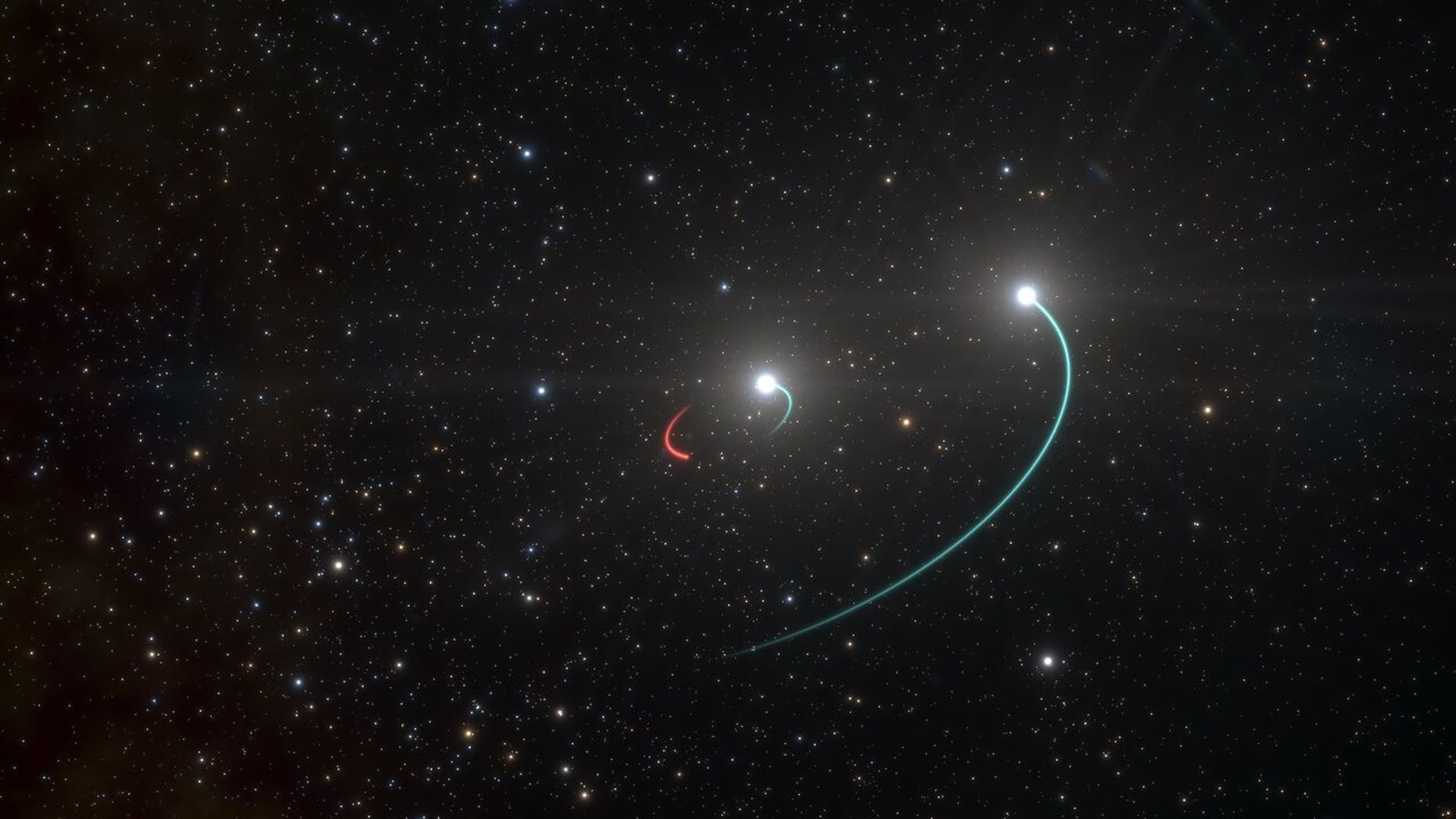
The star system is located in the Telescopium constellation, which was first discovered in 1751–52 by French astronomer Nicolas-Louis de Lacaille.
After looking at the system, the researchers found that one of the stars was orbiting the black hole every 40 days, thanks to the MPG/ESO 2.2-meter telescope at European Southern Observatory’s La Silla Observatory in Chile.
Source: Black hole, 1,000 light-years from Earth, discovered
The big question here - "Is our Solar System moving towards or away from the Black Hole?"
_________________
Author of Practical Preparations for a Coronavirus Pandemic.
A very unique plan. As Dr. Paul Thompson wrote, "This is the very best paper on the virus I have ever seen."
 07 May 2020, 1:03 pm
_________________
The mere fact that science may not yet adequately explain an object, event, or experience does not mean the immediate explanation should automatically default to a conspiratorial, extraterrestrial, paranormal, or supernatural cause.
07 May 2020, 1:10 pm
Thanks Fnord! That is really good news!
_________________
Author of Practical Preparations for a Coronavirus Pandemic.
A very unique plan. As Dr. Paul Thompson wrote, "This is the very best paper on the virus I have ever seen."
07 May 2020, 1:14 pm
_________________
The mere fact that science may not yet adequately explain an object, event, or experience does not mean the immediate explanation should automatically default to a conspiratorial, extraterrestrial, paranormal, or supernatural cause.
07 May 2020, 1:46 pm
For the latter. I was too busy cutting down trees with my chainsaw.
_________________
Author of Practical Preparations for a Coronavirus Pandemic.
A very unique plan. As Dr. Paul Thompson wrote, "This is the very best paper on the virus I have ever seen."
07 May 2020, 3:30 pm
_________________
The mere fact that science may not yet adequately explain an object, event, or experience does not mean the immediate explanation should automatically default to a conspiratorial, extraterrestrial, paranormal, or supernatural cause.
07 May 2020, 3:57 pm
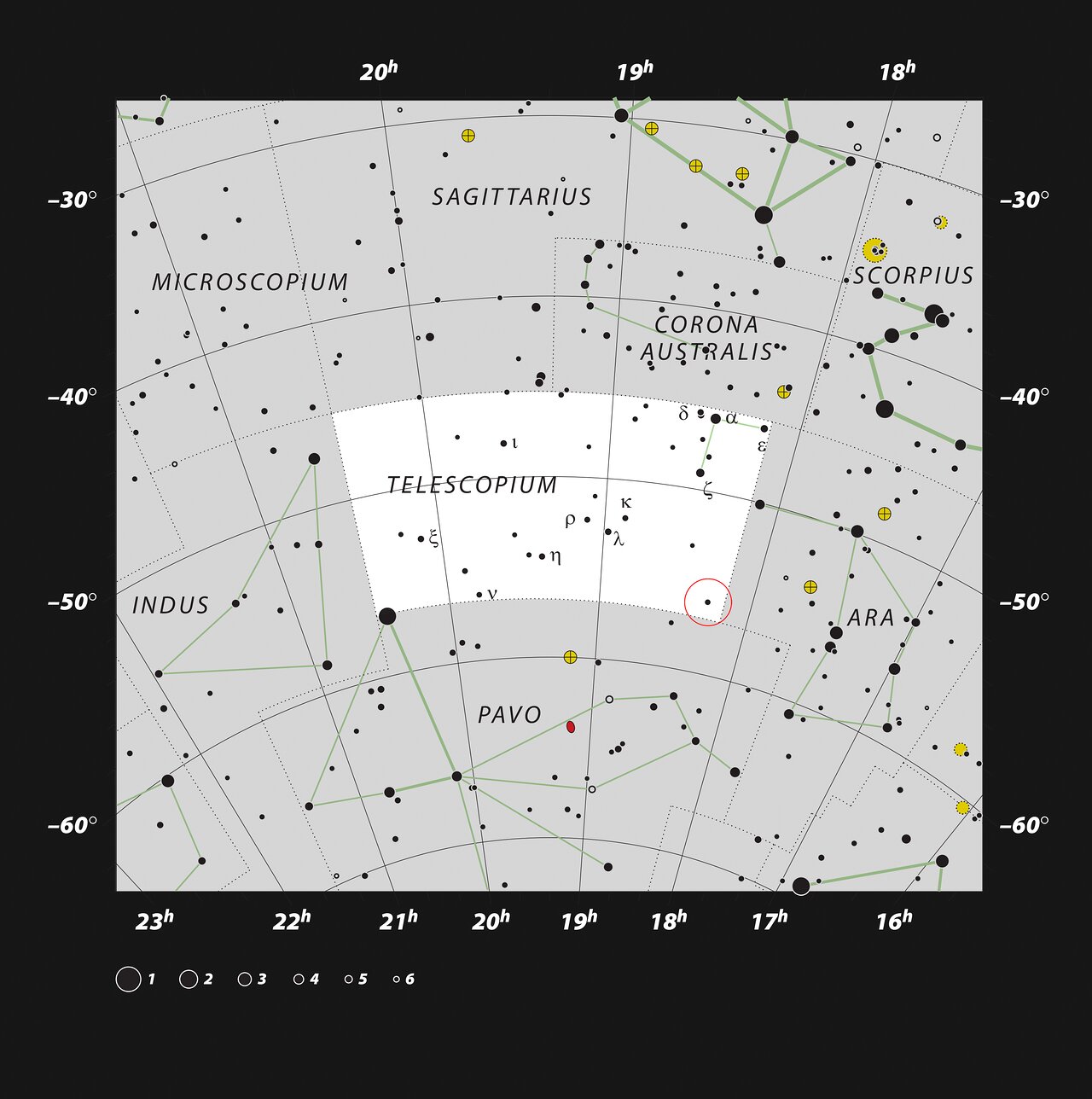
This chart shows the location of the HR 6819 triple system, which includes the closest black hole to Earth, in the constellation of Telescopium. This map shows most of the stars visible to the unaided eye under good conditions and the system itself is marked with a red circle. While the black hole is invisible, the two stars in HR 6819 can be viewed from the southern hemisphere on a dark, clear night without binoculars or a telescope.
Right ascension 18h 17m 07.53179s
Declination −56° 01′ 24.0876″
_________________
The mere fact that science may not yet adequately explain an object, event, or experience does not mean the immediate explanation should automatically default to a conspiratorial, extraterrestrial, paranormal, or supernatural cause.
 08 May 2020, 8:00 am
in other words: yes Mountain Goat, you are right. What the OP said is not literally true. You cannot "see" the blackhole any more than you can see any other black hole, either with, or without a telescope. But you can, in theory, see the star system that this particular black hole resides in with the naked eye (but only if you live in the Southern Hemisphere, like in Australia, or in Argentina).
08 May 2020, 8:27 am
The big question here - "Is our Solar System moving towards or away from the Black Hole?"
The Black Hole has failed to gobble up even the stars in its own solar system. So I am sure that its no threat to us. If that's what you're worried about. The average distance between stars in this part of the galaxy is about five or six lightyears. So a black hole 200 light years away is about forty solar systems away from us. If stars were suburban houses it would be forty doors away. Like four blocks. So it aint gonna pounce on us out of the bushes any time soon.
 08 May 2020, 8:37 am
So living here I would not see the stars around it because it is on the upsidown side of the earth. (The other side to the side that I am on).
It is strange as we don't see the back side of the moon and we dont see the other side of the stars to the ones we see now, but at the same time, everything moves quite a lot. It is actually interesting the way things move.
_________________
Verifying you are human. This may take a few seconds...
08 May 2020, 9:43 am
The proper motion (in mas yr−1: −3.667 and −11.120 from Gaia and −4.10 and −13.30 from HIPPARCOS in α and δ, respectively) is much larger than the parallax and thus is less disturbed by any orbital pattern. At a distance of 310 pc, 1 mas yr−1 translates into 1.5 km s−1. When we average the Gaia and HIPPARCOS velocities as a simple estimate, the total lateral velocity is 12.8 km s−1, or 13.1 pc Myr−1, and the radial velocity of 9.4 km s−1 corresponds to 9.6 pc Myr−1. Without taking the 230 Myr solar orbit in the Galaxy into account, that is, when we assume that the corotating frame is inertial, the closest approach of HR 6819 to the Sun is estimated for 11 Myr ago, at a distance of about 260 pc. A more precise trajectory and origin can only be derived when the outer orbit is known and the astrometric parameters have been computed taking the multiplicity into account.
Source: A naked-eye triple system with a nonaccreting black hole in the inner binary
So the closest approach of this black hole was 11 million years ago when the system was 260 parsec (858 light years) from our solar system.
Ah! here is the problem, they are assuming the corotating frame is inertial.
_________________
Author of Practical Preparations for a Coronavirus Pandemic.
A very unique plan. As Dr. Paul Thompson wrote, "This is the very best paper on the virus I have ever seen."
08 May 2020, 10:14 am
It is strange as we don't see the back side of the moon and we dont see the other side of the stars to the ones we see now, but at the same time, everything moves quite a lot. It is actually interesting the way things move.
The hub of the galaxy is also in the southern hemisphere. That's why observatories in places like Chile are so important to astronomers. The southern hemisphere is where most of the stars are. Ergo were most of the putative black holes, and explanets, and all of the other funky interesting objects astronomers are trying to find are likely to be found. When you're looking at the night sky in the southern hemisphere you're looking downtown. Looking up while here in the northern hemisphere you're just seeing the suburbs and the outskirts of the galaxy.
Most planets rotate. So we do see both sides of most of the planets in our solar system.
But yes...the moon revolves around the earth in such a way that its locked with its slow rotation on its axis. So it shows the same face to the earth all of the time as it goes around the earth. And the same other side is always hidden from us (but not from probes they have sent to the far side of the moon to take pics). Mercury has the same deal with the sun. Over time we can see both sides of Mercury from Earth . But only one side of mercury faces the sun as Mercury goes around the Sun.
And yes celestial motions are amazingly complex. The earth rotates on its axis once every 24 hours while at the same time revolving around the sun once a year, while at the same time the sun itself moves around the galaxy, and the galaxy itself is moving, and the local group of galaxies is moving, and the whole local group is just another piece of shrapnel from the Big Bang flying out ward from the explosion. Maybe someday we will hit God right in the eye!
 04 Jun 2020, 11:26 am
The big question here - "Is our Solar System moving towards or away from the Black Hole?"
The Black Hole has failed to gobble up even the stars in its own solar system. So I am sure that its no threat to us. If that's what you're worried about. The average distance between stars in this part of the galaxy is about five or six lightyears. So a black hole 200 light years away is about forty solar systems away from us. If stars were suburban houses it would be forty doors away. Like four blocks. So it aint gonna pounce on us out of the bushes any time soon.
From New Scientist:
'"Earth is not in any danger," says [Marianne] Heida. "Given that there are two stars that are much closer than we are, and they are not falling in, we won't fall in.'"
So it's official.
 They also say that it's "at least four times as massive as the sun." No upper limit given, but it's a number we can use. And I just stumbled across a Schwarzchild radius calculator! https://www.omnicalculator.com/physics/ ... ild-radius
The Schwarzchild Radius gives the distance from the centre within which nothing can escape a black hole's gravity. (Also known as the event horizon, though I suspect there's some technical difference between those terms.)
For a black hole 4X the mass of the Sun, the Schwarzchild radius works out to 295.4km. I think we're going to be OK.
_________________
You're so vain
I bet you think this sig is about you


