
I'm new, I'm curious and I already love WP :D



 09 Mar 2012, 6:08 am

Hi Fetika!
First off my apologies for the long response time. Basically my depression kicked in and sett me off for some time, but I'm starting to come back to the world again 
Secondly thank you for your reply with many interesting comments.
Philosophia as the love to wisdom also holds true in my view, but when I mentioned it, I was thinking of the academic discipline which lets you study different philosophers from the ancient Greeks up to modern writer as f.x. Bonjour who writes about epistemology (his literature was in my course on epistemology). However - for me the two are still linked because I study philosophy as an academic discipline in order to find the truth about the world (broadly spoken).
I do not find investigations about the meaning of meaning - meaningless (haha) or should I say pointless - the problem only comes when people get lost in this investigation and forget their initial goal. An example from my life right now:
I am writing about the definitions of life in my bachelor paper at the moment. It is fruitful for me to look at how one can make a definition in order to properly evaluate the different ones (and there are MANY) in the literature today. Definitions can f.x. focus on essence of a concept or they can be operational. I have gained insight already my being able to make this distinction. However - this is not the real goal for me. My goal is to understand what is means for something to be alive, and how we might distinguish, and if the concept of life is dichotomous or must be viewed as a continuum.
When I read the next paragraph of your post it seems we rather agree that it is an unworthy for philosophy/ the philosophical pursuit to be lost in the details of 'paving the way' (as one could call it), for the real philosophical issue at stake.
Your write:
I have always loved that phrase - so I am totally with you there.
You also mention eristic philosophy and this is interesting because of course you are totally right that there is no real search of wisdom in that (except for a few honest ones perhaps, who actually used it as a means to find truth through conversation in the form of advocacy of different viewpoints - a method still used in education today(!). Also Protagoras is an example of this in his ‘On the State of Things in the Beginning’ when pointing out a contradiction made by Simonides, with the point that it is important to justify one's criticisms - you can read about this in the Stanford Encyclopedia of Philiosophy article by the name of 'The Sophists').
So although twisting of language and arguments can be misused (and are only too much in today's politics for instance), the ones who practice this, make a very interesting point clear - the fact that it is only too easy to advocate for a certain standpoint, and make people believe this is in fact the truth, IF you have the proper skills of persuasion and argument. AND - these can be learned! Types of argumentation still plays a role in, for instance, the course I took in logic, although courses in rhetoric will be even more focused on this.
The bottom line is;
yes - it would all be much nicer if we didn't have to watch out for the twisting of arguments in our philosophical search for truth, but since it is very much a part of the real life stumbling blocks, it is still an important thing to be knowledgeable about.
You also write:
I agree.
I have been very influenced by buddhist philosophy, and I even have studied the ancient language sanskrit (also because languages fascinate me) - where we have read original indian texts about various topics.
You also mention the German philosophers in the hermeneutic tradition - well yeah I never really was too into that either. But that was because it seemed to full of feelings and intuitive free thinking. I did not see them get grounded in reality.
About the philosophy of science and the understanding of quantum physics I take philosophy of science to be a rather broad term, occupied with understanding the philosophical implications of different theories, hereunder also how to interpret quantum physics. I was probably unclear when stating I "especially wanted to try to understand quantum physics". It is like this:
I am taking a course in quantum mechanics from the physics department. We are learning about the Schrödinger wave equation, the time dependent and time-independent form of it, wells with potentials, and how to calculate different energy levels. All very calculation-oriented.
In another course I took about 2 years ago we learned about the different interpretations of quantum physics. I am sure you are familiar with Bohr (correspondence and complementarity principles), Born (statistical interpretation of the wave function), Einstein (who was disappointed about the observer dependence in the quantum theory, and who spent the rest of his life searching for the missing bricks to complete the theory) and Heisenberg (with his uncertainty realtion) just to mention a few of the scientist trying to make "real" sense out of the Quantum Physics which is so difficult to reconciliate with our classical conception of the world around us.
This last course is my real interest of the quantum physics, but I had the idea that I needed to know about the actual calculations made in quantum physics, in order to improve my understanding and ability to evaluate the different arguments in the debate.
Feynman has a good point, but that should not keep us from trying to understand
I'll stop now. Looking forward to reading your reply

-Sif
TenPencePiece
Veteran


Joined: 11 Dec 2009
Age: 31
Gender: Male
Posts: 46,009
Location: Greater Manchester, United Kingdom

 09 Mar 2012, 8:35 am
Thank you TenPencePiece and ZX_SpectrumDisorder 
Recommendations for someone who has never studied philosophy:
For a rather unusual introduction via a story about a girl called Sophie, read Jostein Gaarder's "Sophie's World" - it takes you through the history of philosophy together with the main character and her mysterious journey introducing her to many different philosophical problems and thinkers. Now I read it many years ago, and it is a fictional story, but with real philosophy in it. In case that is too light for you or you prefer a more academic approach, I have other suggestions:
Wanting a quick introduction you might want to go for the "very short introduction"-series' book on "Philosophy". It was written by Edward Craig, a former Professor of Philosophy at the University of Cambridge. It gives a quick insight in - and introduction to philosophy. Short and quickly read. Also the series of the short introduction is extremely extensive and good if you (like me) have the need to know something about everything
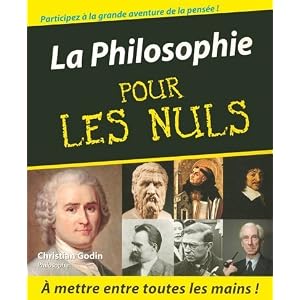
I know that generally the "for dummies"-books are supposed to be really good, so that is another option, but I have not read that one, so I cannot say anything about it specifically.
If you want to start dealing with philosophical problems right away (which is the more engaged way to get into this, and it really gets your brain/mind/thinking going!) you could go for "Can a robot be human? - 33 perplexing philosophy puzzles" by Peter Cave. There is even a few sequels (if you just can't get enough once started) called "What's wrong with eating people?" and "Do llamas fall in love?".
And lastly - if you want the historical introduction Frederick Copleston's History of Philosophy books are nice. I would suggest starting with Greece and Rome (vol. 1) unless you want to go directly to the Rationalists (vol. 4) (think Descartes - cogito ergo sum = I think therefore I am - all that) or even the Enlightenment period (vol. 6) which, including f.x. Kant is also quite inspiring philosophically.
I purposely did not suggest medieval philosophy since it can be very boringly centered around proving Gods existence - but this will naturally depend on your interests.
Extra idea: if you have a certain topic you love, try go to amazon and see what happens when you search for "Philosophy of [the topic you love]" - you could be positively surprised!
ENJOY!

 09 Mar 2012, 11:42 pm
Hi Sif
Just out of curiosity, where did you take your pseudo from? Mine, "fetika", means “A star shining high in the night sky” in reko paomutu, the language of the Tuamotu islands in Polynesia (a star low over the horizon would be called an “eeva”). Hence my avatar...
I notice that many had the time to answer you before me ; I think it will often be the case for at least two reasons : 1° the time zones : I write from Canada ; and 2° except in some occasions, I am slow in writing anything, trying to make sure it is non ambiguous (especially since I am not too fluent in English), proof-reading twice before posting...
Concerning studying the meaning of "meaning", I do not see it as useless neither. But I do not see it as philosophy. Well… I see it as an ancillary activity to philosophy. Allow me a comparison. Is someone who works in aviation an aviator? Are mechanics who maintain aircraft engines aviators? Are metallurgists who develop new alloys for turbines and wings aviators? Are the administrators and salesmen of Boeing and Airbus aviators? I would doubt… Similarly, are those who study the meaning of words philosophers or linguists and semiologists? Are those who study the possible extensions of "meaning" in interdisciplinary exchanges philosophers or hermeneutists? By stating that this is not "philosophy", I do not imply that these people are useless nor that what they do is worthless ; I would just rather call things by their names. It would help prevent confusion …and an awful lot of snobbism and bragging in the name of wisdom.
Is something that moves alive and something that doesn't not living? A pine tree does not move and an asteroid moves damn fast! OK : let us then admit that something that transforms itself is alive, right?. Then the Sun is. OK : then let's say “That transforms in adaptation to its environment for the survival of the fittest”. Then galaxies are… This type of thinking appeared to me as pure fantasy when I was a young science student until I looked into times scales and entropy. For us, a week is not a long period of time, but for a young child or for a mayfly it is. And for a bristlecone pine, it is less than what a minute is for us. Now let us suppose that we do not count the time in weeks, nor even years..,
Let us imagine that "someone" (God or however) recorded a movie taking one picture every 100,000 years since the Big Bang, the last picture so far being taken this year (what a coincidence!), and that we look at it at the usual speed of 24 frames per second. That movie would last approximately one hour and a half. From what I know, anthropoids of any form would appear only on the last 4 or 5 frames, that is the last 1/5th of a second. The earliest primates (lemurs) would appear about 16 seconds ago. The first mammals would appear about 27 seconds ago which is around the time of the last dinosaurs. The earliest dinos would appear approx. 2 minutes ago. Now what about the remaining hour and a half? Our Sun would light up about 35 minutes ago with the Earth forming as a solid planet about 21 minutes ago and early life (as biologists know it : cluttering organic compounds) appearing about 20 minutes ago, plus or minus 10 seconds. Then what about the first hour? What happened then?
To look at that we must zoom out, and I mean very seriously : so far we zoomed in on a tiny planet (Earth) in the planetary system of an ordinary star (Sun), with our view being so narrow that we did not even see the nearby stars. That is not an efficient way to look at the Universe! So let's sit back and enjoy the show from the beginning instead of backwards. At the very beginning we see …no, we don't see the Big Bang : it is much much too short! For the first fraction of a second we see an extraordinarily bright dot that is rapidly expanding. It looks like a ball of fire so bright that it burns our eyes even though this is just a movie. But it doesn't last : after just 1/8th of a second (a very short flash : 300,000 years) it has calmed down and is becoming transparent, so we can see in it. Then we stand in awe as forms appear, group, gather in gigantic spirals (quasar galaxies) and the spirals gather in groups (clusters) and the groups move away from each other as the now transparent blob that was a ball of fire just a minute ago expands, developing long viscous filaments between the clusters. The spirals seem to be immersed in some kind of a viscous milieu as their center rotates on itself in a few seconds while the rims may take up to two minutes to complete a revolution in the big ones, thus developing the spiral structure we see. Idem for the filaments : they twist, they thin, they stretch as the galaxies run away from each other. But they don't break since, apparently out of nowhere, new matter seems to form from the viscous milieu from very thin gazes into bright nebulae, as if it was condensing, and it not only fills the stretching filaments but also creates new spirals where the filaments meet. The whole thing grows more and more complex and interactive. As this incredible show goes on, we cannot help but witness the emergence, in our minds, of an analogy to the development of some kind of a living being, or the development of an eucaryot (a living cell). In any way we look at it, whether we are happy to see it or we feel guilty of falling into some sort of mysticism, the analogy is striking!
OK OK OK : let's calm down now, let us not use analogies to fall into pseudoscience. We know that this is an illusion due to the acceleration of time lapse and that this Universe is governed by entropy ; so the more we wait the more we will see it become disorganized, the more it will be disorderly and it will gradually reach temperature equilibrium where everything will come to a standstill. Or will it? Or, rather, DOES it? Strangely, the longer we look at the movie, the more the temperatures differentiate and the
intergalactic milieu becomes colder and colder instead of moving towards equilibrium with the starts and galaxies. As minutes go by in the movie (or hundreds of thousands of years in the Universe if you prefer), it is more and more transparent which is the opposite of what would happen if it was getting more and more disorderly. OK : we can explain that away : the expansion causes it to be colder and colder and thus more and more transparent, but we know that the viscous milieu (called "gravitation") will slow it down, stop it, then reverse it. Then entropy will reveal the real truth about that illusion. And, as we keep on watching in awe, we notice that expansion does not slow down : it accelerates! No matter how we look at it, things go the opposite of what entropy predicts. One last thing : negentropy is a property exclusive to living systems.
I know, Sif, this too long simulation may not be what you had in mind when you mentioned "the definition of life". But I couldn't refrain from sharing that vision that has completely changed how I see the world.

| Similar Topics | |
|---|---|
| What´s your opinion on Love On The Specttrum? |
31 Dec 1969, 7:00 pm Guest
|
| What´s your opinion on Love On The Specttrum? |
31 Dec 1969, 7:00 pm Guest
|
| What´s your opinion on Love On The Specttrum? |
04 Jul 2026, 9:34 am |


