Orwell wrote:
aleclair wrote:
Just keeping things on topic, do you think more of us would like math if the whole logic-and-proofs thing were emphasized from the start? Something like is described in
Lockhart's Lament (this is a long read, beware!) - more of an emphasis on discovering mathematical conjectures - because, after all, what proportion of us will be using logarithms in the real world? Of course, a good mental gold on fractions, decimals, and algebra is essential - but after that, wouldn't it be better to teach logical thinking as opposed to formula memorization?
I've already read Lockhart's Lament- it's an interesting commentary.
If the logical thought and theorem-proving were emphasized earlier on, then yes, more people would like math. Also importantly, we would all be much better at math. If you've ever sat through a rigorous class and proved theorems, and then gone back and looked at the material that simply required you to apply those concepts, it's astonishing how trivially easy it seems.
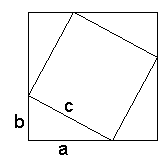
Depend on how are made the proofs... I was sucking in the way it was made. When the teacher had give us a optional homework on proving the pythagorean theorem (with the figure bellow), I was able to do it with algebra though.
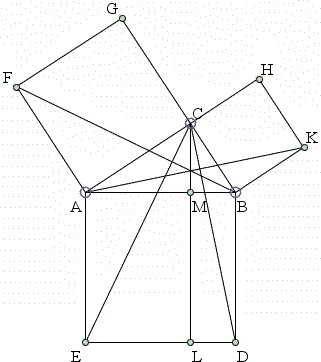
But if you come up with proof LIKE THAT, then I really suck... (The school didn't give anything so complicated, of course, but you get the idea...)
1. Let ACB be a right-angled triangle with right angle CAB.
2. On each of the sides BC, AB, and CA, squares are drawn, CBDE, BAGF, and ACIH, in that order.
3. From A, draw a line parallel to BD and CE. It will perpendicularly intersect BC and DE at K and L, respectively.
4. Join CF and AD, to form the triangles BCF and BDA.
5. Angles CAB and BAG are both right angles; therefore C, A, and G are collinear. Similarly for B, A, and H.
6. Angles CBD and FBA are both right angles; therefore angle ABD equals angle FBC, since both are the sum of a right angle and angle ABC.
7. Since AB and BD are equal to FB and BC, respectively, triangle ABD must be congruent to triangle FBC.
8. Since A is collinear with K and L, rectangle BDLK must be twice in area to triangle ABD.
9. Since C is collinear with A and G, square BAGF must be twice in area to triangle FBC.
10. Therefore rectangle BDLK must have the same area as square BAGF = AB2.
11. Similarly, it can be shown that rectangle CKLE must have the same area as square ACIH = AC2.
12. Adding these two results, AB2 + AC2 = BD × BK + KL × KC
13. Since BD = KL, BD* BK + KL × KC = BD(BK + KC) = BD × BC
14. Therefore AB2 + AC2 = BC2, since CBDE is a square.
This proof appears in Euclid's Elements as that of Proposition 1.47.
_________________
Down with speculators!! !













 I don't get why peoples strugle with pythagore, it's so simple. I do had trouble though for the part where you have to write a long serie of boring sentences such as why ABC angle is equal to the CDE angle, I just unable to write the proof in the way I'm supposed to.