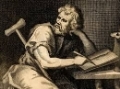
Socrates and Thrasymachus: Symbols of Autism and Psychopathy

Page 1 of 2 [ 19 posts ]  Go to page 1, 2  Next

deafghost52
Deinonychus
Deinonychus

User avatar

Joined: 16 Jul 2014
Gender: Male
Posts: 329
Location: Colorado, United States

21 Nov 2015, 9:35 pm

As many of you know, Socrates was a 5th century BCE philosopher from Athens who's widely considered the founder of objective moral philosophy in Western thought and whose life very closely paralleled that of Jesus' life (my Philosophy professor would joke that "Jesus died for your sins, and Socrates for ours - except we don't go around wearing hemlock around our necks.") Thrasymachus, one of his great debaters, was a moral relativist and a post-sophist, and is famous for the "Ring of Gyges" story, found in Plato's The Republic in a chapter recalling this debate on morality between the two men. I was familiar with the "Ring of Gyges" story as early as age 14, but lacked the context of the debate between these two individuals and their perspectives on morality. My Philosophy class from this past summer helped with that, and, at the same time, spawned an idea in my head - what if Socrates and Thrasymachus represented the quintessential autist and the quintessential psychopath? Let us begin with Thrasymachus.

Thrasymachus advocated being unjust, but only if one is clever enough to appear just through tactful and manipulative behavior. This is my first clue that he is the "quintessential psychopath," for psychopaths have a reputation for appearing to be good, honest individuals, but in reality they are not. Thrasymachus also stated, through the "Ring of Gyges" story, that one is only just because one is fearful of the consequences of one's actions; to remove those consequences (as with a ring of invisibility) is to remove the need for one to be just. Thrasymachus was unjust because he didn't care about the consequences of his actions, a trait similarly found in psychopaths; all that he cared about was appearing just, so as to deceive and gain trust from others - to be "invisible" to them.

Socrates, on the other hand, believed it moral to be just, even at the expense of appearing unjust at times. In a society such as Ancient Athens in which ignorance, injustice and general depravity were hardly in short supply, unjust individuals like Meletus and Anytus, and indeed the judge and jury at Socrates' trial, would have regarded a just man like Socrates to be unjust, precisely because of their own injustice. I contend that Socrates was the "quintessential autist" for three reasons:
1. He was incredibly naive, as evidenced by:
i. His failure to use court-appropriate language at his trial,
ii.His suggestion for punishment that he should receive a minimal fine and free food at the Prytaneum, and
iii.His incessant questioning of the citizens of Athens in order to get a better understanding of "the good life," at the expense of their patience (which was part of the reason he was tried and sentenced to death).
2. His obsessive curiosity over what makes "the good life," which dominated his life (he never really held any jobs as a result of this pursuit), and
3. His understanding of his own fallibility, giving him a sense of humility that I believe can be associated with many among us who are autistic.

Something I find strikingly symbolic of all of this in today's society are autistic people being bullied by psychopaths, whether it's in a school, or at the corporate level in "the real world"; and society seems to constantly condemn the autists and praise the psychopaths.

What do you guys think of this hypothesis? Does it hold any weight? Do you guys have anything to add to it (or take from it)? Let me know! :)


_________________
"Works of art make rules; rules do not make works of art."

-- Claude Debussy


LoveNotHate
Veteran
Veteran

User avatar

Joined: 12 Oct 2013
Gender: Female
Posts: 6,195
Location: USA

21 Nov 2015, 10:18 pm

deafghost52 wrote:
. I contend that Socrates was the "quintessential autist" for three reasons:

In college, my history professor described him as a someone who would like to go into town, draw out arguments, and point out other people's inconsistent logic.

This is where we get the "Socratic method" style of argument.
https://en.wikipedia.org/wiki/Socratic_method

It would seem like his nature of pursuing a "consistent logic" might be evidence also.

However, I don't see why you believe he had psychopathic traits.


deafghost52
Deinonychus
Deinonychus

User avatar

Joined: 16 Jul 2014
Gender: Male
Posts: 329
Location: Colorado, United States

21 Nov 2015, 10:30 pm

LoveNotHate wrote:
However, I don't see why you believe he had psychopathic traits.

No, no. I said Thrasymachus may have been symbolic of the "quintessential psychopath," not Socrates.


_________________
"Works of art make rules; rules do not make works of art."

-- Claude Debussy


GoonSquad
Veteran
Veteran

User avatar

Joined: 11 May 2007
Age: 56
Gender: Male
Posts: 5,748
Location: International House of Paincakes...

22 Nov 2015, 1:12 pm

Your take on Socrates is interesting but, I don't think it's quite right.

I don't think he was naive in taking on his role as social gadfly. Also, his method DEPENDS on excellent theory of mind. He needs to put himself in his target's shoes in order to see their flawed thinking and guide them toward the truth.

Autistics, generally have very poor theory of mind.


_________________
No man is free who is not master of himself.~Epictetus


deafghost52
Deinonychus
Deinonychus

User avatar

Joined: 16 Jul 2014
Gender: Male
Posts: 329
Location: Colorado, United States

22 Nov 2015, 6:30 pm

GoonSquad wrote:
Also, his method DEPENDS on excellent theory of mind. He needs to put himself in his target's shoes in order to see their flawed thinking and guide them toward the truth.

Autistics, generally have very poor theory of mind.

That is an excellent point, Goon. However, as I was taught in my class (which may or may not have been entirely accurate), he started by asking people what "the good life" was, and when they didn't give him a sufficient answer, he would ask better questions in the hope of getting better answers, which lead him to asking several different people, all of whom seemed not to have the answer he was looking for (even poets, craftsmen, and politicians all disappointed him). He didn't seem to understand their position (from a theory of mind perspective), he was just genuinely dissatisfied with their answers, and even - unintentionally - made fools out of them. And because of this, the citizens of Athens developed a deep animosity towards him, to which he seemed pretty oblivious up until his trial, at which point he told Meletus to simply take him aside and discuss his wrongdoings, for he "did not do wrong knowingly." Also, just the very fact that he continued to speak as he had always spoken - with integrity, honesty, and a thirst for understanding - in the courtroom, rather than just "playing the game" like most people, suggests to me that he is a symbol for autism*. His tenacity for doing the right thing by virtue of reason and good judgement points towards autistic traits, because most - if not all - of us commit wrongdoings unintentionally**, the exact antithesis of a psychopath who knows what they are doing is wrong, but genuinely does not care - someone like Thrasymachus.

*to reiterate, I don't necessarily believe that Socrates and Thrasymachus were autistic and psychopathic in an actual sense, but rather in a symbolic sense - they symbolize the dichotomy between the two modes of thinking.
**it has occurred to me that when we do commit wrong actions intentionally and knowingly, our faculties of judgement and reason are clouded by emotion. Otherwise, we'd hate more than anything for evil to be reciprocated upon us, so we try to do our best to be good people in the hopes of getting good back to us.


_________________
"Works of art make rules; rules do not make works of art."

-- Claude Debussy


LoveNotHate
Veteran
Veteran

User avatar

Joined: 12 Oct 2013
Gender: Female
Posts: 6,195
Location: USA

23 Nov 2015, 3:55 pm

I think there is something to be said about Socrates pursuit of "logical consistency", and some ASDs.

There is a sub-group of ASD that focus on patterns, order, logic, and are super-keen to see errors in logical consistency.

Perhaps, they thrive on it, because it's an exercise in their talent.

So, in that respect, I can see Socrates belonging to that ASD sub-group.


deafghost52
Deinonychus
Deinonychus

User avatar

Joined: 16 Jul 2014
Gender: Male
Posts: 329
Location: Colorado, United States

23 Nov 2015, 9:32 pm

Also, Goon, from what I understand, he wasn't necessarily trying to guide others towards the truth, but rather himself. In asking others what "the good life" was and what it meant to be just and virtuous, he sought to better his own understanding of these concepts. It was part of his very nature to do so.


_________________
"Works of art make rules; rules do not make works of art."

-- Claude Debussy


deafghost52
Deinonychus
Deinonychus

User avatar

Joined: 16 Jul 2014
Gender: Male
Posts: 329
Location: Colorado, United States

23 Nov 2015, 9:42 pm

I also find it quite interesting to note that he may have taken what Thrasymachus said about "justice being in the interest of the stronger" somewhat literally:

Quote:
"Listen, then, he said; I proclaim that justice is nothing else than the interest of the stronger. And now why do you not me? But of course you won't.

Let me first understand you, I replied. justice, as you say, is the interest of the stronger. What, Thrasymachus, is the meaning of this? You cannot mean to say that because Polydamas, the pancratiast, is stronger than we are, and finds the eating of beef conducive to his bodily strength, that to eat beef is therefore equally for our good who are weaker than he is, and right and just for us?

That's abominable of you, Socrates; you take the words in the sense which is most damaging to the argument.

Not at all, my good sir, I said; I am trying to understand them; and I wish that you would be a little clearer." The Republic, 16


_________________
"Works of art make rules; rules do not make works of art."

-- Claude Debussy


kraftiekortie
Veteran
Veteran

Joined: 4 Feb 2014
Gender: Male
Posts: 87,510
Location: Queens, NYC

24 Nov 2015, 8:34 am

I believe Socrates sought, through the encouragement of independent inquiry, to promote the acquisition of knowledge, and to encourage students to see the "error of their ways."

Quite possibly, he sought, through his methodology, to educate himself fulsomely as well.

I don't see Socrates as being a "symbol of autism." He might be called an "odd NT" these days.


GoonSquad
Veteran
Veteran

User avatar

Joined: 11 May 2007
Age: 56
Gender: Male
Posts: 5,748
Location: International House of Paincakes...

24 Nov 2015, 9:19 am

deafghost52 wrote:
Also, Goon, from what I understand, he wasn't necessarily trying to guide others towards the truth, but rather himself. In asking others what "the good life" was and what it meant to be just and virtuous, he sought to better his own understanding of these concepts. It was part of his very nature to do so.

Sure, Socrates was trying to educate himself.

Socratic paradox: All I know is that I cannot know anything with absolute certainty.

Because of this, he is constantly trying to test his perceptions and ideas. However, he is also trying to demonstrate this truth/paradox to others who seem to be so certain that they have everything figured out.

Further, in the Apology Socrates compares the politicians of Athens to a slow and dimwitted horse and casts himself in the role of gadfly--trying to sting the horse, and wake it up.

This suggests that he is trying to educate others as well.

PS

It has been a LONG time since I read the Apology, but that's what I remember.


_________________
No man is free who is not master of himself.~Epictetus


deafghost52
Deinonychus
Deinonychus

User avatar

Joined: 16 Jul 2014
Gender: Male
Posts: 329
Location: Colorado, United States

24 Nov 2015, 2:52 pm

kraftiekortie wrote:
I don't see Socrates as being a "symbol of autism." He might be called an "odd NT" these days.

True, but might not a lot of Asperger's/HFA people be considered "odd NTs"? My therapist thinks I just have a Cluster A personality, someone with his own quirks and odd mannerisms, yet I can say with certainty now that I am, to a small degree at least, autistic. It just seems like Socrates' mode of thinking closely matches that of the autistic experience, even if he wasn't necessarily autistic in an actual sense. Same goes for Thrasymachus and psychopathy.


_________________
"Works of art make rules; rules do not make works of art."

-- Claude Debussy


deafghost52
Deinonychus
Deinonychus

User avatar

Joined: 16 Jul 2014
Gender: Male
Posts: 329
Location: Colorado, United States

24 Nov 2015, 2:54 pm

Also, I'd like to rectify an error I made in my original post - it was Glaucon who recounted the story of Gyges, not Thrasymachus.


_________________
"Works of art make rules; rules do not make works of art."

-- Claude Debussy


Kuraudo777
Veteran
Veteran

User avatar

Joined: 20 Sep 2015
Posts: 14,743
Location: Seventh Heaven

25 Nov 2015, 12:22 pm

That's an interesting idea. Socrates is my favourite Greek philosopher.


_________________
Quote:
A memory is something that has to be consciously recalled, right? That's why sometimes it can be mistaken and a different thing. But it's different from a memory locked deep within your heart. Words aren't the only way to tell someone how you feel.” Tifa Lockheart, Final Fantasy VII


deafghost52
Deinonychus
Deinonychus

User avatar

Joined: 16 Jul 2014
Gender: Male
Posts: 329
Location: Colorado, United States

25 Nov 2015, 4:43 pm

Kuraudo777 wrote:
That's an interesting idea. Socrates is my favourite Greek philosopher.

That's awesome! :D He's one of my favorites too, although I enjoy Aristotle and Epictetus a little bit more. I also really enjoy Plato's "World of Forms" hypothesis.


_________________
"Works of art make rules; rules do not make works of art."

-- Claude Debussy


Kuraudo777
Veteran
Veteran

User avatar

Joined: 20 Sep 2015
Posts: 14,743
Location: Seventh Heaven

25 Nov 2015, 4:55 pm

^Did you know that the Allegory of The Cave was originally from Socrates? Plato just copied it and made it his own. The sneak! :o


_________________
Quote:
A memory is something that has to be consciously recalled, right? That's why sometimes it can be mistaken and a different thing. But it's different from a memory locked deep within your heart. Words aren't the only way to tell someone how you feel.” Tifa Lockheart, Final Fantasy VII


deafghost52
Deinonychus
Deinonychus

User avatar

Joined: 16 Jul 2014
Gender: Male
Posts: 329
Location: Colorado, United States

25 Nov 2015, 10:59 pm

Kuraudo777 wrote:
^Did you know that the Allegory of The Cave was originally from Socrates? Plato just copied it and made it his own. The sneak! :o

Really? :? I could have sworn that Socrates was more famous for the "Harmony of the Parts," and Plato the "Allegory of the Cave" or "World of Forms." Although, you are right that much of what Socrates spoke was written by Plato (including Socrates' search for the meaning and understanding of "justice," which he never concluded - Plato was the one who did that).


_________________
"Works of art make rules; rules do not make works of art."

-- Claude Debussy