Page 1 of 2 [ 24 posts ]  Go to page 1, 2  Next

Ragtime
Veteran
Veteran

User avatar

Joined: 2 Nov 2006
Age: 47
Gender: Male
Posts: 7,927
Location: Dallas, Texas

28 Jan 2009, 3:28 pm

This question immediately poses another: What does it mean for a system to "make sense"?

People are fairly split on the first question, which can also be phrased: "Does reality have a pattern, or is it all just random chaos?"

I'm not looking for a yes or a no, but rather a supposition of a valid way in which we could go about finding the answer.

The world could in reality be sensical, while continuing to not "make sense" in the normal way. (Make sense to our finite minds.) The first part is what I'm mostly asking: Is there a pattern to reality, whether or not we can see that pattern? Can we at least know whether or not there is a pattern, even if we can't discover what the pattern might be?

I would like a yes or a no to that last question.


_________________
Christianity is different than Judaism only in people's minds -- not in the Bible.


MR_BOGAN
Veteran
Veteran

User avatar

Joined: 5 Mar 2008
Age: 126
Gender: Male
Posts: 2,479
Location: The great trailer park in the sky!

28 Jan 2009, 3:44 pm

It's evolution baby. :wink:

[youtube]http://www.youtube.com/watch?v=FS69fuCOhTM[/youtube]

Start studying that and you begin to understand.


ruveyn
Veteran
Veteran

User avatar

Joined: 21 Sep 2008
Age: 89
Gender: Male
Posts: 31,502
Location: New Jersey

28 Jan 2009, 3:44 pm

Ragtime wrote:

The world could in reality be sensical, while continuing to not "make sense" in the normal way. (Make sense to our finite minds.) The first part is what I'm mostly asking: Is there a pattern to reality, whether or not we can see that pattern? Can we at least know whether or not there is a pattern, even if we can't discover what the pattern might be?

I would like a yes or a no to that last question.


Nature provides the dots and we connect them. You can say order is a feature of nature since our evolutionary course, driven by natural processes has provided us the the kind of consciousness which finds order in what is perceived. It is hard to say whether the order in nature is there if there are no sentient beings to see order.

ruveyn


Awesomelyglorious
Veteran
Veteran

User avatar

Joined: 17 Dec 2005
Gender: Male
Posts: 13,157
Location: Omnipresent

28 Jan 2009, 3:55 pm

I don't know if reality is random chaos or not. There is no method to determine the truth of the matter.

No system can make sense, the very concept of making sense does not make sense, as does the rejection of sense as nonsense.


Ragtime
Veteran
Veteran

User avatar

Joined: 2 Nov 2006
Age: 47
Gender: Male
Posts: 7,927
Location: Dallas, Texas

28 Jan 2009, 4:18 pm

ruveyn wrote:
It is hard to say whether the order in nature is there if there are no sentient beings to see order.


Or, perhaps, sentient beings who must see order whether order is there or not, to prevent going insane.
That's another view. (I don't subscribe to it, though.)


_________________
Christianity is different than Judaism only in people's minds -- not in the Bible.


Last edited by Ragtime on 28 Jan 2009, 4:22 pm, edited 1 time in total.

Ragtime
Veteran
Veteran

User avatar

Joined: 2 Nov 2006
Age: 47
Gender: Male
Posts: 7,927
Location: Dallas, Texas

28 Jan 2009, 4:20 pm

Awesomelyglorious wrote:
I don't know if reality is random chaos or not. There is no method to determine the truth of the matter.

No system can make sense, the very concept of making sense does not make sense, as does the rejection of sense as nonsense.


True. But in that case, the question arises, "Where did the concepts 'sense' and 'making sense' come from?"
"From us", one would answer. But how? And why do we value those concepts as much as a traveller in a strange land values a map?


_________________
Christianity is different than Judaism only in people's minds -- not in the Bible.


Awesomelyglorious
Veteran
Veteran

User avatar

Joined: 17 Dec 2005
Gender: Male
Posts: 13,157
Location: Omnipresent

28 Jan 2009, 4:25 pm

Ragtime wrote:
True. But in that case, the question arises, "Where did the concepts 'sense' and 'making sense' come from?"
"From us", one would answer. But how? And why do we value those concepts as much as a traveller in a strange land values a map?

Arguably because, the concept of "making sense" seems to have survival value, but when pushed, the entire system breaks down.


AspE
Veteran
Veteran

User avatar

Joined: 31 Dec 2007
Gender: Male
Posts: 4,114

28 Jan 2009, 4:27 pm

Parts of it make sense in relation to other parts. Overall... no, it makes no sense.


Dussel
Veteran
Veteran

User avatar

Joined: 19 Jan 2009
Age: 62
Gender: Male
Posts: 1,788
Location: London (UK)

28 Jan 2009, 4:32 pm

Awesomelyglorious wrote:
I don't know if reality is random chaos or not. There is no method to determine the truth of the matter.


It can be fully chaos, because otherwise we couldn't make prediction regarding the future, like when I open my hand the glass will be accelerated by gravity and the sudden negative acceleration caused by interaction of the electrons in of the atoms of the glas with of the stone will bring such high stresses that some atom-bonds will wreak.

If the world would be only chaos, such a prediction wouldn't be able.


Awesomelyglorious
Veteran
Veteran

User avatar

Joined: 17 Dec 2005
Gender: Male
Posts: 13,157
Location: Omnipresent

28 Jan 2009, 4:44 pm

Dussel wrote:
It can be fully chaos, because otherwise we couldn't make prediction regarding the future, like when I open my hand the glass will be accelerated by gravity and the sudden negative acceleration caused by interaction of the electrons in of the atoms of the glas with of the stone will bring such high stresses that some atom-bonds will wreak.

If the world would be only chaos, such a prediction wouldn't be able.

If the world were only chaos, then knowledge would be impossible, even the knowledge that the world were only chaos. Thus arguments from prediction fail because they presuppose knowledge.


Ragtime
Veteran
Veteran

User avatar

Joined: 2 Nov 2006
Age: 47
Gender: Male
Posts: 7,927
Location: Dallas, Texas

28 Jan 2009, 5:05 pm

AspE wrote:
Parts of it make sense in relation to other parts. Overall... no, it makes no sense.


That fits two characteristics of a local perspective. But whether or not it fully indicates a local perspective cannot be determined.


_________________
Christianity is different than Judaism only in people's minds -- not in the Bible.


Ragtime
Veteran
Veteran

User avatar

Joined: 2 Nov 2006
Age: 47
Gender: Male
Posts: 7,927
Location: Dallas, Texas

28 Jan 2009, 5:13 pm

Do I remember right, that the number pi was formally declared to have an infinite number of decimal places?
I heard that long ago, and always wondered how they knew that was true if 1. pi has not yet been solved and 2. the numbers after the decimal point do not repeat. I see a parallel between those aspects of pi, and reality.


_________________
Christianity is different than Judaism only in people's minds -- not in the Bible.


ruveyn
Veteran
Veteran

User avatar

Joined: 21 Sep 2008
Age: 89
Gender: Male
Posts: 31,502
Location: New Jersey

28 Jan 2009, 8:47 pm

Ragtime wrote:
Do I remember right, that the number pi was formally declared to have an infinite number of decimal places?
I heard that long ago, and always wondered how they knew that was true if 1. pi has not yet been solved and 2. the numbers after the decimal point do not repeat. I see a parallel between those aspects of pi, and reality.


The correct word is proved. See the following URL for a proof of the Lindeman-Wierstrass Theorem:

http://planetmath.org/encyclopedia/Proo ... ntal2.html

The theorem says that pi is transcendental which is to say that it is not the root of any polynomial equation. This immediately implies that pi is irrational and cannot have a finite decimal expansion. Pi can only be expressed as an infinite decimal expansion which is not repeating.

ruveyn


Ragtime
Veteran
Veteran

User avatar

Joined: 2 Nov 2006
Age: 47
Gender: Male
Posts: 7,927
Location: Dallas, Texas

28 Jan 2009, 8:52 pm

ruveyn wrote:
Ragtime wrote:
Do I remember right, that the number pi was formally declared to have an infinite number of decimal places?
I heard that long ago, and always wondered how they knew that was true if 1. pi has not yet been solved and 2. the numbers after the decimal point do not repeat. I see a parallel between those aspects of pi, and reality.


The correct word is proved. See the following URL for a proof of the Lindeman-Wierstrass Theorem:

http://planetmath.org/encyclopedia/Proo ... ntal2.html

The theorem says that pi is transcendental which is to say that it is not the root of any polynomial equation. This immediately implies that pi is irrational and cannot have a finite decimal expansion. Pi can only be expressed as an infinite decimal expansion which is not repeating.

ruveyn


Interesting.

Pi looks nosensical, and there is an endless amount of its nonsensical appearance, and yet pi describes the circle perfectly, and is thus quite sensical indeed.

So, pi would seem like complete nonsense if one saw only the irrational number and not its awesome purpose and function.

I think reality is like that.


_________________
Christianity is different than Judaism only in people's minds -- not in the Bible.


twoshots
Veteran
Veteran

User avatar

Joined: 26 Nov 2007
Age: 40
Gender: Male
Posts: 3,731
Location: Boötes void

28 Jan 2009, 9:06 pm

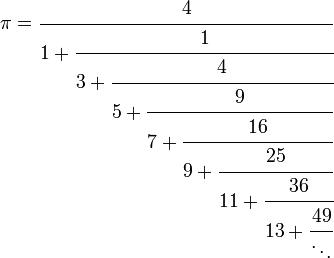
There are of course much simpler examples of irrational numbers than pi. The square root of 2 was the first irrational number discovered (although it is not transcendental, but it has the advantage of being quite elementary to be proven irrational), and thus has an infinite non repeating decimal expansion. In fact, "almost all" numbers are like this.

Whether or not pi is nonsensical is a matter of perspective. It looks quite orderly when written like this:
Image


_________________
* here for the nachos.


Ragtime
Veteran
Veteran

User avatar

Joined: 2 Nov 2006
Age: 47
Gender: Male
Posts: 7,927
Location: Dallas, Texas

28 Jan 2009, 9:14 pm

twoshots wrote:
There are of course much simpler examples of irrational numbers than pi. The square root of 2 was the first irrational number discovered (although it is not transcendental, but it has the advantage of being quite elementary to be proven irrational), and thus has an infinite non repeating decimal expansion. In fact, "almost all" numbers are like this.

Whether or not pi is nonsensical is a matter of perspective. It looks quite orderly when written like this:
Image


That's interesting. I always thought it must surely look more orderly when presented in other ways.

But I was just making an analogy... which I will now extend with your input:

Reality's being nonsensical is also a matter of perspective, and it can look quite beautiful when viewed certain creative ways.

So, we see that, whether or not pi is nonsensical, that doesn't really matter: It still has a definite purpose and function, which it performs perfectly!

Life may seem like a never-ending stream of random numbers to some people, but all the numbers make sense -- and make sense perfectly! :D

I love God.


_________________
Christianity is different than Judaism only in people's minds -- not in the Bible.