We have no free will, according to a scientist.
Then why are there so many bad and selfish people in the world if morality is completely objective?
Many ancient cultures were also cruel and cannibalistic so are you telling me that morality is completely objective? It can't be completely objective.
Traits aren’t passed on 100% of the time.
Ancient cultures tended to be very tribalistic and viewed people outside of their tribes as less than human. You still see that today, especially when it comes to religion or nationalism. The war between Israel and Palestine is largely tribalistic in my opinion. I don’t think morality is entirely objective. There are social factors as well.
_________________
“The darkness shall be the light, and the stillness the dancing.”
— from Four Quartets by T.S. Eliot
envirozentinel
Forum Moderator
Joined: 16 Sep 2012
Gender: Male
Posts: 17,226
Location: Keshron, Super-Zakhyria
Being Defined By Labels Others Give Us With
Expectations of Our Failure; And Suggesting
YOU Have NO Control Over YOUR Life is A Self-Fulfilling Prophecy
This.
We all have a range of choices to make every day. A woman in my coùntry was on drug rehab and living in a homeless shelter made a conscious decision one day to turn her life around and make her life a success and today has her own publishing firm. It can be done.
_________________
Why is a trailer behind a car but ahead of a movie?
my blog:
https://sentinel63.wordpress.com/
RetroGamer87
Veteran
Joined: 30 Jul 2013
Age: 38
Gender: Male
Posts: 11,185
Location: Adelaide, Australia
Writing A 12.2 MiLLioN Word Free Verse EPiC Longest Form Poem at Age 63.
I'm not sure that behavior addiction is a good example of free will.
_________________
The days are long, but the years are short
techstepgenr8tion
Veteran
Joined: 6 Feb 2005
Age: 46
Gender: Male
Posts: 24,685
Location: 28th Path of Tzaddi
techstepgenr8tion
Veteran
Joined: 6 Feb 2005
Age: 46
Gender: Male
Posts: 24,685
Location: 28th Path of Tzaddi
@ 58:40 - I'm actually glad Krauss is confirming that quantum mechanics is deterministic. I'd love to know why he's convinced of that to see if Brian Greene's claims of quantum randomness are shot down (and if they are - much stronger evidence that we are indeed in a Minkowski block universe).
_________________
The loneliest part of life: it's not just that no one is on your cloud, few can even see your cloud.
Speak for Yourself And DO NOT Go Arm-Chairing me;
i Don't Suffer from Any Kind of Disease of Addiction Now
Yet i Do Enjoy the Creative Process; Yes Particularly, in Meditative
Flow, Free Verse Poetically Responding to Human Beings Now Who
(Mostly Women of Course) Show Some Full Semblance
of Humanity Around the Globe. Other than Dance,
Free Verse Poetry is An Oldest Human Language;
A Best Part of it, It is Not 'Dead' Without Human Emotions;
Same With a Free Flowing Dance in Public for 18,988 Miles of
Meditative Dance As of Tonight, Helping Folks to Smile and Be
More Human All the Way Across my Metro Area; Other than that
i'm Financially Independent Which Means i Get to Do Whatever the
'Hell' i Wanna Do Everyday; i Choose Play; Keeps me Smiling, Ya Oughta Try it;
(Other Than Playing
Video Games)
Yet i Ain't
gonna
Tell you
What to Do;
Yet 'Heaven' is A Better
Place When Ya Creatively Generate
It Within As far Away As A Human
Being Could Possibly Get from Any Kind
Disease of Addiction; True, it's a Special (Got A few Others)
Interest Yet Considering the Territory, Big F(un) in Surprise.
Other than that Learn the Difference Between 'Literal Free Will' and 'Relative Free Will,' if You Can and Will;
Free Arts Are A Much Deeper Human Process than the .5 Percent Experiential Process that Comprises 'Mechanical
Cognition Alone;' It Just Flows Baby; 'Like A Wave Is the Ocean Water Whole' With Little Pre-Planning At All;
Relative
Free Will
Indeed; Yep,
"The Stuff
of 'Faith'
(Nothing to Do with
Dogmatic Religion)
Without Eyes or Ears..."
(Don't Expect You to
Understand any of This by 'the way')
Yet Again, Don't Put Yourself in
A Position You Are Not Qualified For;
At Least Not When You are Replying to me.
https://www.youtube.com/watch?v=4OFUiYMU9DM
_________________
KATiE MiA FredericK!iI
Gravatar is one of the coolest things ever!! !
http://en.gravatar.com/katiemiafrederick
Not currently, but if the courts ever flip to the "there is no free will" thing, the judge and jury would then be able to counter the defense with "neither do we, that's why we have no choice but to execute you."
Personally I'm not too uncomfortable with the idea that there's no such thing as free will. As far as I can tell, the positions, velocities, etc. of every particle in the universe depends on their prior positions, velocities, etc. This is governed by the known and unknown laws of the universe. Extend that idea backwards and forwards, and we see a universe that was always going to do what it's doing. Thus we are passive cogs in the machine, incapable of free will.
I suppose many folks would object on the grounds that it certainly feels as if many of our actions are the result of our conscious will, that we have choices. It feels like that to me too. But how it feels isn't very good evidence about how things are.
It may be depressing to some to take that on board, and I'm not sure that they'd be any happier for taking it on board. It would seem to take the last crumb of hope from those who already feel overwhelmed by life. For hard religionists whose view of the world is steeped in a conviction that we each have a divine soul whose free moral choices will be judged by some deity, it may lead to an existential crisis, and they would feel the need to close their minds against anything that threatened to do that to them. Yet curiously they're not so different to me.
But according to Zen, there are many who make too much of their supposed power to control their behavior and as a result, rather than feeling "Great, I can do anything," they work too hard at it and end up feeling "Oh s**t, I have to do everything." With great power there comes a great burden of responsibility. If they're lucky they may learn from Zen, or otherwise, that once they've given up all hope, they feel much better. They can then relax and stop trying too hard. Still, according to Zen, for anything a person may assert, the converse is also true.
Me, I pretty much accept that free will isn't real, but in my daily life I still work on the assumption that it is. Sometimes I have to remind myself that I'm here to enjoy the ride and not to pull the train. Whatever gets me through the night is good enough for me. Strangely, sincere hard religionists may not be so different to me except in the path they choose to the same goal. They learn to relax by complete submission to their deities, and it must be a lot easier than thinking for themselves.
I may well be talking rubbish, which suggests to me that I'd make a great philosopher.
Fascinating subject.

There's a lot of nuance to the question of free will when discussed in the neuroscience community. I think that this story may just be another case of the media being bad at science communication. A lot of it comes down to how you define "free will". If you're talking about the incompatibilist notion of free will as discussed philosophy (e.g. see here ), the most scientists will say no, we do not have free will because decisions made by the brain follow the same deterministic laws of physics as everything else in the universe. However, we may have the kind of "free will" as described by a school of thought known as compatibilism because that merely corresponds to the ability of the brain to respond to given information.
Can that be expressed clearly in plain English? I noticed the bit that says "Man can do what he wills but he cannot will what he wills," but doesn't that mean that will isn't ultimately free?
This is old news
Anyone heard of the Libert experiment?![]()
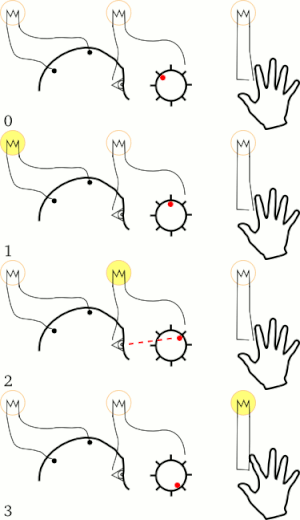
A pioneering experiment in this field was conducted by Benjamin Libet in the 1980s, in which he asked each subject to choose a random moment to flick their wrist while he measured the associated activity in their brain (in particular, the build-up of electrical signal called the Bereitschaftspotential (BP), which was discovered by Kornhuber & Deecke in 1958. Although it was well known that the "readiness potential" (German: Bereitschaftspotential) preceded the physical action, Libet asked how it corresponded to the felt intention to move. To determine when the subjects felt the intention to move, he asked them to watch the second hand of a clock and report its position when they felt that they had felt the conscious will to move
Libet found that the unconscious brain activity leading up to the conscious decision by the subject to flick their wrist began approximately half a second before the subject consciously felt that they had decided to move. Libet's findings suggest that decisions made by a subject are first being made on an unconscious level and only afterward being translated into a "conscious decision", and that the subject's belief that it occurred at the behest of their will was only due to their retrospective perspective on the event.
The simple principle is that there is no such thing as an executive function neuron that's kind of like "you".
Multiple nuerons act in synchronicity in unison. So in response to an external stimuli it makes sense
But in terms of coming up with an idea or making a decision innately, there has to be preliminary brain function leading to the decision. There is no "you" or "me" here or "I"
The brain is (according to the theory) an autonomous system
techstepgenr8tion
Veteran
Joined: 6 Feb 2005
Age: 46
Gender: Male
Posts: 24,685
Location: 28th Path of Tzaddi
My only problem with Libert, when you're asked to do something and set the tempo at random (internal queue) - you're thinking about when you want to do it, or you're at least serving that back out to your unconscious / feeling side to figure out what a good 'Now!' moment feels like. I would assume that the time between when the person flicked their wrist and the time before that where they started getting the internal confirmations that yes - now is the time to flick your wrist - either has full overlap or majority overlap with the half-second delay.
Something I've been saying for almost fifteen years now though about free will that I both have never seen anyone else but myself say and I've had no one refute it or find a hole in it either (mostly people just ignore it) - our being in time means that at any given moment we are a collection of states. That collection of states is precise and cannot be anything but what it is based on all immediate internal and external causes. Every moment flows out from that the same way it came from the one before it. The story example I give is that if I walked into a casino, went to the craps table, and throw a winning roll - If that was a five minute process I should be able to replay that five minutes infinitely many times and never see any deviation from it. That would not be a unique five minutes either, it would be like any hour, day, week, month, year, decade, century, etc.. The behavior of time effectively makes this a Minkowski block universe.
_________________
The loneliest part of life: it's not just that no one is on your cloud, few can even see your cloud.
Excellent point! but the spike in brain activity happens anyway prior to the actual decision. This has been replicated in many subsequent experiments. This also overlaps with another phenomena called precognition. There are literally hundreds of experiments that show the brain spikes in activity not just prior to a decision but even a random external stimulus (the latter is particularly weird as the brain appears to perceive the future).
How that play out in a multiverse?
techstepgenr8tion
Veteran
Joined: 6 Feb 2005
Age: 46
Gender: Male
Posts: 24,685
Location: 28th Path of Tzaddi
How that play out in a multiverse?
Massive probabilities tree. Complex but deterministic rather than chaotic.
_________________
The loneliest part of life: it's not just that no one is on your cloud, few can even see your cloud.