
11th Circuit Court of Appeals slams Individual Mandate


 16 Aug 2011, 1:03 am

As to insurance companies competing with each other by running ads attacking each other, for this to do anything you would first have to disconnect health insurance from employment, as almost no Americans today directly choose their health insurance provider- their employer makes that choice for them.
No, because employers are looking for low cost and quality of service, particularly if they consider employees to be valuable.
 16 Aug 2011, 1:09 am
State Government of Oregon ≠ Federal Government of the United States of America
One difference being that the US Government isn't (yet) constrained by moronic balanced budget ammendments (Oregon's particularly inane version bans surpluses of a certain amount).
The Heritage Foundation-RomneyCare National plan probably won't be that bad unless stupid balanced budget ammendments are passed to force cost-cutting across the government admist a recession. Regardless, the healthcare administered didn't decide that she had to die, they decided that after $1000s spent, medication that extended the life two months in some experimental trials wasn't a sound investment. The particular letter writer, with misguided intentions, thought she might like the suicide pill - it was a dumb thing to include, for sure.
HMO Death Panels don't weigh whether an extra two months is worth $4000, they weigh whether they'll cover that drug on the basis of how much money they can squeeze out of you with premiums. If you're young, healthy, and unlikely to die soon, they'll cover that drug after getting well more than that from you in premiums over your long life. If you're old and need a drug immediately that would almost certainly extend your life 8 years, they almost certainly wouldn't cover it.
I'll take my chance with the public servants adminstering healthcare in Canada over the HMO Death Panels any day of the week, thank you very much.
 16 Aug 2011, 1:54 am
How the hell can the Canadian Healthcare system "go broke"? It's a monopsony system where all healthcare service is bought by the government. As it is financed by the government, that either means taxation or deficit spending is used to fund healthcare. The only way I could conceive of a system like this going "broke" is if the government decides to stop buying a sufficient amount of healthcare services for most of the citizenry, and that's hard to define.
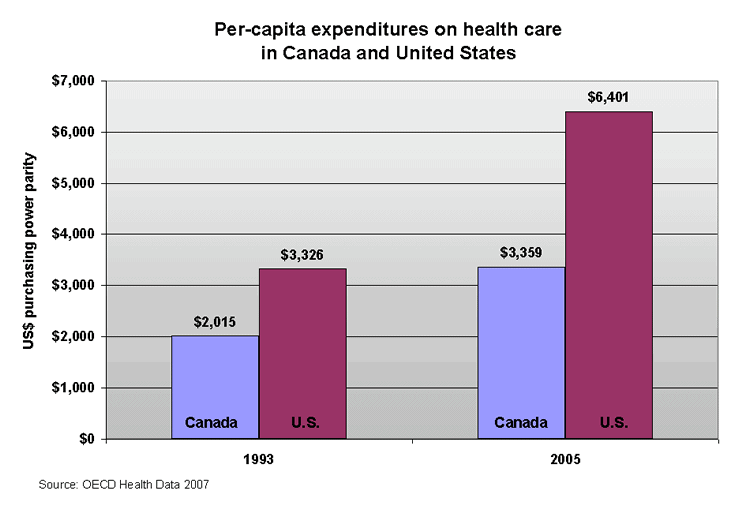
Regardless, per capita healthcare costs are lower than in the USA.
 16 Aug 2011, 2:35 am
I just want to say that I live in Oregon and voted for the Death with Dignity Act.. I don't know, 3 times I think. Each time it passed and got blocked by out-of-state lawyers until it finally went into effect. I'm not 100% certain of the final regulations, but I think to be eligible under the Act you have to be terminally ill with less than 6 months to live and have to have (I believe) at least 2 physicians confirm this prognosis. You make it sound like the State would opt to give you "The Death Pill" as opposed to granting an appendectomy or something. You're talking $24,000 to give a woman 2 more months. Probably not even 2 more GOOD months.
I love that you ignore the fact that she got the pills and died anyway. Impressive reporting!
You know, Oregon doesn't discriminate against illegal aliens, in that all illegal alien minors are given the Oregon Health Plan. Would you have traded their medical coverage for this woman's 2 extra months? Have you by chance looked at how sh***y Oregon's economy is these days? To be quite honest, the lady was fortunate that she had OHP, not many adults are able to get State medical. Don't get me wrong, there are a lot of problems with the Oregon Health Plan. Then there are tons of people who abuse the system. Over all though, it's a pretty damn good system, and for the children and the adults that are fortunate enough to get it, it's a huge relief. But the system can only spread so far.
I bet the woman was offered Medicinal Marijuana too, did the story mention that? Cancer is a sure bet for a pot script.
 16 Aug 2011, 11:37 am
Not only that, but for that lower price per capita, we manage to provide universal, medically necessary care.
As for this present issue, I'm going to put my cynic hat on for a moment, and ask whether this result isn't exactly what the President wanted?
Inuyasha has demonstrated himself to be a pretty poor legal scholar in the past, and I do not for a moment assume that his assertions about severability are correct. Severability is the assumption in statory interpretation, and unless he can point to a section of the legislation that demonstrates non-severability, then the balance of the act will remain good law.
Well, that is going to very quickly create an unsustainable position. Americans will have been promised universal health insurance, and insurers will be forced to accept all applicants. Which means that free riders will avoid the system until they get sick. Costs will balloon, leading either to bankruptcy, or skyrocketing premiums. In theory Congress could incentivize the free riders to buy early (by imposing a tax penalty at the time of purchase for those who have delayed, for example). But if there is no appetite in Congress to create a roundabout route to the individual mandate, then Congress will, I suggest, wind up utterly destroying universal coverage through private markets. The only alternative left will be public insurance.
Conservatives should be very, very careful what they wish for, for they may wind up winning a Pyrrhic victory that paves the way for universal public health insurance because it will be the only option left.
_________________
--James
16 Aug 2011, 11:55 am
Not only that, but for that lower price per capita, we manage to provide universal, medically necessary care.
As for this present issue, I'm going to put my cynic hat on for a moment, and ask whether this result isn't exactly what the President wanted?
Inuyasha has demonstrated himself to be a pretty poor legal scholar in the past, and I do not for a moment assume that his assertions about severability are correct. Severability is the assumption in statory interpretation, and unless he can point to a section of the legislation that demonstrates non-severability, then the balance of the act will remain good law.
Well, that is going to very quickly create an unsustainable position. Americans will have been promised universal health insurance, and insurers will be forced to accept all applicants. Which means that free riders will avoid the system until they get sick. Costs will balloon, leading either to bankruptcy, or skyrocketing premiums. In theory Congress could incentivize the free riders to buy early (by imposing a tax penalty at the time of purchase for those who have delayed, for example). But if there is no appetite in Congress to create a roundabout route to the individual mandate, then Congress will, I suggest, wind up utterly destroying universal coverage through private markets. The only alternative left will be public insurance.
Conservatives should be very, very careful what they wish for, for they may wind up winning a Pyrrhic victory that paves the way for universal public health insurance because it will be the only option left.

One reason your healthcare is cheaper is because you aren't paying for the prescription drugs and letting us foot the R&D bill, freeloaders.
16 Aug 2011, 12:50 pm
We pull our weight when it comes to biomedical and pharmaceutical research, thank you very much.
Public insurance coverage of prescription drugs varies by province. In British Columbia, it is means tested (based on my household income, the province kicks in at 80% after about $3750, and at 100% after about $4500, if memory serves), but some classes of drugs (for example, antiretrovirals for people who are HIV+) are automatically covered at 100%. Seniors are automatically covered as well. Private insurance or out of pocket spending covers the rest. Other provinces will be different.
Prescription drugs are cheaper here than they are in the United States. Same pill, different price. Why is that? Because the pharmaceutical companies have created a wonderfully circular chain: they convince you that their pill will make you feel better. You go to your doctor and ask for your pill. The doctor has little time and expertise, and gets an incentive from the drug company for writing the prescription, so you get your Rx. You go to the pharmacy and buy the pill, and your insurer is left holding the bag.
The pharmaceutical company has artificially created the demand for the drug, incentivized the prescription, and relies on moral hazard and its patent to keep the price high. Anyone who thinks that this is an open, competitive market had better take a good look at their prescription list.
Have you considered the question of how much unnecessary spending is being made on unnecessary drugs in the United States? Antidepressants are now the single largest class of drugs prescribed in the United States. In 2005, over 118 million prescriptions for anti-depressants were written. I find it difficult to believe the clinical incidence of depression in the United States is this high, or that the cases that do present warrant this level of medical intervention. And the number has only gotten higher. By 2009, over 10% of the US population were using antidepressants. Even worse, fewer people are being treated by a mental health professional for their depression, meaning that physicians in family medicine are diagnosing and medicating depression--and in many of these cases they are comedicating with mood stabilizers or antipsychotics.
_________________
--James
Sweetleaf
Veteran


Joined: 6 Jan 2011
Age: 36
Gender: Female
Posts: 35,282
Location: Somewhere in Colorado
16 Aug 2011, 1:36 pm
Read more: http://www.politico.com/news/stories/08 ... z1V9C3xZKb
Next stop, US Supreme Court, and if this ruling stands, the Insurance companies will have grounds to sue over Obamacare.
What happens to people who cannot afford to buy insurance?
 16 Aug 2011, 1:43 pm
Public insurance coverage of prescription drugs varies by province. In British Columbia, it is means tested (based on my household income, the province kicks in at 80% after about $3750, and at 100% after about $4500, if memory serves), but some classes of drugs (for example, antiretrovirals for people who are HIV+) are automatically covered at 100%. Seniors are automatically covered as well. Private insurance or out of pocket spending covers the rest. Other provinces will be different.
Prescription drugs are cheaper here than they are in the United States. Same pill, different price. Why is that? Because the pharmaceutical companies have created a wonderfully circular chain: they convince you that their pill will make you feel better. You go to your doctor and ask for your pill. The doctor has little time and expertise, and gets an incentive from the drug company for writing the prescription, so you get your Rx. You go to the pharmacy and buy the pill, and your insurer is left holding the bag.
The pharmaceutical company has artificially created the demand for the drug, incentivized the prescription, and relies on moral hazard and its patent to keep the price high. Anyone who thinks that this is an open, competitive market had better take a good look at their prescription list.
Have you considered the question of how much unnecessary spending is being made on unnecessary drugs in the United States? Antidepressants are now the single largest class of drugs prescribed in the United States. In 2005, over 118 million prescriptions for anti-depressants were written. I find it difficult to believe the clinical incidence of depression in the United States is this high, or that the cases that do present warrant this level of medical intervention. And the number has only gotten higher. By 2009, over 10% of the US population were using antidepressants. Even worse, fewer people are being treated by a mental health professional for their depression, meaning that physicians in family medicine are diagnosing and medicating depression--and in many of these cases they are comedicating with mood stabilizers or antipsychotics.
The situation with mental health is particularly awful here. My mother suffered with bipolar for most of her life and I watched her treatment go from bad to worse over the years. 20 or 30 years ago, the focus was more on counseling with the addition of medication when needed. It's taken quite a shift away from counseling and towards prescription-only treatment. They go from one concoction to another as people's bodies adjust. There's a real dependency issue too as going off the meds can also be quite dangerous.
That's not to say that I think we've ever really had good treatment towards mental health here in the states. I have vivid memories of visiting family members decades ago in the psych wards. I wouldn't have wished that sort of treatment on anyone either, but today we just push the pills and neglect them.
The pharmaceutical companies really are just legal drug pushers. Just last night during my local news show there were 3 drug commercials right in a row. You would think ED is like some sort of global crisis. Haven't seen any restless leg syndrome commercials in a while so maybe we've cured that. They always follow up with an offer for a free sample too, just like a dealer on the corner. And every single time I take my kids to the doctor, there's at least one pharm rep in the waiting room - no exaggeration - every single time. That bit in bold is right on the money.
Sweetleaf
Veteran
Joined: 6 Jan 2011
Age: 36
Gender: Female
Posts: 35,282
Location: Somewhere in Colorado
16 Aug 2011, 2:03 pm
How is universal healthcare a form of welfare based on freeloading......if the citizens are paying taxes and in turn getting healthcare I have a hard time seeing how its based on freeloading.
16 Aug 2011, 4:13 pm
How is universal healthcare a form of welfare based on freeloading......if the citizens are paying taxes and in turn getting healthcare I have a hard time seeing how its based on freeloading.
Nearly 50% of the country are not paying income taxes right now.
Sweetleaf
Veteran
Joined: 6 Jan 2011
Age: 36
Gender: Female
Posts: 35,282
Location: Somewhere in Colorado
16 Aug 2011, 4:14 pm
How is universal healthcare a form of welfare based on freeloading......if the citizens are paying taxes and in turn getting healthcare I have a hard time seeing how its based on freeloading.
Nearly 50% of the country are not paying income taxes right now.
Ok well I was referring to such a system in general, you know how it would work in an ideal world.....and we don't even have universal healthcare here.


