
Why is the third world poor?


techstepgenr8tion
Veteran


Joined: 6 Feb 2005
Age: 46
Gender: Male
Posts: 24,682
Location: 28th Path of Tzaddi
 19 Jan 2018, 12:23 am

I'm pretty sure it's loin cloths or toga-like thingies, possibly staffs as well. I often see video clips of them with loin cloths and there seems to be a correlation between poverty and that sort of garb.
_________________
The loneliest part of life: it's not just that no one is on your cloud, few can even see your cloud.
 19 Jan 2018, 4:14 am
I see a lot of people in this thread saying stuff like this.
You aren't totally wrong, but you are oversimplifying.
Nearly every third world country has rich natural resources ... that are privately owned by billionaires. Read about what Nestle did to Africa back in the seventies. It will blow your mind.
Addionally, when a country has a poor education system, this is typically a product of hyper-capitalism. What if the school system in the West was privatised? Most of us couldn't afford it. In most third world countries, the only schools are private schools because the government is run by tightwads. Whenever education is privatised, it is usually super-expensive.
That's why these Western foreign aid programs often don't work. The people of Africa have been screwed over by their own leaders ... who live in mansions as their people starve. Western businesses often play a role as well.
When we think of the third world, we typically think of little grass huts. Of course, nearly every third world country also has skyscrapers and mansions. This is proof that these countries aren't universally poor. They merely have a massive divide between the upper and lower class.
In medieval Europe, the wealthy lived in castles, whereas the poor lived in little cobblestone huts. We generally accept that the greed of the European upper class created this situation. Why the double standard?
_________________
Synthetic carbo-polymers got em through man. They got em through mouse. They got through, and we're gonna get out.
-Roostre
READ THIS -> https://represent.us/
 22 Jan 2018, 11:51 pm
"Third world countries" are not "culturally primitive". People who live in tin shacks and naked/semi-naked tribes people who live in stick huts or caves typically have cultures and beliefs just as complex as cultures with modern infrastructure. They have ideas of religion, and ethics, and morals, modesty and how to handle life problems, and what is socially appropriate and what isn't. Their worlds are no less complex than those in developed nations.
The subject of why "third world" countries are poor is complex and varies from country to country, and it's a lot easier to talk about why "first world" countries aren't poor.
Most "third world" countries started out as technologically less developed than the countries that conquered them and there was not an altruistic sharing of new resources.
Native inhabitants were often either left to fend for themselves as they always have, or disenfranchised or oppressed, exploited, enslaved, or killed.
In the region that became the United States and Canada, the new inhabitants had no interest in class systems as they were trying to break away from them themselves, and most of the native populations were killed or kicked off their land and herded into reservations. Some reservations in the U.S. today have third world poverty levels. For example, Pine Ridge Reservation. The land taken from the native Americans was sold or homesteaded to colonists and later immigrants from Europe, some who were affluent and some who were escaping poverty in their home country, and found that in this new land, they had better economic prospects and had escaped the class system that kept them down in their home country. This is also the case in Australia, though it started as a prison colony.
South of the United States, those regions were colonized by the Spanish and Portuguese who were met with a significantly larger indigenous population, many that had obtain civilization level societies. On these people, a class system was imposed, with Europeans at the top. Land was often gifted or ceded to those close to the ruling class as rewards for loyalty. Countries like Mexico and Brazil do not need to have half of the problems that they do, the class system resulted in wage and wealth disparities from the beginning, and mentalities that keep the class system alive to some extent, which have yet to abate.
Anyway though, history aside, if you were to take a third world or undeveloped country that was politically stable...say Ghana, how would you develop it?
Unless the country had some sort of sought after resource, you would likely need foreign investors and to get them, you would need to give them reason they would make money on the investment. Additionally, you would need government leaders who were not corrupt. You would need a population that does not accept corruption as a cultural norm, and you would need a population that is not afraid to give up mentalities and customs that inhibit economic progress.
A model country for modernization is Japan, in my opinion. Japan is a country that modernized at the call of it's emperor and under it's own collective will. But the Japanese have a continuous history and culture and a strong sense of nationalism. They did not have the social, political, and cultural upheavals that many countries have experienced. And no one told them where their borders were.
In many African countries, Europeans came in, shredded the population, and then drew lines around areas that contained multiple ethnic groups that didn't necessarily get along. When European countries pulled out of these regions and gave the countries they declared their independence, civil war broke out in many of them between different ethnic groups. A country cannot develop economically while it's inhabitants are trying to kill each other.
One might ask though, why did European nations get to a point where they become technologically advanced enough to go on colonizing sprees? And why do they still maintain some of the highest standards of living on the planet?
There's a vague correlation between distance from the equator and crime rates and standard of living.
One theory as to why this may be is that in warmer climates, people have to plan less and so warmer climates foster lower standards of living. For example, if you live in a warm, tropical climate, a bamboo hut might serve your needs just fine and you don't have to plan for any winter so you a lot of free time and don't have to cooperate much with your neighbor. If you live in a climate that gets very cold every year, you may be more inclined to build more substantial dwellings and you will may spend more time planning for the winter and may work with your neighbor to ensure you have enough food to do this.
I imagine other pressures can have a similar effect, for example, Egypt is typically a very warm climate but ancient Egypt had to contend with dry seasons and had to manage water and plan accordingly to harvest and store grain properly.
Ancient Greeks lived in city states and had to defend themselves from other Ancient Greeks. When people have to cooperate, crime may go down and standard of living may go up, in general.
Now that that's said and done, guess the country....
1.
2. 
3.
4. 
23 Jan 2018, 8:51 pm
1. Bhutan. A county in the Himalayas north of Bangladesh and India. While it does have poverty, it has a higher GDP than India and it's buildings and infrastructure are more similar to European Alps countries...in fact Europe in general. Older Bhutanese buildings are made with waddle and daub common in Tudor architecture.
2. Winhoek, Namibia. Windhoek is hands down the cleanest city in Africa. Namibia was colonized by the Germans. Caucasians currently make up about 7% of the population. Poverty in Namibia is difficult to quantify because portions of the population, such as the Himba, willingly maintain their traditional way of life as pastoralists and resist "modernization".
She is not not wearing western clothes because she doesn't have access to them. She isn't wearing them because she doesn't want to. Himba women have also resisted western medical care seeking it would mean they have to wash off their red ochre.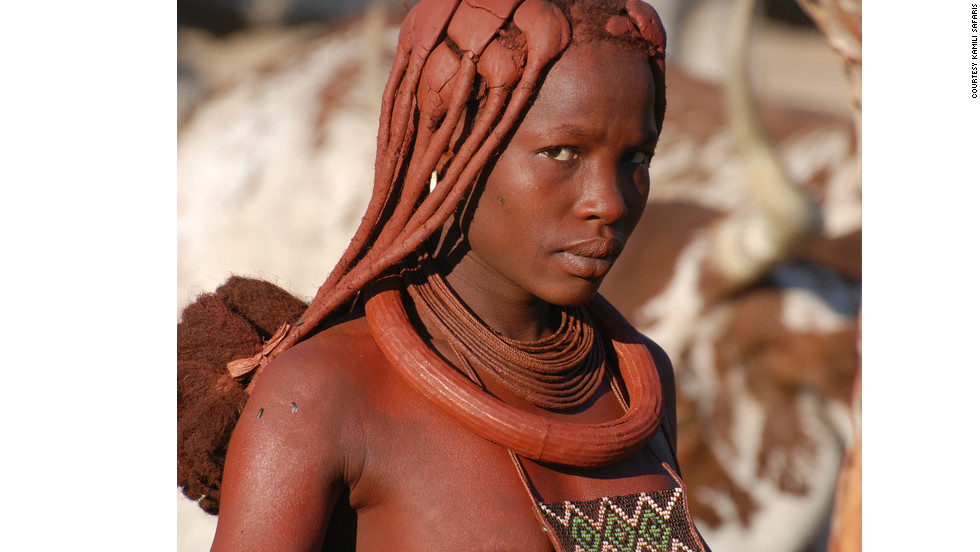
Namibia is also home to the Herero, who are linguistically, ethnically, and culturally related to the Himba but adopted cultural aspects of German colonists in the 1800s. These are Herero women in their "traditional" attire. They live a more modern life than the Himba.
3. Roma gypsie village in Romania. And this is not the worst of it. Some Roma live in far worse conditions, if you can imagine it. The Roma, not to be confused with ethnic Romanians, migrated out of northern India perhaps 1,000 years ago. A combination of discrimination, self isolation, and cultural differences keep them from fully integrating into mainstream society. Illiteracy is common among some Roma populations and those who do go to school often drop out when they are married at a young age. There are, however, affluent Roma.
4. A house on a Native American reservation. A number of factors and policies prevent economic growth on many reservations.
23 Jan 2018, 8:55 pm
I'm pretty sure the second picture is Nigeria, in Lagos State, perhaps Victoria Island. Or perhaps in the capital, Abuja.
The third one seems like El Salvador or some other Central American country.
The fourth one is almost certainly either the United States or Canada.
I'm thinking the first picture is taken in an affluent part of a place like Myanmar or Laos.
I guess I'm wrong then LOL
23 Jan 2018, 9:10 pm
The third one seems like El Salvador or some other Central American country.
The fourth one is almost certainly either the United States or Canada.
I'm thinking the first picture is taken in an affluent part of a place like Myanmar or Laos.
Nope. Thimphu, Bhutan. Windhoek, Namibia. A gypsie village in Romania, and yes, a Native American reservation.
Lagos is quite the city though. I know a few Nigerians and image and style are very important to their culture. I'm typically a function over form person but the value and desire for certain aesthetics can be a big driver of progress.
Beauty pageants are a big thing in Nigeria.
 23 Jan 2018, 9:21 pm
It's not very hard to see why.

_________________
Synthetic carbo-polymers got em through man. They got em through mouse. They got through, and we're gonna get out.
-Roostre
READ THIS -> https://represent.us/


