
Why theism doesn't work for everybody


 27 Apr 2012, 9:05 pm

WilliamWDelaney wrote:
As sure as I didn't throw in that caveat, some moron would have stomped in and shouted, "hey, I'm not like that!" leading to people thoroughly missing the point of the OP.
Heh, fair enough.
Quote:
That was the point of me stating, "there is no one explanation that fits everybody," before I tried to postulate an explanation, to theists, for why (some) atheists simply aren't suited to theism. If I hadn't stated that caveat, a lot more people would have made the idiotic and pointless remark, "that doesn't fit everybody," missing the point that I wasn't trying to explain everybody's thoughts in exact detail.
I am not trying to start an argument on that small detail if we agree in practice.
Quote:
However, I also had to take into account my intended audience. Theists often have difficulty holding in their minds the concept of a "universe without a god," so I had to demonstrate how atheists have an essentially parallel concept of the universe that simply takes on a different form. My own private beliefs are actually a little bit less "mystical" than I suggested in the OP, but I could not have communicated what I meant as well if I had tried to postulate a more precise concept of how I and many other atheists tend to look at the universe. Sometimes it's necessary to sacrifice some precision for the sake of improving transmissibility.
Understandable. I think a lot of the "mystical" tendencies are both to appeal to that human desire/tendency, and yeah, transmitting the idea to people more suitable to mysticism.
Quote:
It actually requires a more imaginative mind to comprehend a universe that was not created by a powerful "father figure," and this is one of the inherent limitations of our animal minds. It is actually normal for a person to superimpose anthropomorphic or, at best, zoomorphic interpretations onto reality. You are really not much different from your pet dog in how you put your thoughts together, at the most basic level.
Understandable in some ways. I don't think it's imagination, but rather there are different cognitive mechanisms at work. Some model agency, and others model things as tools or objects. A more tool/object-oriented modelling is probably more likely with autism. It's probably also more cognitively demanding as well.
I agree with the bit on the pet dog. You've read about the embodied mind, and heard about how some think metaphors are a model of how the mind constructs "higher" thoughts out of "lower" thoughts, yes?
Quote:
When we forget this, we tend to make some stupid mistakes in interpreting human behavior. For example, I once had somebody point out that the use of the atlatl was evidence that our primitive ancestors thought in a cold-blooded, methodical manner about capturing larger game for the sake of feeding larger numbers of people. The most probable reason that they enjoyed using the weapon in real life, though, was that it was a cool toy they could play with, and their motivation for pursuing large game was most likely that it made them feel impressed with themselves to see that they could overpower a much larger animal. It is unnatural for human beings to think in a cold-blooded, methodical manner. We are at heart creatures of passion and impulse...including those of us who consider ourselves to be rationalists.
It's all complicated. There are hot and cold processes. I'll probably agree with your general thrust though, but with reservation as I've gone too far in the "emotional" direction in the past. The brain is modular, not monistic.
Quote:
You chimp. You pry into superficial experience to dig out how it works for the same reason that you would cut into the hide of an animal to dig out the sweet-tasting organ meat. You are the same brute animal we have always been.
In some sense, yes. But the feeling isn't the same. The sense of getting something right, and cutting past superficiality appeals more to curiosity, and status-oriented motivation, than cutting into an animal.
Quote:
You are inclined to respond to this very post in an agonistic manner because, when you and I interact, your posterior pituitary gland starts releasing vasopressin, along with other hormones. It gives you a sense of social gratification to challenge someone. You would want to debate with me even if you and I could not find a single topic that we actually disagreed on substantially. We could spend hours shouting the same exact arguments at each other, just with irrelevant syntactical and semantic differences, and it would give you the same buzz.
I was not aiming to debate you. I wouldn't be surprised if the basic cognitive structure is the same across the two actions. I don't really want to debate you though, as this is not a thrill at combat, but rather a thrill at winning. By putting forward a position different than yours that I know I can defend, I have established some sort of social victory. I don't need to fight you to have that victory, and the battle you're describing is something I would rather avoid because of the stress it causes, but also because I am intelligent enough to find that such contests not to really give me the status of a superior combatant, and so would rather waste my effort to where I can win/make a difference. Frankly, I am more likely to assess you as an ally, not an enemy given my current mood. I just have some distaste for the positive mysticism, simply because the ugliness of the world takes a prominent role in how I understand reality.
Quote:
As the ground shook, the beast rose up, wreathed in flame. Its maw descended over the sky and cast it into darkness. Forests withered under its footstep, and its very breath poisoned and befouled the water.
You would do better if you were to learn how to comprehend the shorthand version of things. It saves a lot of trouble.
You would do better if you were to learn how to comprehend the shorthand version of things. It saves a lot of trouble.
Your shorthand is a misunderstanding of my point. You have to realize that detachment actually favors the idea I am trying to convey. "Beast" is a misunderstanding. Instead the core idea is "mechanism", "mindless", "soulless", "purposeless", "empty", "crass", "materialist", "alien", etc. "Ugly" is only part of the characteristics, and "beast" is just the opposite. The concepts evoked need to be closer to analysis, detachment, depression, etc.
And no, I don't want to debate that. You're missing my point. There is no point for the debate. You know the cognitive mechanism, but if we play our status games right, then we actually win by both understanding each other when we make high-level conceptual points. We're both smart enough to know that the minutiae game reduces our relative rankings, and we're both smart enough to know that we both can understand each other's position. So, let's stop this. Our agreements are too significant, and by knowing the psychology game, we're both better off PLAYING IT as a superiority card.
Joker
Veteran


Joined: 19 Mar 2011
Age: 37
Gender: Male
Posts: 7,593
Location: North Carolina The Tar Heel State :)
27 Apr 2012, 11:32 pm
Rainy wrote:
Joker wrote:
Vexcalibur wrote:
Joker wrote:
Vexcalibur wrote:
Joker wrote:
I do find it odd that atheists always attack the abrahamic religions the most
It is obvious that the atheist you met always attack the abrahamic religions the most.
If you go to India , there are a couple of key atheists that attack Hindu mythos.
One though had to find a Christian crying statue hoax in his spare time and is being processed for blasphemy.
It is hard not to be wary the Abrahamic religions when they are so full of a-holes, it seems.
That all goes back to opinon why is it that theists and non theists can not have a friendly debate about each others thoughts and opinons about the other with out getting heated?
After such a jerk move, it is difficult not to heat the debate.
I valute honor and respect I find it beneath me to get upset that others attack me for being a theist cause that is my personal choice and belief you can't proove magic of any kind exsist but I bet would like to see you proove to me that it doesn't.
Everything has a cause and effect.
Therefore, magic doesn't exist.
That does not proove magic does not exist.
 28 Apr 2012, 9:45 am
Awesomelyglorious wrote:
I was not aiming to debate you. I wouldn't be surprised if the basic cognitive structure is the same across the two actions. I don't really want to debate you though, as this is not a thrill at combat, but rather a thrill at winning. By putting forward a position different than yours that I know I can defend, I have established some sort of social victory. I don't need to fight you to have that victory, and the battle you're describing is something I would rather avoid because of the stress it causes, but also because I am intelligent enough to find that such contests not to really give me the status of a superior combatant, and so would rather waste my effort to where I can win/make a difference. Frankly, I am more likely to assess you as an ally, not an enemy given my current mood. I just have some distaste for the positive mysticism, simply because the ugliness of the world takes a prominent role in how I understand reality.
Agonistic play is also applicable to social bonding between lovers, friends or, in the case of our lupine cousins, packmates. It is a part of our nature to spend our leisure time preparing for combative situations. Between mutually acknowledged social equals, it is generally of an amicable nature. However, the presence of a non-participating third party, particularly one to whom the combatants are attempting to appeal for acceptance or recognition, it can get a bit more rough. Even without the actual presence of a third party, a "sense of stakes" can act in the same capacity.However, the presence of rules and guidelines can serve as a preventative tonic against catastrophe. Information stored in the cortical regions of our brains serves as a gating system for checking and shaping our behavior. When we are considering an action, it is fed through this gating system. If the impulse conflicts with the algorithms that are stored in our cortices, the impulse is inhibited. If not, it progresses to neural systems in the motor areas of our brains.
Involved in this gating system is cortisol, which is a wicked, little hormone that is involved in stress responses. When a set of actions frequently results in a stress response, the algorithms in our gating system are modified in a manner that results in repetition of the behavior being inhibited. This is why children usually don't run out into the street a second time if their mothers pull them aside and beat blisters in their posterior the first time they do it.
However, catecholamines can also be released during a stress response, and this can actually serve as a confound in the system. If the release of catecholamines overwhelms the effects of cortisol, we end up with a reversal of the system that would ideally result in the extinction of a behavior. In fact, the behavior could even intensify. This is what we call "perversity" or "bloody-mindedness."
Now, since both you and I probably both have a propensity for being bloody-minded, perverse, and generally a migraine-inducing nuisance to individuals who are attempting to keep things under control, conventional guidelines are not likely to hedge sufficiently against conflict.
Therefore, in order to escape this quandary, any engagement must be fed through a gating system that is not reliant on stress feedback. This can be accomplished by the associating a reward stimulus with the gating system, and we can control our behavior by virtue of the removal of the reward stimulus.
As a result, we can simulate moral conduct by simply establishing an aesthetic system that serves as a standing reward for good conduct. By adhering to this system, two honorable, hard-headed fools, who are normally impossible to discipline or contain, can normally get along and manage not to murder each other. Refractory behavior by such individuals is generally unlikely in situations to which their sense of honor and fair play is applicable.
Of course, truly ignorant people tend to confuse a resistance to stress-induced behavioral modification with a lack of the intellectual capacity for comprehending ordered thought. They are inferior creatures, worthy only as game animals to be hunted. Neither AG nor WD are prey. AG and WD are predators. Therefore, since we are both predators, we can agree that verbal abuse would be a futile and stupid waste of resources that would only serve to agitate our respective sense of bloody-mindedness. Since we acknowledge each other as highly boneheaded, we shouldn't have any difficulty getting along, and perhaps we can trot off later and abuse some peasants.
Having established that, allow me to reassert the position that I postulated in the OP. What I postulate is that an atheist can derive a sense of spiritual satisfaction from comprehending the universe in terms of scale, and we are not required to make a departure from comprehending it accurately in order to get the effect. Although this kind of exercise can potentially lead to delusions of something being there that actually isn't, we can safeguard against this by simply developing a point of departure between experiences that we consider to arise from material substance and experiences that are derived from changes in our state of mind...in other words, "distinguishing between fantasy and reality." Therefore, you could tickle your nucleus accumbens all day long, and you wouldn't become a holy roller unless you were to suddenly decide that you no longer find it satisfying to feel grounded in reality.
Quote:
Your shorthand is a misunderstanding of my point. You have to realize that detachment actually favors the idea I am trying to convey. "Beast" is a misunderstanding. Instead the core idea is "mechanism", "mindless", "soulless", "purposeless", "empty", "crass", "materialist", "alien", etc. "Ugly" is only part of the characteristics, and "beast" is just the opposite. The concepts evoked need to be closer to analysis, detachment, depression, etc.
Actually, what I meant by "shorthand" was that the comprehension of the world in terms of metaphor actually makes it easier for us to store and handle information. It is a method of encryption. Because you are on the autistic spectrum, you have more difficulty understanding it than most people do, but you can overcome this limitation by looking upon it as a system of data encryption. I am doubtful that I am imparting upon you a new idea, here, but I hope to have iterated it well here.I am trying to understand your "negative mysticism," though. From the sound of it, you are just saying that elevated moods and high spirits tend to be a buzzkill for you, and you like tripping on self-induced depersonalization, which has some fairly amusing psychotic-like symptoms. You can mechanically cultivate this effect by sleep deprivation, which I would have no doubt you have done if I am correct about the effect you are referring to.
Quote:
And no, I don't want to debate that.
Oh, of course we don't have to. But you are tempted to because you get a jolly off of the clash.
28 Apr 2012, 12:31 pm
WilliamWDelaney wrote:
Now, since both you and I probably both have a propensity for being bloody-minded, perverse, and generally a migraine-inducing nuisance to individuals who are attempting to keep things under control, conventional guidelines are not likely to hedge sufficiently against conflict.
Therefore, in order to escape this quandary, any engagement must be fed through a gating system that is not reliant on stress feedback. This can be accomplished by the associating a reward stimulus with the gating system, and we can control our behavior by virtue of the removal of the reward stimulus.
As a result, we can simulate moral conduct by simply establishing an aesthetic system that serves as a standing reward for good conduct. By adhering to this system, two honorable, hard-headed fools, who are normally impossible to discipline or contain, can normally get along and manage not to murder each other. Refractory behavior by such individuals is generally unlikely in situations to which their sense of honor and fair play is applicable.
Therefore, in order to escape this quandary, any engagement must be fed through a gating system that is not reliant on stress feedback. This can be accomplished by the associating a reward stimulus with the gating system, and we can control our behavior by virtue of the removal of the reward stimulus.
As a result, we can simulate moral conduct by simply establishing an aesthetic system that serves as a standing reward for good conduct. By adhering to this system, two honorable, hard-headed fools, who are normally impossible to discipline or contain, can normally get along and manage not to murder each other. Refractory behavior by such individuals is generally unlikely in situations to which their sense of honor and fair play is applicable.
LOL, that's pretty much correct.
Quote:
I am trying to understand your "negative mysticism," though. From the sound of it, you are just saying that elevated moods and high spirits tend to be a buzzkill for you, and you like tripping on self-induced depersonalization, which has some fairly amusing psychotic-like symptoms. You can mechanically cultivate this effect by sleep deprivation, which I would have no doubt you have done if I am correct about the effect you are referring to.
I don't think that's correct. I don't intentionally deprive myself of sleep for highs, nor do I tend towards these feelings when I lack sleep. Background issue: I am a former theist, and these feelings are the result of a rapid, painful, and emotional deconversion process. The better conceptual metaphor is the death of God, with the negativity being the inversion of a normal spirituality induced by strong emotional aversion to traditional spirituality.
28 Apr 2012, 4:31 pm
Awesomelyglorious wrote:
I don't think that's correct. I don't intentionally deprive myself of sleep for highs, nor do I tend towards these feelings when I lack sleep. Background issue: I am a former theist, and these feelings are the result of a rapid, painful, and emotional deconversion process. The better conceptual metaphor is the death of God, with the negativity being the inversion of a normal spirituality induced by strong emotional aversion to traditional spirituality.
Does it seem to be a somewhat paranoid suspicion of anything that seems "too good to be true," then? I am sure there is some reward stimulus involved here, even if an especially insidious one. Wherever dopamine shows its face, there is a reward stimulus in there somewhere.
In which case, releasing the skepticism sufficiently to allow experiences that can result from doing so could contribute to feelings of anxiety, danger, or an essential wrongness. You hedge against these feelings with a simple patch, which is simply a general sense of cynicism. You thereby keep limbic dopamine elevated, so it essentially "screams louder" than the anxiety. So it goes back to, "once burned, twice shy." It's not a permanent solution, but it's a good short-term fix.
Therefore, perhaps there is an essential difference between an established atheist and a former theist who feels burned and cheated by religion. A person who is well established in a non-religious mindset ultimately has the same needs as a person who grew up with religion. They pursue it in different ways. They are essentially more like each other than either is like a person who is still reeling from a "loss of faith."
That's what I would postulate, anyway.
28 Apr 2012, 6:40 pm
WilliamWDelaney wrote:
Does it seem to be a somewhat paranoid suspicion of anything that seems "too good to be true," then? I am sure there is some reward stimulus involved here, even if an especially insidious one. Wherever dopamine shows its face, there is a reward stimulus in there somewhere.
In which case, releasing the skepticism sufficiently to allow experiences that can result from doing so could contribute to feelings of anxiety, danger, or an essential wrongness. You hedge against these feelings with a simple patch, which is simply a general sense of cynicism. You thereby keep limbic dopamine elevated, so it essentially "screams louder" than the anxiety. So it goes back to, "once burned, twice shy." It's not a permanent solution, but it's a good short-term fix.
Therefore, perhaps there is an essential difference between an established atheist and a former theist who feels burned and cheated by religion. A person who is well established in a non-religious mindset ultimately has the same needs as a person who grew up with religion. They pursue it in different ways. They are essentially more like each other than either is like a person who is still reeling from a "loss of faith."
That's what I would postulate, anyway.
In which case, releasing the skepticism sufficiently to allow experiences that can result from doing so could contribute to feelings of anxiety, danger, or an essential wrongness. You hedge against these feelings with a simple patch, which is simply a general sense of cynicism. You thereby keep limbic dopamine elevated, so it essentially "screams louder" than the anxiety. So it goes back to, "once burned, twice shy." It's not a permanent solution, but it's a good short-term fix.
Therefore, perhaps there is an essential difference between an established atheist and a former theist who feels burned and cheated by religion. A person who is well established in a non-religious mindset ultimately has the same needs as a person who grew up with religion. They pursue it in different ways. They are essentially more like each other than either is like a person who is still reeling from a "loss of faith."
That's what I would postulate, anyway.
I get the feeling that this isn't just cynicism, but rather a reversed attitude. So, the mechanisms that point to ideals, to divine notions, and everything else, are instead dealing with an absence. They aren't just negative towards religion, but they are finding an opposite truth. So, where God appeared to rule the world, instead they are seeing that the world has no purposes or unity, and they are reacting to that.
I am not sure it's even a flaw or a failure to adapt. Alex Rosenberg's depiction of disenchanted naturalism evokes many of the same kinds of mental patterns and mindsets as my "negative mysticism". http://onthehuman.org/2009/11/the-disen ... o-reality/ However, Alex is not coming at this from a religious perspective, he's really pointing to failures of reality to deal with pre-existing human needs often filled by religion, and how naturalism actually cuts down these notions as well. So, when you talk about my cognitive tendencies, and those of a criminals, the issue isn't a moral difference but rather a mechanism difference(a confused distinction under compatibilism, but a very intuitive one given our libertarian free will instincts), and that's a massive issue going on there, and even every recreation never gets to the original conception.
I dunno, I could have misunderstood your earlier statement. When you said "you are just saying that elevated moods and high spirits tend to be a buzzkill for you", were you meaning that they kill the experience, or that I dislike elevated moods and high spirits? They kill the experience, but they do not have any negative impact on me as a person.
 29 Apr 2012, 2:17 am
Joker wrote:
Rainy wrote:
Joker wrote:
Vexcalibur wrote:
Joker wrote:
Vexcalibur wrote:
Joker wrote:
I do find it odd that atheists always attack the abrahamic religions the most
It is obvious that the atheist you met always attack the abrahamic religions the most.
If you go to India , there are a couple of key atheists that attack Hindu mythos.
One though had to find a Christian crying statue hoax in his spare time and is being processed for blasphemy.
It is hard not to be wary the Abrahamic religions when they are so full of a-holes, it seems.
That all goes back to opinon why is it that theists and non theists can not have a friendly debate about each others thoughts and opinons about the other with out getting heated?
After such a jerk move, it is difficult not to heat the debate.
I valute honor and respect I find it beneath me to get upset that others attack me for being a theist cause that is my personal choice and belief you can't proove magic of any kind exsist but I bet would like to see you proove to me that it doesn't.
Everything has a cause and effect.
Therefore, magic doesn't exist.
That does not proove magic does not exist.
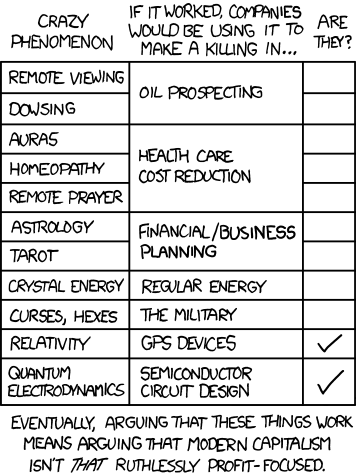
But that's pretty compelling evidence against it.
_________________
Et in Arcadia ego. - "Even in Arcadia, there am I."
 29 Apr 2012, 2:40 am
Joker wrote:
Rainy wrote:
Joker wrote:
Vexcalibur wrote:
Joker wrote:
Vexcalibur wrote:
Joker wrote:
I do find it odd that atheists always attack the abrahamic religions the most
It is obvious that the atheist you met always attack the abrahamic religions the most.
If you go to India , there are a couple of key atheists that attack Hindu mythos.
One though had to find a Christian crying statue hoax in his spare time and is being processed for blasphemy.
It is hard not to be wary the Abrahamic religions when they are so full of a-holes, it seems.
That all goes back to opinon why is it that theists and non theists can not have a friendly debate about each others thoughts and opinons about the other with out getting heated?
After such a jerk move, it is difficult not to heat the debate.
I valute honor and respect I find it beneath me to get upset that others attack me for being a theist cause that is my personal choice and belief you can't proove magic of any kind exsist but I bet would like to see you proove to me that it doesn't.
Everything has a cause and effect.
Therefore, magic doesn't exist.
That does not proove magic does not exist.
If it has a cause and effect, then it becomes rational, and not magic or supernatural.
29 Apr 2012, 8:33 am
Awesomelyglorious wrote:
I dunno, I could have misunderstood your earlier statement. When you said "you are just saying that elevated moods and high spirits tend to be a buzzkill for you", were you meaning that they kill the experience, or that I dislike elevated moods and high spirits? They kill the experience, but they do not have any negative impact on me as a person.
So they snuff the experience. I'm just trying to ferret out the mechanism, here.I read your link. I am getting this picture that the "positive mysticism" tastes something like "answer." However, there seems to be "complete" in there. It's somewhere in that general category.
So there is a sense of "meaninglessness," which I think is like the sense of frustration that comes with the realization, "I am wasting my time." I recall Ecclesiastes:
Ecclesiastes wrote:
“Meaningless! Meaningless!”
says the Teacher.
“Utterly meaningless!
Everything is meaningless.”
3 What do people gain from all their labors
at which they toil under the sun?
4 Generations come and generations go,
but the earth remains forever.
5 The sun rises and the sun sets,
and hurries back to where it rises.
6 The wind blows to the south
and turns to the north;
round and round it goes,
ever returning on its course.
7 All streams flow into the sea,
yet the sea is never full.
To the place the streams come from,
there they return again.
8 All things are wearisome,
more than one can say.
The eye never has enough of seeing,
nor the ear its fill of hearing.
9 What has been will be again,
what has been done will be done again;
there is nothing new under the sun.
10 Is there anything of which one can say,
“Look! This is something new”?
It was here already, long ago;
it was here before our time.
11 No one remembers the former generations,
and even those yet to come
will not be remembered
by those who follow them.
12 I, the Teacher, was king over Israel in Jerusalem. 13 I applied my mind to study and to explore by wisdom all that is done under the heavens. What a heavy burden God has laid on mankind! 14 I have seen all the things that are done under the sun; all of them are meaningless, a chasing after the wind.
15 What is crooked cannot be straightened;
what is lacking cannot be counted.
16 I said to myself, “Look, I have increased in wisdom more than anyone who has ruled over Jerusalem before me; I have experienced much of wisdom and knowledge.” 17 Then I applied myself to the understanding of wisdom, and also of madness and folly, but I learned that this, too, is a chasing after the wind.
18 For with much wisdom comes much sorrow;
the more knowledge, the more grief.
says the Teacher.
“Utterly meaningless!
Everything is meaningless.”
3 What do people gain from all their labors
at which they toil under the sun?
4 Generations come and generations go,
but the earth remains forever.
5 The sun rises and the sun sets,
and hurries back to where it rises.
6 The wind blows to the south
and turns to the north;
round and round it goes,
ever returning on its course.
7 All streams flow into the sea,
yet the sea is never full.
To the place the streams come from,
there they return again.
8 All things are wearisome,
more than one can say.
The eye never has enough of seeing,
nor the ear its fill of hearing.
9 What has been will be again,
what has been done will be done again;
there is nothing new under the sun.
10 Is there anything of which one can say,
“Look! This is something new”?
It was here already, long ago;
it was here before our time.
11 No one remembers the former generations,
and even those yet to come
will not be remembered
by those who follow them.
12 I, the Teacher, was king over Israel in Jerusalem. 13 I applied my mind to study and to explore by wisdom all that is done under the heavens. What a heavy burden God has laid on mankind! 14 I have seen all the things that are done under the sun; all of them are meaningless, a chasing after the wind.
15 What is crooked cannot be straightened;
what is lacking cannot be counted.
16 I said to myself, “Look, I have increased in wisdom more than anyone who has ruled over Jerusalem before me; I have experienced much of wisdom and knowledge.” 17 Then I applied myself to the understanding of wisdom, and also of madness and folly, but I learned that this, too, is a chasing after the wind.
18 For with much wisdom comes much sorrow;
the more knowledge, the more grief.
And it goes on and on, throughout Ecclesiastes, along the same vein. Eventually, you start to get a little bit annoyed with it. It gets especially annoying when you realize that the Teacher is looking for not only the unobtainable but the improper. The answer to anxiety is not to keep feeding it with things that sate it temporarily. That's like removing a dog from the room as soon as the infant utters so much as a sniffle: it simply establishes a perverse reward system that results ultimately in a deeply entrenched phobia of dogs. You deal with the reaction by waiting quietly for the infant to calm itself, having the dog sit quietly and demonstrate good temper.
But you speak of a "reversed truth." I am trying to comprehend "truth," but bear with me for a while. This truth of yours has a divine entity ruling and uniting the world, so let's consider it in terms of Handel's Messiah, "Hallelujah" Chorus.
Handel wrote:
Hallelujah (Aleluya)
Written by George Friedrich Händel
Hallelujah hallelujah hallelujah hallelujah hallelujah
Hallelujah hallelujah hallelujah hallelujah hallelujah
For the lord God omnipotent reigneth
Hallelujah hallelujah hallelujah hallelujah
For the lord God omnipotent reigneth
Hallelujah hallelujah hallelujah hallelujah
For the lord God omnipotent reigneth
Hallelujah hallelujah hallelujah hallelujah
Hallelujah hallelujah hallelujah hallelujah
Hallelujah hallelujah hallelujah hallelujah
(For the lord God omnipotent reigneth)
Hallelujah hallelujah hallelujah hallelujah
For the lord God omnipotent reigneth
(Hallelujah hallelujah hallelujah hallelujah)
Hallelujah
The kingdom of this world;
Is become
The kingdom of our Lord,
And of His Christ
And of His Christ
And He shall reign for ever and ever
And he shall reign forever and ever
And he shall reign forever and ever
And he shall reign forever and ever
King of kings forever and ever hallelujah hallelujah
And lord of lords forever and ever hallelujah hallelujah
King of kings forever and ever hallelujah hallelujah
And lord of lords forever and ever hallelujah hallelujah
King of kings forever and ever hallelujah hallelujah
And lord of lords
King of kings and lord of lords
And he shall reign
And he shall reign
And he shall reign
He shall reign
And he shall reign forever and ever
King of kings forever and ever
And lord of lords hallelujah hallelujah
And he shall reign forever and ever
King of kings and lord of lords
King of kings and lord of lords
And he shall reign forever and ever
Forever and ever and ever and ever
(King of kings and lord of lords)
Hallelujah hallelujah hallelujah hallelujah
Hallelujah
"He shall reign forever and ever" comes from Book of Revelation 11:15. "King of Kings" comes from Revelation 19:16. Anyway, the music combined with the chorus develops a sense of many different things all leading to a sort of climax. This is actually one of the benefits of polyphony: by virtue of this method, you can weave symphonies that are parallel with the idea of the disparate and seemingly disorganized ultimately being unified under a common plan. Its parallel with our day-to-day existence and what we HOPE that existence is a part of is emotionally quite moving.
Written by George Friedrich Händel
Hallelujah hallelujah hallelujah hallelujah hallelujah
Hallelujah hallelujah hallelujah hallelujah hallelujah
For the lord God omnipotent reigneth
Hallelujah hallelujah hallelujah hallelujah
For the lord God omnipotent reigneth
Hallelujah hallelujah hallelujah hallelujah
For the lord God omnipotent reigneth
Hallelujah hallelujah hallelujah hallelujah
Hallelujah hallelujah hallelujah hallelujah
Hallelujah hallelujah hallelujah hallelujah
(For the lord God omnipotent reigneth)
Hallelujah hallelujah hallelujah hallelujah
For the lord God omnipotent reigneth
(Hallelujah hallelujah hallelujah hallelujah)
Hallelujah
The kingdom of this world;
Is become
The kingdom of our Lord,
And of His Christ
And of His Christ
And He shall reign for ever and ever
And he shall reign forever and ever
And he shall reign forever and ever
And he shall reign forever and ever
King of kings forever and ever hallelujah hallelujah
And lord of lords forever and ever hallelujah hallelujah
King of kings forever and ever hallelujah hallelujah
And lord of lords forever and ever hallelujah hallelujah
King of kings forever and ever hallelujah hallelujah
And lord of lords
King of kings and lord of lords
And he shall reign
And he shall reign
And he shall reign
He shall reign
And he shall reign forever and ever
King of kings forever and ever
And lord of lords hallelujah hallelujah
And he shall reign forever and ever
King of kings and lord of lords
King of kings and lord of lords
And he shall reign forever and ever
Forever and ever and ever and ever
(King of kings and lord of lords)
Hallelujah hallelujah hallelujah hallelujah
Hallelujah
Essentially, the idea that there is no eternal reward means, ultimately, that you go through your entire life practicing good moral behavior, and you practice self-discipline and self-restraint, because you know that trying to go "chasing the dragon" leads ultimately to disaster. But you go through all of your life with a sense that it is there to be chased. It is the "ultimate high." Therefore, practicing temperance and chastity leaves one with a gnawing sensation that one is missing out on something.
So the imagined (or fervently believed) "eternal reward" is like establishing a mechanism for delayed gratification, thereby rendering it unnecessary to have that feeling of "being left out." You can look at the fools around you who are indulging in the passing pleasures of the moment, and you don't feel so much like a fool. You have a sense that, somehow, it's worth it in the end.
Now, the sudden removal of that impetus would therefore leave one with a feeling of, "what a gyp." In fact, if you hold the belief in it, you are likely to resent someone who comes along and says, "you know you are just kidding yourself, right?" It comes across as quite rude, and your instinct is essentially to say, "bugger off." After all, it means you have spent your entire life, up until that point, leaving yourself out of what little pleasure there is to be found in life, if that is actually the case.
However, what does an established humanist use in the place of God? What is the humanist's secret magic? Why aren't they all out there doing drugs and jumping out of airplanes and otherwise behaving recklessly, trying to obtain that rush? How does the humanist just calmly accept living a dreary day-to-day life, knowing it ultimately comes to nothing?
And this question gnaws at the theist. It is simply incomprehensible.
And trying to argue with them is like trying to explain the complexities and subtleties of a fine draft beer to a teetotoler or a reformed alcoholic who once went from cheap beer to cheap liquor without detour. You might as well be speaking Greek.
Joker
Veteran
Joined: 19 Mar 2011
Age: 37
Gender: Male
Posts: 7,593
Location: North Carolina The Tar Heel State :)
29 Apr 2012, 1:42 pm
Rainy wrote:
Joker wrote:
Rainy wrote:
Joker wrote:
Vexcalibur wrote:
Joker wrote:
Vexcalibur wrote:
Joker wrote:
I do find it odd that atheists always attack the abrahamic religions the most
It is obvious that the atheist you met always attack the abrahamic religions the most.
If you go to India , there are a couple of key atheists that attack Hindu mythos.
One though had to find a Christian crying statue hoax in his spare time and is being processed for blasphemy.
It is hard not to be wary the Abrahamic religions when they are so full of a-holes, it seems.
That all goes back to opinon why is it that theists and non theists can not have a friendly debate about each others thoughts and opinons about the other with out getting heated?
After such a jerk move, it is difficult not to heat the debate.
I valute honor and respect I find it beneath me to get upset that others attack me for being a theist cause that is my personal choice and belief you can't proove magic of any kind exsist but I bet would like to see you proove to me that it doesn't.
Everything has a cause and effect.
Therefore, magic doesn't exist.
That does not proove magic does not exist.
If it has a cause and effect, then it becomes rational, and not magic or supernatural.
Not everything has a cause and effect.
Joker
Veteran
Joined: 19 Mar 2011
Age: 37
Gender: Male
Posts: 7,593
Location: North Carolina The Tar Heel State :)
29 Apr 2012, 1:44 pm
Lord_Gareth wrote:
Joker wrote:
Rainy wrote:
Joker wrote:
Vexcalibur wrote:
Joker wrote:
Vexcalibur wrote:
Joker wrote:
I do find it odd that atheists always attack the abrahamic religions the most
It is obvious that the atheist you met always attack the abrahamic religions the most.
If you go to India , there are a couple of key atheists that attack Hindu mythos.
One though had to find a Christian crying statue hoax in his spare time and is being processed for blasphemy.
It is hard not to be wary the Abrahamic religions when they are so full of a-holes, it seems.
That all goes back to opinon why is it that theists and non theists can not have a friendly debate about each others thoughts and opinons about the other with out getting heated?
After such a jerk move, it is difficult not to heat the debate.
I valute honor and respect I find it beneath me to get upset that others attack me for being a theist cause that is my personal choice and belief you can't proove magic of any kind exsist but I bet would like to see you proove to me that it doesn't.
Everything has a cause and effect.
Therefore, magic doesn't exist.
That does not proove magic does not exist.
But that's pretty compelling evidence against it.
So all you did was give a graph that had nothing to really say it was just a bunch of words and phrases that hardly counts as proof
 29 Apr 2012, 6:02 pm
WilliamWDelaney wrote:
I read your link. I am getting this picture that the "positive mysticism" tastes something like "answer." However, there seems to be "complete" in there. It's somewhere in that general category.
Both taste like answer. One is the cheerful answer where one finds unity and reconciliation with the world, and where a divine order penetrates the universe.
The other is the bitter answer, like a comfortable cynicism. It isn't bitter/resentful(except perhaps against reality itself for being so flawed, but this is not necessarily the dominating feeling). It isn't angry. It isn't disenfranchised. It's the cold reflections of a practitioner of realpolitik. Reality makes sense, but the sense of it is ugly, even horrifying in some sense. So, in realpolitik, the truth that you discover is that states do not and really cannot act out of their altruism, but that survival is a brutish conflict where peace is a matter of delicately balancing powers. In recognizing this you lose your soul, but you gain clarity.
Quote:
So there is a sense of "meaninglessness," which I think is like the sense of frustration that comes with the realization, "I am wasting my time."
There is a sense of meaninglessness, but not frustration. Meaninglessness is a fact. It's not a frustrating fact, but rather just a melancholic one.
Quote:
But you speak of a "reversed truth." I am trying to comprehend "truth," but bear with me for a while. This truth of yours has a divine entity ruling and uniting the world, so let's consider it in terms of Handel's Messiah, "Hallelujah" Chorus.
Two extended quotes like this comes off as pretentious, and both appear wrong.
Quote:
Essentially, the idea that there is no eternal reward means, ultimately, that you go through your entire life practicing good moral behavior, and you practice self-discipline and self-restraint, because you know that trying to go "chasing the dragon" leads ultimately to disaster. But you go through all of your life with a sense that it is there to be chased. It is the "ultimate high." Therefore, practicing temperance and chastity leaves one with a gnawing sensation that one is missing out on something.
Irrelevant. The eternal reward was never part of my religious experience. I mean, that's not to say I didn't believe in it, but I didn't believe in it as a motivational factor, but rather the divine moral code was understood as intrinsically motivating and order-providing to the world. Morality was not taken as a given fact about reality, but rather a God-given aspect of reality.
In any case, this entire lengthy morass seems more of a sign that you care to hear yourself talk. Displays of knowledge are fine, so long as they don't become tawdry. However, you're going down rabbit-holes on the mechanism. This isn't resentment. This is a one-ness with divinity being filled with a void, and understood through the lens of the gaps/cracks. Don't think extrinsic motivation, but rather think about God as the unifying element of reality, that which brings order, that which gave mankind morality as a gift(not as a pointless sacrifice), and through whose wisdom the world makes sense, and the loss of that. Think of it as the destruction of meaning at a loss. Think of it as a recognition of Nietzsche's death of God without Nietzsche's affirmation of life.
 30 Apr 2012, 10:52 am
Awesomelyglorious wrote:
WilliamWDelaney wrote:
I read your link. I am getting this picture that the "positive mysticism" tastes something like "answer." However, there seems to be "complete" in there. It's somewhere in that general category.
Both taste like answer. One is the cheerful answer where one finds unity and reconciliation with the world, and where a divine order penetrates the universe.
The other is the bitter answer, like a comfortable cynicism. It isn't bitter/resentful(except perhaps against reality itself for being so flawed, but this is not necessarily the dominating feeling). It isn't angry. It isn't disenfranchised. It's the cold reflections of a practitioner of realpolitik. Reality makes sense, but the sense of it is ugly, even horrifying in some sense. So, in realpolitik, the truth that you discover is that states do not and really cannot act out of their altruism, but that survival is a brutish conflict where peace is a matter of delicately balancing powers. In recognizing this you lose your soul, but you gain clarity.
Quote:
There is a sense of meaninglessness, but not frustration. Meaninglessness is a fact. It's not a frustrating fact, but rather just a melancholic one.
Okay, why does it make you feel melancholic? I ask that because it would help matters if we could get a better grip on the meaning of...well, "meaning."Quote:
Irrelevant. The eternal reward was never part of my religious experience. I mean, that's not to say I didn't believe in it, but I didn't believe in it as a motivational factor, but rather the divine moral code was understood as intrinsically motivating and order-providing to the world. Morality was not taken as a given fact about reality, but rather a God-given aspect of reality.
So what was your religious experience, then? Why was it important to you?Quote:
In any case, this entire lengthy morass seems more of a sign that you care to hear yourself talk.
No, there was a purpose in it. Like most of what I type, I don't connect it on screen as well as I do in my head. I think that Handel's Messiah, in the way that its music is organized, is illustrative of what you seem to have derived once out of religion, based on what you have told me. Some charismatic sects are especially reliant on Revelation.Quote:
This is a one-ness with divinity being filled with a void, and understood through the lens of the gaps/cracks. Don't think extrinsic motivation, but rather think about God as the unifying element of reality, that which brings order, that which gave mankind morality as a gift(not as a pointless sacrifice), and through whose wisdom the world makes sense, and the loss of that. Think of it as the destruction of meaning at a loss. Think of it as a recognition of Nietzsche's death of God without Nietzsche's affirmation of life.
In other words, it's something like what the musical structure of Handel's Messiah leads us to feel as a result of hearing it, especially the "Hallelujah" part. It's not just pretty music, but it is music that tells a religious point of view.
30 Apr 2012, 10:54 am
Grebels wrote:
Quote:
After all, it means you have spent your entire life, up until that point, leaving yourself out of what little pleasure there is to be found in life, if that is actually the case.
Hi William, this has not been my experience of Christianity.
30 Apr 2012, 11:55 am
Quote:
But it has been for some people. I know that you have more depth than that, Grebels. However, you also seem to comprehend the way atheists think and why better than some Christians do. I hope that you don't think that I consider your religious views to be that narcissistic or materialistic. I think much more highly of you than that, and the same goes for your beliefs.
I admit to seeing a lot of Christians who are more concerned with what they don't do, than what they actually do. There are so many dried twigs. I have to wonder if the whole point of Christianity get missed a lot of the time.


