The Genographic Project 1.0+2.0 A Participant's Story
One of our fellow WP users has participated in The Genographic Project (https://genographic.nationalgeographic.com/about/.
It's a fascinating story.....more to follow....
There is also more information at http://en.wikipedia.org/wiki/Genographic_Project
I participated by giving my daughter the original Genographic kit as a present a few years ago. Some of the results are below. I gave her the Genographic 2.0 (new and improved) kit about a month ago. Those results are pending. The Genographic 2.0 is more detailed and looks at any DNA link to Neanderthals.
Per the Genographic results:
Your deep ancestry (1,000-100,000 years ago). Your maternal haploid (a cell or nucleus having a single set of unpaired chromosomes) group is shared by 33.5% of all participants in the project.
Modern humans started to leave Africa between 60,000 and 70,000 years ago. They traveled in groups, taking different paths and arriving at different destinations. These journeys can be traced through DNA "markers" that form personal markers, each person alive today can be assigned to a specific haplogroup, which identifies their branch on the tree.
It will show how the movements of distant ancestors and their descendants gave rise to your lineage. We start with the marker for your oldest ancestor. DNA is passed on unchanged, unless a mutation occurs. The mutation, known as a marker, acts as a beacon; it can be mapped through generations because it will be passed down for thousands of years.
Each marker is essentially the beginning of a new lineage on the family tree of the human race. Looking at the markers reveals the path they traveled as they moved out of Africa.
Branch L3 Age: 67,000 years ago. Location of origin: East Africa. The story begins here with your earliest ancestor.
I will write more later so this is not a wall of text.
_________________
Impermanence.
btbnnyr
Veteran
Joined: 18 May 2011
Gender: Female
Posts: 7,359
Location: Lost Angleles Carmen Santiago
continued...
The common direct maternal ancestor to all women alive today was born in East Africa around 180,000 years ago. She represents the root of the human family tree and gave rise to two descendant lineages characterized by a different set of genetic mutations their members carry.
Eventually, the one descendant lineage gave rise to L3 in East Africa. An individual underwent a mutation which was passed onto her children. The children were successful and their descendants ultimately broke away from the one descendant lineage, eventually separating into a new group called L3.
While L3 individuals are found all over Africa, L3 is important for its movements north. They are the first modern humans to have left Africa, representing the deepest branches of the tree found outside of that continent.
(per Genographic results) to be continued
_________________
Impermanence.
continued...
From there, members of this group went in a few different directions. Many stayed on in Africa, dispersing to the west and south. Some L3 lineages are predominant in many Bantu-speaking groups who originated in west-central Africa, later dispersing throughout the continent and spreading this L3 lineage from Mali to South Africa. Today, L3 is also found in many African-Americans.
Other L3 individuals, your ancestors, kept moving northward, eventually leaving the African continent completely. These people gave rise to two important macro-haplogroups (M and N) that went on to populate the rest of the world.
The L branch is shared by all women alive today, both in Africa and around the world. The L3 branch is the major maternal branch from which all mitochondrial DNA lineages outside of Africa arose.
Branch N (Age: about 60,000 years ago. Location of origin: East Africa or Asia)
Your next ancestor is the woman whose descendants formed haplogroup N. Haplogroup N comprises one of two groups that were created by the descendants of L3.
One of these two groups of individuals moved north rather than east and left the African continent across the Sinai Peninsula, in present-day Egypt. Also faced with the harsh desert conditions of the Sahara, these people likely followed the Nile basin, which would have proved a reliable water and food supply in spite of the surrounding desert and its frequent sandstorms.
Descendants of these migrants eventually formed haplogroup N. Early members of this group lived in the eastern Mediterranean region and western Asia, where they likely coexisted for a time with other hominids such as Neanderthals. This likely accounts for the presence of Neanderthal DNA in people living outside of Africa.
After several thousand years in the Near East, members of your group began moving into unexplored nearby territories, following large herds of migrating game across vast plains. These groups broke into several directions and made their way into territories surrounding the Near East.
Descendants of these people eventually went on to populate the rest of Europe, and today comprise the most frequent mitochondrial lineages found there.
This line and its sister lineage are the only two founding lineages to expand out of Africa.
Branch R (Age: about 55,000 years ago. Location of origin: West Asia
After several thousand years in the Near East, individuals belonging to a new group called haplogroup R began to move out and explore the surrounding areas. Some moved south, migrating back into northern Africa. Others went west across Anatolia (present-day Turkey) and north across the Caucasus Mountains of Georgia and southern Russia. Still others headed east into the Middle East, and on to Central Asia. All of these individuals had one thing in common: they shared a female ancestor from the N clan, a recent descendant of the migration out of Africa.
Descendants of this line dominate the European maternal landscape, making up 75 to 95 percent of the lineages there.
Branch R0 (Age: about 41,000 Years Ago. Location of Origin: West Asia
Some individuals moved across West Asia into Central Asia and then the Indus Valley. Others moved south, heading back into the African homeland from where their ancestors had recently departed.
Later, members of this lineage moved north across the Caucasus Mountains and west across Anatolia into Europe. These were Cro-Magnon. Their arrival in Europe heralded the end of the era of the Neanderthals.
Branch HV (Age: 22,350 plus or minus 7,745 Years Ago. Location of Origin: West Asia
Descending from haplogroup R were a group of individuals who formed a western Eurasian lineage.
Individuals in haplogroup pre-HV can be found all around the Red Sea and widely throughout the Near East. While this genetic lineage is common in Ethiopia and Somalia, individuals from this group are found at highest frequency in Arabia. Because of their close genetic and geographic proximity to other western Eurasian clusters, members of this group living in eastern Africa are the likely result of more recent migrations back into the continent.
to be continued....
_________________
Impermanence.
continued...
As we have seen from haplogroups N and R, descendants from these western Eurasian lineages used the Near East as a home base of sorts, radiating from that region to populate much of the rest of the world. Their descendants comprise all of the western Eurasian genetic lineages, and about half of the eastern Eurasian mtDNA gene pool. Some individuals moved across the Middle East into Central Asia and the Hindus Valley near western India. Some moved south, heading back into the African homeland from where their ancestors had recently departed.
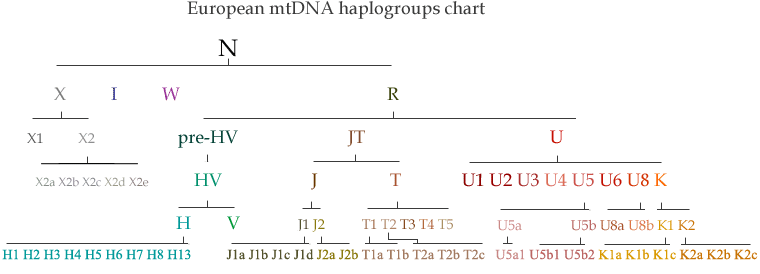
Haplogroup pre-HV is of particular importance because over the course of several thousand years, its descendants split off and formed their own group, called HV. This group - thanks in large part to a brutal cold spell that was about to set in - gave rise to the two most prevalent female lineages found in Western Europe.
While some descendants of these ancestral lineages moved out across Central Asia, the Indus Valley, and even back into Africa, your ancestors remained in the Near East. Descending from haplogroup pre-HV, they formed a new group, characterized by a unique set of mutations, called haplogroup HV.
Haplogroup HV is a west Eurasian haplogroup found throughout the Near East, including Anatolia (present-day Turkey) and the Caucasus Mountains of southern Russia and the republic of Georgia. It is also found in parts of East Africa, particularly Ethiopia, where its presence there indicates recent Near Eastern gene flow, likely the result of the Arab slave trade over the last two millennia.
Much earlier, around 30,000 years ago, some members of HV moved north across the Caucasus Mountains and west across Anatolia, their lineages being carried into Europe for the first time by the Cro-Magnon. Their arrival in Europe heralded the end of the era of the Neanderthals, a hominid species that inhabited Europe and parts of western Asia from about 230,000 to 29,000 years ago. Better communication skills, weapons, and resourcefulness probably enabled them to outcompete Neanderthals for scarce resources. Importantly, some descendants of HV had already broken off and formed their own group, haplogroup H, and continued the push into Western Europe.
Today, members of this line are part of the populations of Europe, West Asia (including Anatolia), and the Caucasus Mountains of South Russia and the Republic of Georgia.
This lineage accounts for around 21 percent of maternal lineages in Armenia. It is about 8 percent of those in Turkey and about 5 percent of those in Croatia. Across much of Europe, this line is present at low frequencies of around 1 percent. This lineage accounts for about 7 percent of the population of both India in South Asia and the United Arab Emirates in West Asia.
Some descendant branches that are now part of the populations of East Africa were introduced by the Arab slave trade of the last two millennia.
to be continued...
_________________
Impermanence.
continued...
Branch: H
Age: About 28,000 years ago
Location of Origin: West Asia
This wave of migration into western Europe marked the appearance and spread of what archaeologists call the Aurignacian culture, a culture distinguished by significant innovations in methods of manufacturing tools, standardization of tools, and use of a broader set of tool types, such as end-scrapers for preparing animal skins and tools for woodworking.
Around 15,000 to 20,000 years ago, colder temperatures and a drier global climate locked much of the world's fresh water at the polar ice caps, making living conditions near impossible for much of the northern hemisphere. Early Europeans retreated to the warmer climates of the Iberian Peninsula, Italy, and the Balkans, where they waited out the cold spell. Their population sizes were drastically reduced, and much of the genetic diversity that had previously existed in Europe was lost.
Beginning about 15,000 years ago - after the ice sheets had begun their retreat - humans moved north again and recolonized western Europe. By far the most frequent mitochondrial lineage carried by these expanding groups was haplogroup H. Because of the population growth that quickly followed this expansion, your haplogroup now dominates the European female landscape.
Today haplogroup H comprises 40 to 60 percent of the gene pool of most European populations. In Rome and Athens, for example, the frequency of H is around 40 percent of the entire population, and it exhibits similar frequencies throughout western Europe. Moving eastward the frequencies of H gradually decreases, clearly illustrating the migratory path these settlers followed as they left the Iberian Peninsula after the ice sheets had receded. Haplogroup H is found at around 25 percent in Turkey and around 20 percent in the Caucasus Mountains.
While haplogroup H is considered the Western European lineage due to its high frequency there, it is also found much further east. Today it comprises around 20 percent of southwest Asian lineages, about 15 percent of people living in Central Asia, and around five percent in northern Asia.
Importantly, the age of haplogroup H lineages differs quite substantially between those seen in the West compared with those found in the East. In Europe its age is estimated at 10,000 to 15,000 years old, and while H made it into Europe substantially earlier (30,000 years ago), reduced population sizes resulting from the glacial maximum significantly reduced its diversity there, and thus its estimated age. In Central and East Asia, however, its age is estimated at around 30,000 years old, meaning your lineage made it into those areas during some of the earlier migrations out of the Near East.
Haplogroup H is a great example of the effect that population dynamics such as bottleneck events, founder effect, genetic drift, and rapid population growth, have on the genetic diversity of the resulting populations.
Later migrations, such as those during the Neolithic Revolution and those triggered by the Bronze Age, brought additional groups containing different descendant branches of this line to Europe.
The highest percentage of this line in Europe is in Ireland, where it makes up 61 percent of the population.
to be continued if my daughter sends in a cheek swab for the Genographic Project 2.0 and we will see if we have Neanderthal relatives...
_________________
Impermanence.

This is where your ancestors and mine split up from each other.
Per 23andme I am T2b which split away from our mutual R ancestors as yours can be traced via pre-HV whereas mine went via JT.

Since one set of great grandparents left actual photos of themselves taken when they lived in Georgia (now in my sister's archival care) I guess mine would be the R group that moved across the Caucasus Mountains of Georgia.
This genetic info is fascinating.
| Similar Topics | |
|---|---|
| Toy Story 5 - please discuss |
01 Jul 2026, 7:15 pm |
| My short story is going to get published in a book :D |
28 Jun 2026, 2:52 am |