
Emergence of a Deadly Coronavirus



 12 Mar 2020, 8:52 pm

I stumbled onto a list of mitigation strategies for the coronavirus. So if you want to know more about what to do, if you find yourself in a hot spot, a community with a high number of infected individuals you might wish to explore these links:
Centers of Disease Control and Prevention (CDC)
Infectious Disease Society of America (IDSA)
World Health Organization (WHO)
_________________
Author of Practical Preparations for a Coronavirus Pandemic.
A very unique plan. As Dr. Paul Thompson wrote, "This is the very best paper on the virus I have ever seen."
12 Mar 2020, 9:34 pm
As of 4 hours ago:
23 states have declared states of emergency to fight coronavirus — here's what it means for them
_________________
Author of Practical Preparations for a Coronavirus Pandemic.
A very unique plan. As Dr. Paul Thompson wrote, "This is the very best paper on the virus I have ever seen."
12 Mar 2020, 10:02 pm
out of an abundance of caution i will chop off my hands, block off my lungs and rip off my face to prevent myself from touching my face or breathing in virus-infested particles.
Wouldn't it be simpler to buy a backpack with hydration reservoir so you can fill the bladder with sanitizer or rubbing alcohol?
I hear ticket sales to Mars are selling like hotcakes.

I think that buying an NBC suit would be less expensive to wear in public on Earth than it would be for buying oxygen tanks on Mars.
I doubt those suits are still available.
Not much good to you if they have all been bought out.
On the other hand, I hear scalpers have a whole lot of tickets to mars, but no refunds on purchase, however.
BTW, WOW! First time ever, I had to verify I am not a robot when doing a Google search. Bummer.

 12 Mar 2020, 10:10 pm
"coronavirus conference cancelled due to coronavirus"
then he told me that under it, someone had commented:
"conference of soothsayers cancelled due to unforeseen circumstances"


about balance/focus (they do something with beanbags, and balance boards). she was telling me i should do it, it helps in coordination and focus,
since our modern habits, often have us not using our brains in the correct way to coordinate and focus..
it is great to re-calibrate, or to improve if you suck at it already.
however, the class has been cancelled due to the fear of Coronavirus...
BTW, A psychologist once told me I have an "unbalanced personality".
Obviously, that was in reference to my "Executive Functioning" deficit/disorder, which is common amongst autistics.
I mean, EF in general, not *my* specific EF problems.
By way of Brazilian foreign dignitaries.This doesn't mean he has it but he has been exposed for sure.
I wish you would stop doing that.
ASPartOfMe
Veteran


Joined: 25 Aug 2013
Age: 68
Gender: Male
Posts: 39,637
Location: Long Island, New York
12 Mar 2020, 10:18 pm
Sophie Gregoire Trudeau, wife of Canada PM Justin Trudeau, tests positive for coronavirus
“Following medical advice, she will remain in isolation for the time being. She is feeling well, is taking all the recommended precautions and her symptoms remain mild,” according to a statement tweeted by Cameron Ahmad, the prime minister’s communications director.
Health professionals are set to reach out to people who have been in close contact with Gregoire Trudeau. The prime minister himself is in “good health with no symptoms,” Ahmad said.
As a precautionary measure and following the advice of doctors, he will be in isolation for a planned period of 14 days,” the statement added. “Also on the advice of doctors, he will not be tested at this stage since he has no symptoms.”
Trudeau will address Canadians on Friday, the statement said.
Gregoire Trudeau thanked people in a personal statement that Ahmad shared on Twitter. She said although she is experiencing “uncomfortable symptoms of the virus, I will be back on my feet soon,” and noted that other Canadian families and patients may be facing more serious health concerns.
Gregoire Trudeau had recently returned from a speaking engagement in London and began exhibiting “mild flu-like symptoms including a low fever” late Wednesday.
As of Thursday, Canada has at least 138 confirmed cases, according to government data
_________________
“Self Acceptance is a process not a performance”
“You are autistic enough. And you always have been”
Professionally Identified and joined WP August 26, 2013
DSM 5: Autism Spectrum Disorder, DSM IV: Aspergers Moderate Severity.
12 Mar 2020, 10:22 pm
Resinferatoxin would be better than habanero.
Lol that’ll fix em.
I somehow think that regardless of what you spray on the wall, people will still lick it.
What about this?
You can hire me for $US80 an hour. No call out fee if booked for 3 hours or more.


 13 Mar 2020, 3:30 am
For several weeks now the percentage of people who had recovered from the virus has been 94%, and the percentage of dead has been a consistent 6%.
Now the number of cases which have had an outcome is 73,862
But only 93%, 68,898, of them have recovered/been discharged, ....
and 7%, 4,964, have now ended in death.
Italy is the second "oldest" population group of the world.
Yes, it is, and Japan is the oldest, with 28% of its population over 65.
And the USA, UK, Europe generally and Australia all have populations with much higher than average percentages of people over 65.
Whereas the world average is 8.5% over 65, and China has around 11%, the USA and Australia have 16%, the UK 18%, Spain 19%, France 20% and Germany 21%.
Most of the cases in the figures for "cases with an outcome" ( recovery or death ), are for the cases in China, where the number of old people is significantly less than for many of the richest most "developed" societies of the West.
This suggests that the number of deaths per number of identified cases is likely to go up over the coming months. 7% death is already a pretty alarming number, even if it is "only" the percentage of *confirmed* cases with "an outcome".
Last edited by ouinon2 on 13 Mar 2020, 3:36 am, edited 1 time in total.
 13 Mar 2020, 3:35 am
For several weeks now the percentage of people who had recovered from the virus has been 94%, and the percentage of dead has been a consistent 6%.
Now the number of cases which have had an outcome is 73,862
But only 93%, 68,898, of them have recovered/been discharged, ....
and 7%, 4,964, have now ended in death.
do you think that is because of it's spread in areas with higher populations of elderly (like italy, the west)
or because...people are getting reinfected and it is killing them the second time around?
keep us posted
_________________
הייתי צוללת עכשיו למים
הכי, הכי עמוקים
לא לשמוע כלום
לא לדעת כלום
וזה הכל אהובי, זה הכל.
ASPartOfMe
Veteran
Joined: 25 Aug 2013
Age: 68
Gender: Male
Posts: 39,637
Location: Long Island, New York
13 Mar 2020, 4:44 am
Australian politician who met Ivanka Trump, Attorney General William Barr infected with coronavirus
Peter Dutton, who is Australia's minister for home affairs, released a statement saying he has been diagnosed with the virus, known formally as COVID-19, and admitted to the hospital, where he is in isolation. Dutton's proximity to President Donald Trump's daughter on March 6 could increase pressure on the president to get tested for the virus.
Australia has more than 120 cases of COVID-19.
Chinese diplomat claims US military brought the coronavirus to Wuhan
Posting to his more than 300,000 followers on Twitter, Foreign Ministry spokesman Zhao Lijian republished a video of Robert Redfield, the director for the US Centers for Disease Control and Prevention, addressing a US Congressional committee on March 11.
In the clip, Redfield said some influenza deaths in the US were later identified as cases of Covid-19, the disease caused by the novel coronavirus.
Redfield didn't say when those people had died or over what time period, but Zhao pointed to his remarks as proof of a growing conspiracy theory that the coronavirus did not originate in Hubei province in central China.
"CDC was caught on the spot. When did patient zero begin in US? How many people are infected? What are the names of the hospitals? It might be US army who brought the epidemic to Wuhan. Be transparent! Make public your data! US owe us an explanation!" the Foreign Ministry official said.
Hundreds of athletes from the US military were in Wuhan for the Military World Games in October 2019.
The video of Redfield was also published to Twitter by other state media outlets, including national broadcaster CCTV and the popular Global Times tabloid.
On Friday, Zhao's fellow Foreign Ministry spokesman Geng Shuang said there were "varied opinions" on the origin of the virus in the international community.
"China always considers this a scientific question, which should be addressed in a scientific and professional manner," he said, avoiding questions on whether Zhao's tweet represented the Chinese government's official position.
Parts of Chinese social media, and even the country's government, appear to have launched a concerted campaign to question the origin of the novel coronavirus, which has infected more than 125,000 people globally.
The first reported cases of the virus were in Wuhan, and since then the city has had more infections and deaths than anywhere in the world.
Speaking in his official capacity at a press conference in Beijing on March 4, Zhao told reporters that "no conclusion has been reached yet on the origin of the virus" -- and Chinese scientists were still tracing where it came from.
On February 27, renowned Chinese infectious disease expert Zhong Nanshan also questioned where the coronavirus had come from.
"The infection was first spotted in China but the virus may not have originated in China," Zhong said at a press conference.
On Thursday, Hua Chunying, Zhao's boss who heads the Chinese Foreign Ministry's Department of Information, tweeted a link to Redfield's testimony, saying it was "absolutely wrong and inappropriate to call this the Chinese coronavirus."
China's ambassador to South Africa, Lin Songtian, took to Twitter on March 8 to say that although the first epidemic was recorded in China, it didn't mean the virus "originated from China."
However, Zhao's colleague Geng cautioned Thursday that the origin of the virus could only be determined "by science."
"We don't hope to see anyone making an issue out of this to stigmatize other countries," he said. "With COVID-19 developing into a pandemic, the world should come together to fight it instead of leveling accusations and attacks against each other, which is not constructive at all."
Zhao's comments are another example of Chinese government figures using Twitter to defend China against criticism -- despite the platform being banned in the country, along with Facebook, Instagram and a number of other prominent Western social media sites.
The Coronavirus Outbreak And The Challenges Of Online-Only Classes
Ohio State. Harvard. University of Virginia. University of Michigan. Duke. These are just some of the more than 100 universities across the country that are moving classes online.
Lecture halls will be empty. Labs closed. Concerts cancelled. Sports practices called off. Some universities are asking students to go home early for spring break, and if on break now, not to return to campus at all.
A massive shift like this is unprecedented in higher education. It's led to an onslaught of questions for online learning specialists such as Karen Costa.
"I think like many folks there has been a lot of shock and stress on a personal and professional level," Costa says. "My first instinct after that initial shock was how can we get our students and faculty the support that they need to navigate this crisis?"
She has been fielding questions on twitter, giving webinars online, and uploading youtube tutorials, all in hopes of easing this transition — which she admits is less than ideal.
"To ask someone to go from a land based course to an online course without any previous online teaching experience is a huge ask and it's not something that can be done overnight," Costa says. "And we're trying to do it overnight."
She has spoken with professors who don't have staff or online systems in place to support the shift.
And Costa worries about the digital divide: if students aren't allowed back on campus some may not have access to reliable internet. As a result, students might drop out.
And online learning isn't for everyone.
"I'm worried about classes being cancelled physically, because me and virtual online learning does not get along," says Ohio State senior Cartier Pitts. "I don't like learning online so it's going to be a rough two weeks."
And much longer than two weeks for some schools. Pitts worries these changes could keep her from graduating on time.
The move has raised other critical questions about campus life: Just how safe is it to have students on campus at all?
"It's worth first thinking about people of college age they are not at great risk of getting severely ill with the virus that causes COVID-19," says Andrew Pavia, chief of pediatric infectious diseases at the university of Utah. "But they can act as tremendous amplifiers of the epidemic. And the behaviors that young people have in college: spending a lot of time close together, intimate contact, sharing food and drink, make the the spread of viruses in that setting a pretty high liklihood."
evicting students from their dorms altogether carries its own set of risks: some of the students may not have anywhere else to go.
_________________
“Self Acceptance is a process not a performance”
“You are autistic enough. And you always have been”
Professionally Identified and joined WP August 26, 2013
DSM 5: Autism Spectrum Disorder, DSM IV: Aspergers Moderate Severity.
13 Mar 2020, 5:09 am
For several weeks now the percentage of people who had recovered from the virus has been 94%, and the percentage of dead has been a consistent 6%.
Now the number of cases which have had an outcome is 73,862
But only 93%, 68,898, of them have recovered/been discharged, ....
and 7%, 4,964, have now ended in death.
I don't know.
But this amazing and brilliant blog post on Medium, which presents the data and a hopefully galvanising comprehensive analysis of the situation, might be helpful!! !
https://medium.com/@tomaspueyo/coronavi ... d3d9cd99ca
The take home message is "Act now!". Self-isolate or enable/encourage/impose serious social distancing NOW!
13 Mar 2020, 5:23 am
By way of Brazilian foreign dignitaries.This doesn't mean he has it but he has been exposed for sure.
I wish you would stop doing that.
What am I doing you don't like
_________________
Forever gone
Sorry I ever joined
Biscuitman
Veteran

Joined: 11 Mar 2013
Age: 46
Gender: Male
Posts: 2,674
Location: Dunking jammy dodgers
13 Mar 2020, 7:14 am
I came across an article this morning that provided a good analysis of the threat posed by the Coronavirus.
The first person to die from coronavirus on American soil passed away on Feb. 29 at a Seattle area hospital – incidentally, the same hospital where my daughter was born just ten and a half months ago.
For epidemiologists, the most important unanswered question about the Wuhan coronavirus, or COVID-19, is the case-fatality rate. But for the general public, the question is much more personal: “Might I – or anyone I love – get sick and die?” When faced with uncertainty, people make decisions cautiously, and they base them on emotion and personal experience instead of statistics. If enough people answer “Yes,” there could be major repercussions as panic sets in around the world. Small behavioral modifications, such as telecommuting or reducing factory activity to avoid spreading the disease, made by millions of people can have a large impact. The United Nations already estimated $50 billion worth of exports worldwide will be affected, excluding non-trade economic activities such as travel tourism, as manufacturing slows and governments impose measures like port restrictions. This is why it is necessary to develop a “risk of death” profile for COVID-19.
The first substantial effort to do just that was published by the Chinese Center for Disease Control and Prevention. Though these numbers should be thought of as preliminary (and perhaps specific to only China), they allow us to begin to comprehend the risk that our global society is facing. After analyzing 44,672 confirmed cases, Chinese health officials estimated the case-fatality rates by age group: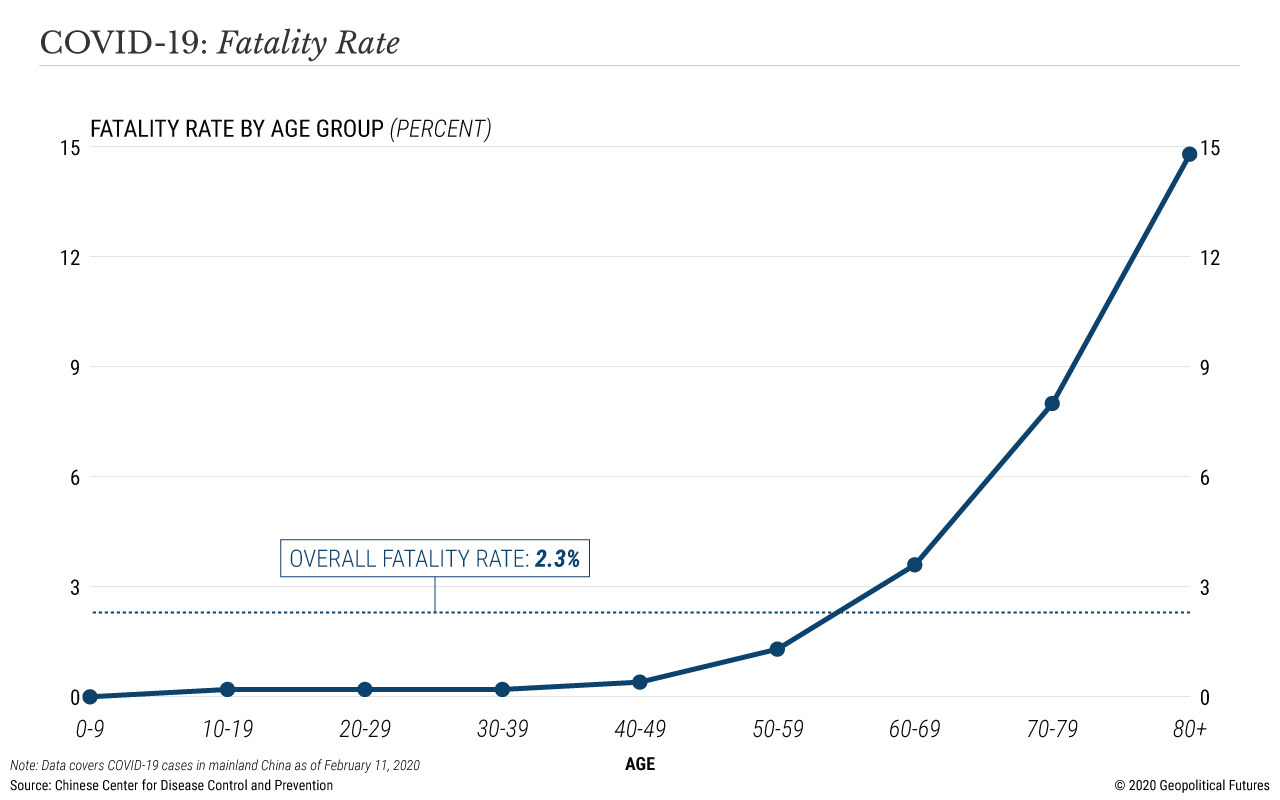
Of the 416 children aged 0 to 9 who contracted COVID-19, precisely zero died. This is unusual for most infectious diseases, but not for coronaviruses; the SARS coronavirus outbreak also had minimal impact on children. For patients aged 10 to 39, the case-fatality rate is 0.2 percent. The case-fatality rate doubles for people in their 40s, then triples again for people in their 50s, and nearly triples yet again for people in their 60s. A person who contracts COVID-19 in their 70s has an 8 percent chance of dying, and a person in their 80s a nearly 15 percent chance of dying.
The virus can be lethal in a variety of ways. Viral infections in the lungs can trigger an immune response so strong that it fatally damages the lungs. In others, a systemic immune response, called a “cytokine storm,” can cause multiple organ failure. This could explain why some young, healthy people are killed by the virus, such as Dr. Li Wenliang, the 34-year-old doctor who died shortly after alerting the world to this new strain of coronavirus. An older person’s immune system may not be able to fight a respiratory virus. Underlying conditions such as high blood pressure or diabetes can worsen outcomes.
The above statistics are no doubt frightening numbers. But there are at least three major mitigating factors. First, the number of mild or asymptomatic cases is unknown and probably substantial. Second, China is still a poor country with low-quality health care and, at the epicenter of the outbreak in Hubei province, was overwhelmed by the virus. (The case-fatality rate in Chinese provinces outside Hubei, where hospitals aren’t overloaded, is much lower.) Third, smoking is much more prevalent in China than America, especially among men (52 percent in China versus 16 percent in the U.S.), and smoking is a risk factor for poor responses to respiratory infections. Together, this means the case-fatality rate is likely inflated, and it would be a mistake to apply these figures to the United States or other advanced nations.
The real question, then, is how inflated the case-fatality rates are. At this point, it’s impossible to determine because scientists are still collecting data on how widespread the virus is. But to get a sense of how exaggerated these numbers might be, it is useful to examine the case-fatality rate for seasonal influenza. For the 2018-19 influenza season, the U.S. Center for Disease Control and Prevention provides estimates for the number of cases (defined here as “symptomatic illnesses”) and deaths. From these, we can derive case-fatality rate estimates by age group.
If COVID-19 ends up being similar to seasonal influenza, then the case-fatality rates for COVID-19 are inflated by a factor of 20 to 100. Dr. Anthony Fauci, head of the U.S. NIAID, co-authored an editorial for the New England Journal of Medicine in which he wrote:
“If one assumes that the number of asymptomatic or minimally symptomatic cases is several times as high as the number of reported cases, the case fatality rate may be considerably less than 1%. This suggests that the overall clinical consequences of Covid-19 may ultimately be more akin to those of a severe seasonal influenza (which has a case fatality rate of approximately 0.1%) or a pandemic influenza (similar to those in 1957 and 1968) rather than a disease similar to SARS or MERS, which have had case fatality rates of 9 to 10% and 36%, respectively."
We have reason to believe this view is closest to reality. In South Korea, public health officials screened about 100,000 people and detected over 7,300 cases. So far, the death toll is 50, which translates to a case-fatality rate of 0.7 percent. That’s still seven times worse than seasonal flu, but it’s far lower than the initial reports from China.
Stat News describes two possible scenarios that epidemiologists envision for the future of COVID-19. In the first, COVID-19 becomes just another cold virus, and possibly evolves to become less lethal as well. What we call the “common cold” is actually caused by roughly 200 different viruses. Each year, about 25 percent of common colds are due to four coronaviruses, and some scientists think COVID-19 could eventually join this group as its fifth member. In the second scenario, COVID-19 behaves more like a severe seasonal flu, vanishing in the summer and returning to hit us hard in the winter.
In neither scenario does COVID-19 resemble the Spanish flu of 1918, which disproportionately killed young people. In neither scenario does the virus mutate to become more lethal. Most likely, the opposite will be true. There is an inverse relationship between lethality and contagiousness; that is, the most contagious viruses tend to be less lethal. Evolutionary pressures – namely, the biological imperative to reproduce as far and wide as possible (which means not killing people) – may push COVID-19 down this path.
For now, influenza remains the far bigger global public health threat. Each year, about 1 billion people become infected with seasonal flu, killing some 300,000 to 500,000. This season alone (2019-20), about 20,000 Americans have died from flu, including 136 children. Yet, very few people fear the flu. Society has accepted it as part of reality, and people carry about their daily lives without excessive concern over influenza. This is the likely future for COVID-19.
Until then, perhaps the last word should be given to virologist Dr. Lisa Gralinski, who told The Scientist, “If you’re over fifty or sixty and you have some other health issues and if you’re unlucky enough to be exposed to this virus, it could be very bad.” While everyone else should remain vigilant and take proper precautions (e.g., washing hands and avoiding crowds) until more data comes in, from a scientific perspective the public alarm is disproportionate to the risk.
Source: Most Important Coronavirus Question: Will I Get Sick And Die?
_________________
Author of Practical Preparations for a Coronavirus Pandemic.
A very unique plan. As Dr. Paul Thompson wrote, "This is the very best paper on the virus I have ever seen."


