
Emergence of a Deadly Coronavirus




 29 Feb 2020, 9:19 pm

But as far as I can see it wouldn't make any difference to how world governments approach it.
Epidemiological research requires an understanding of ground zero where the virus first arose to properly inform treatment protocols. The Chinese government's reluctance to share information on viral biolab facility just next door to the virus outbreak plus sudden new protocols on security in such labs in Wuhan is highly suspicious.
I read about that lab and what it does. I do not remember the details, but it is not the kind of lab that produces bio-weapons or anything that would cause the virus. That is why it is not outside of a populated area like the labs which really do produce that sort of thing.
 29 Feb 2020, 9:34 pm
I'm not necessarily saying it's a bioweapons facility but the Insitutute of Virology does experiment on viruses. I agree with Prof. Richard Ehbright from Rutgers University who told BBC China that the possibility of the virus entering the population due to a laboratory accident should not be ruled out.
https://www.bbc.com/zhongwen/simp/chinese-news-51388024
Based on this risk the CHinese should be more open and transparent in the interests of wiping this virus out.

 29 Feb 2020, 9:51 pm
I hadn't thought of the practical use for disease management/response in having as much information as possible about a virus' origins, evolution, growth environments etc but it's a very good point! ...
And yes, I suppose that ideally China/any country should be liable to pay compensation of some kind for acts of negligence which impact other countries .... but imagine what an international can of worms that might open.
I was wondering if certain countries are even now quietly negotiating some sort of reparations deal together behind the scenes, as it surely won't have escaped the beady eyes of certain national intelligence services that there is something suspicious or at least questionable about the particular location of this outbreak, ( just as there was about the white hot missile flare spotted by U.S. satellite shortly before the passenger plane crashed in Iran recently ).
But perhaps no one, amongst the "big nations", wants to go down that route, because of plastic waste, toxic algae-bloom, global warming caused sea level rise flooding island nations, the introduction of European diseases to the Amazonian basin erasing a whole society, among a great many other things?
I don't know, but demanding a "trial"/examination of China's "guilt"/responsibility in this case and suitable damages/penalty might set a rather dangerous precedent. Depending on the limit set on old cases some peoples might want to claim for harms suffered as the result of the invention of agriculture.

But I agree that China should definitely make all useful data available for Epidemiological purposes ... ...
.... which reminds me that I read that the Shanghai disease research laboratory which released the genome structure online for use by labs worldwide has since been closed down, for "rectification", all activity suspended, by the Chinese government. The scientific staff are completely puzzled, and frustrated, asking why they aren't allowed to carry on working on the virus to help with analysis and possible creation of a vaccine etc.

Last edited by ouinon2 on 29 Feb 2020, 10:47 pm, edited 2 times in total.
 29 Feb 2020, 10:35 pm
Harvard epidemiologist Eric Feigl-Ding says this is just the tip of the iceberg. The epidemic has likely been spreading in the US for 3 to 4 weeks. Mild cases have 2 to 3 weeks duration, but severe cases have 3 to 6 weeks duration. The man who died has had it for at least 3 weeks, and he likely caught it in the community:
The actual number of cases right now may run into the hundreds to over a thousand people. However, Dr. Feigl-Ding says that travel restrictions are likely no longer helping. The lack of testing is a major problem here, until a few days ago, we had performed fewer than 500 tests, while South Korea had performed over 90,000. Due to the problems in the CDC kits earlier this month, we've lost 2 weeks of preparation.
Today, in Washington State, a health care worker at a nursing home and a patient there tested positive, and over 50 people in the nursing home are now sick, including many staff members:
https://www.statnews.com/2020/02/29/new ... ing-homes/
A lot of the outbreaks occuring in the different states do not appear to be directly related to each other, which is even more concerning.
_________________
"You have a responsibility to consider all sides of a problem and a responsibility to make a judgment and a responsibility to care for all involved." --Ian Danskin
29 Feb 2020, 10:42 pm
The actual number of cases right now may run into the hundreds to over a thousand people. However, Dr. Feigl-Ding says that travel restrictions are likely no longer helping. The lack of testing is a major problem here, until a few days ago, we had performed fewer than 500 tests, while South Korea had performed over 90,000. Due to the problems in the CDC kits earlier this month, we've lost 2 weeks of preparation.
Today, in Washington State, a health care worker at a nursing home and a patient there tested positive, and over 50 people in the nursing home are now sick, including many staff members:
https://www.statnews.com/2020/02/29/new ... ing-homes/
A lot of the outbreaks occuring in the different states do not appear to be directly related to each other, which is even more concerning.
How do you think this could have been minimized? How do you think the U.S. could have handled things differently?
29 Feb 2020, 11:01 pm
I think that it could perhaps have been minimised by having long term permanent measures or systems which increase resilience;
.... automatic adequate sick pay; plentiful free/nationally subsidised hospitals and health care; free education accessible to all ages; a press that isn't allowed to tell lies/that is fact-checked at source/pre-"publishing" and which helps to keep people well informed, ( rather than acting as mouthpieces for political and commercial intetests ); greater connection and cooperation between people on a smaller local community basis as well as more widely online; politicians/leaders and administrators that care about their society rather than their paychecks, bonuses and approval ratings; good nutrition and healthier lives spent more active physically, out in the sunlight/daylight which increases the production of Vitamin D which strengthens the immune system and is particularly important for lung health/fighting off pulmonary diseases; less inequality/better pay/fairer pay for the "lowly" but so important careworkers, nurses, cleaners, cooks, clerical staff, security guards, teachers, etc. That might have helped.
29 Feb 2020, 11:45 pm
The actual number of cases right now may run into the hundreds to over a thousand people. However, Dr. Feigl-Ding says that travel restrictions are likely no longer helping. The lack of testing is a major problem here, until a few days ago, we had performed fewer than 500 tests, while South Korea had performed over 90,000. Due to the problems in the CDC kits earlier this month, we've lost 2 weeks of preparation.
Today, in Washington State, a health care worker at a nursing home and a patient there tested positive, and over 50 people in the nursing home are now sick, including many staff members:
https://www.statnews.com/2020/02/29/new ... ing-homes/
A lot of the outbreaks occuring in the different states do not appear to be directly related to each other, which is even more concerning.
How do you think this could have been minimized? How do you think the U.S. could have handled things differently?
Well, for a biggie, we could have gotten our act together on testing much faster. Testing helps you see where you're having cases, which allows you to engage in contact tracing and isolation of affected individuals. This would not have completely stopped the spread, probably, but it would have helped us massively slow it down. I find it inexcusable when other developed countries have had working tests for a while. I feel part of our problem was that we tried to reinvent the wheel with regard to testing; Hawaii had been asking to use Japan's testing equipment for a while, for example, but never got approved:
https://www.hawaiipublicradio.org/post/ ... n#stream/0
_________________
"You have a responsibility to consider all sides of a problem and a responsibility to make a judgment and a responsibility to care for all involved." --Ian Danskin
29 Feb 2020, 11:48 pm
PS. I think that all of the above measures, and others like them which increase resilience would have helped because they would have encouraged and enabled people to pay attention, to notice things.
I think this virus thrives on lack of attention, on most people not noticing very much because they are numbed out and blinded and deafened by working too hard, rarely getting more than 6 hours sleep a night, by constant stimulation, sights and sounds and smells, and sugar ( which is a painkiller and spaces you out ), and stress.
There's a theory that humans have such fine/precise colour sightedness because of its evolutionary advantage in combination with human's relatively hairless faces, which is being able to see and distinguish many different facial colourations indicating emotional reactions etc but also very importantly health.
I think if people were able to spend the time that it takes to see things properly rather than as rapid outlines, this disease would not be spreading so fast. It wouldn't be so invisible, so successfully camouflaged in a society in which people slept well, ate well, walked and sat in sunshine daily, in which environments were quieter, slower, etc.
As it is many people seem to see the slightest sign of illness as reason to take combinations of caffeine and paracetamol etc to lower fever, kill the pain and get them into work, ie. to pay even less attention.
Last edited by ouinon2 on 01 Mar 2020, 2:51 am, edited 2 times in total.


 01 Mar 2020, 12:42 am
I think we are beyond talking about containment. That battle has been lost a long time ago. It's time to talk about the end game.
Here is one opinion: https://finance.yahoo.com/news/coronavirus-end-game-look-000023845.html
The genie is already out of the bottle. The best one can do now is just to boost one's overall health resilience. Exercise probably helps.
Vaccines? That's for the next winter. Seriously, who would dare to get a vaccine developed in a hurry? Compassionate-use experimental drugs, yes. But vaccines? I doubt it.
Last edited by eikonabridge on 01 Mar 2020, 12:58 am, edited 1 time in total.
01 Mar 2020, 12:47 am
This is precisely the reason why i) the communist party clamped down early on information getting our delaying a proper response by at 3-4 weeks. ii) by blocking information about the origin of the virus the Chinese can hide any negligence on their part to reduce the risk of compensating countries impacted.
The initial actions by the CCP aren't that different though to US intelligence agencies who would probably do the same thing if one their experimental labs was compromised.
Of course now there is no excuse, transparency is essential.
01 Mar 2020, 12:51 am
The long incubation periods and the strong prospect of non-symptomatic individuals being carriers probably means the US is likely to have an epidemic.
The need for quick mandatory testing of people may have to be expanded to everyone but how practical is that? furthermore there is no quick assay for the virus, it requires extensive sputum sampling.
01 Mar 2020, 1:02 am
South Korea has ~3,000 confirmed cases back then and has performed 90,000 sample testings. That is 30:1 ratio.
Taiwan has ~40 confirmed cases and has performed 16,000 sample testings. That's 400:1 ratio.
US did not even have enough test kits.
That is, Taiwan is currently testing 400 people to try to catch just one true positive case. You can see how wide a net they are casting. US is nowhere close. Taiwan has finished testing all recent hospitalized pneumonia cases last week, and caught a few cases and proactively chase down all people contacted. It's worthy of a detective novel.
Taiwan has 1,100 negative pressure isolation rooms.
Western Europe and Japan each has about 1,800 such rooms.
The US has only 400 (from data that I could find, could be slightly more today).
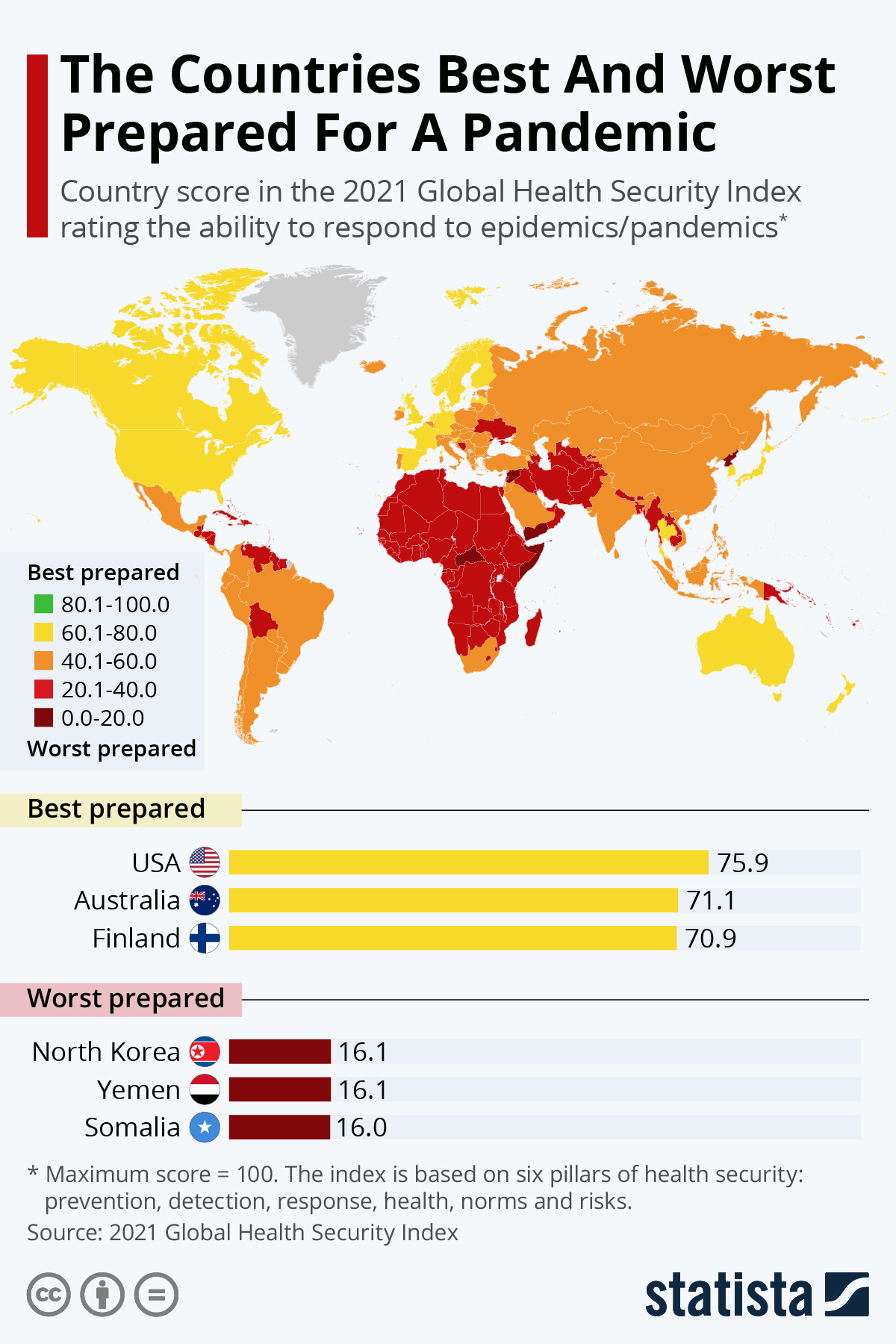
Why is US so behind in epidemic-control infrastructure? Well, because US enjoys some natural protection layers that other countries don't have. First of all, US has a widespread land. Secondly, people moves around in passenger cars. So, US has become complacent, and lags behind in infrastructure and experience in handling epidemics.
When the first batch of evacuees came home, US found itself in an awkward situation: there were simply no test kits to check on the evacuees. Some cases took 5 days to confirm. Taiwan checks about 2,500 cases per day.
US has advanced pharmaceutical technology. But that is not epidemic healthcare. In epidemic healthcare, US is behind.
Last edited by eikonabridge on 01 Mar 2020, 1:03 am, edited 1 time in total.


