cyberdad wrote:
Fnord wrote:
.One prankster, maybe not … two pranksters would make it easier and quicker. A half-dozen pranksters might be required for some of the more elaborate patterns, while also providing more lookouts. It's amazing how much can be accomplished in one night by a group of drunken frat boys
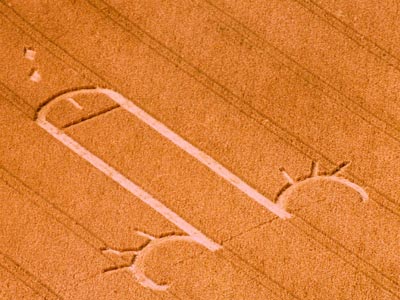
Seriously how do inebriated frat boys create this (below) in the pitch dark??
https://www.nature.com/articles/465693a.pdf?origin=ppubWith 27 stakes, 27 balls of twine, 27 planks, 12 conspirators (7 of who have the "blind staggers"), lots of preparation, and lots of experience with previous patterns.
cyberdad wrote:
If you read the 2010 Nature article the author suggests artists using microwave generators.
"Suggests" does not mean "Prove", and "Anecdote" does not mean "Evidence".
cyberdad wrote:
Given the patterns (although simpler) have a history going back to the 1600s there is perhaps more than meets the eye.
I "suggest" that a fraternal organization such as the Oculists or the Freemasons -- both of which rely heavily on geometry and mathematic formulae in their rituals --
may have been involved from the beginning. But that's only speculation. Even then, nothing but a crew of well-organized people need be posited for these "circles" to exist.
"... today’s patterns are mapped out using computers, laser pointers and satellite equipment, and artists work in coordinated teams. Bower once used only a crude sight, consisting of a circular wire dangling from his cap, to guide his lines. Other traditionalists used wooden planks, string and garden rollers. Artists even used bar stools to vault over regions of undisturbed crop. But there are signs that modern techniques are reaching their limits: in 2009, for the first time, one pictograph was created over three nights, potentially compromising the secrecy tenet."