
Shocking study finds most will torture if ordered


 19 Dec 2008, 11:11 pm

By Maggie Fox, Health and Science Editor – Fri Dec 19, 1:20 pm ET
http://news.yahoo.com/s/nm/20081219/od_nm/us_torture_odd;_ylt=Agqk8tpyJirZ35CzNfgdn6ESH9EA
Seventy percent of volunteers continued to administer electrical shocks -- or at least they believed they were doing so -- even after an actor claimed they were painful, Jerry Burger of Santa Clara University in California found.
See linked article for more.
 20 Dec 2008, 12:07 am
What's next? A replication of the "Stanford Prison Experiment"?
They had to stop short of faking the heart attack though... In spite of the fact that some of the people involved may experience negative side-effects from the study, I think the study itself is important. It's like brain study. I certainly don't want researchers cavalierly cutting into people's brains, and yet, I think the study of brain function is tremendously important. I also think it's important to know over the course of time if those kinds of behaviors have been influenced by changes in culture, so that we can identify their causes. They don't appear to have been affected, which doesn't mean that they're not influenced by culture, but at least that if they are going to be influenced by culture, we haven't yet discovered the specific cultural attitude (or collection) that will change it. I would actually really like to see Berger go a step further and give big-five personality questionnaires to all the people who took part in this one after the fact, to see if there's a correlation between the person's willingness to obey the order and one or more of the currently studied personality traits.
 20 Dec 2008, 12:35 am
What's next? A replication of the "Stanford Prison Experiment"?
They had to stop short of faking the heart attack though... In spite of the fact that some of the people involved may experience negative side-effects from the study, I think the study itself is important.
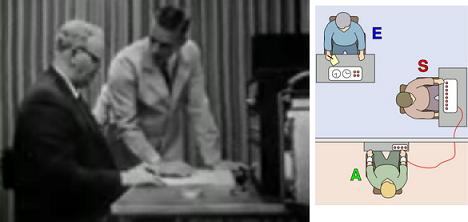
Keep in mind that this study is a replication of Stanley Milgram's famous identical study, performed in 1961, and subsequently deemed unethical, despite its importance.
It does provide important insight into human behavior and is often cited in efforts to explain how so many normal people became Nazis and carried out acts of torture during WWII, for example. And, in general, all studies, especially ones as important as this one, should be replicated for the sake of validity.
I'm just surprised by this because of all the ethical questions that were raised, even shortly after Milgram's original study was carried out. I've heard a lot of research psychologists say, "No one could get away with that today! The proposal would never be approved by the ethics committee!" But someone did it!

 20 Dec 2008, 1:33 am
...
I'm just surprised by this because of all the ethical questions that were raised, even shortly after Milgram's original study was carried out. I've heard a lot of research psychologists say, "No one could get away with that today! The proposal would never be approved by the ethics committee!" But someone did it!
Much like the Little Albert experiment. http://en.wikipedia.org/wiki/Little_Albert_experiment
My guess would be that they made an educated guess about the point at which the trauma experienced by the teacher would be worth the scientific value (they're gonna tell everyone afterward anyway and at a certain point, most people who aren't already unstable can recover from the experience once they know it was faked -- i.e. watching a suspense movie and having nightmares). Their guess would have been based on other emotional trauma and recovery studies that have been carried out in recent years.
And then they layered on top of that the fact that unlike in Milgram's original experiment, the fact that they could choose to quit at any time was reinforced a couple of times prior to the start of the experiment. That reinforcement seems to have been enough to produce a variance in the result (fewer people getting to the 150volt level where they ended it short), but not a statistically significant variance.
The combination of those two things apparently was enough to convince the ethics board that it was a small enough risk compared to the scientific value.
Although I admit, the setup for the thing still has a creepy, Outer Limits kind of feel to it.
 20 Dec 2008, 1:52 am
Ironically, just moments ago, I read this very same article. And it's always disturbingly sick! But human nature just...is.
Also ironically, I wrote to another today about related: The antipathy of those who WITNESS atrocities, and do nothing! This is very common too. I wrote to her about the anti-Semitic activites that had occured (WWII era), ultimately the Holocaust. Although there were plenty of people who were not instigating this or even 'supporting' it, per se, they nevertheless WATCHED...and looked away. As if being impassive somehow excuses them - it doesn't.
The reason I had written this (above) was in regard to how Autists (I don't mean to generalize, but in trait) just don't conform to societal standards - I think we all can attest to that; we're socially awkward and just 'don't fit in.' BUT - we are rather impervious to peer pressure too.
I know some highly selfless Aspies, and plenty here on Wrong Planet. Even if it's not 'politically correct' for someone to say, "NO! That's wrong!" An Autist will do just this.
I think, in some ways, our aloofness is really a gift. We don't follow the herd - and don't need to follow those orders.
I also read (and don't forget): Autistic guy who was hit my a car. He was hit by running out into traffic. But why? There was a stray dog in the street - this guy instantaneously jumped to save that dog. Even risking his own life. And that's why I'm proud to be an Aspie.
_________________
The ones who say “You can’t” and “You won’t” are probably the ones scared that you will. - Unknown
20 Dec 2008, 2:07 am
Yeah, that's called the Bystander Effect. The bigger the herd, the more likely they are to allow someone to suffer.
http://en.wikipedia.org/wiki/Bystander_effect
Has also been measured in a lab setting, interestingly enough.
Bingo!
 20 Dec 2008, 2:31 am
Oh dear ! I have to ask the question of what was the point of repeating the Stanley Milgram work. I hold a view that some experiments are best never done, or at least never repeated becuase they will cause so much damage or harm.
I have moral trouble with all three experiments, but the one which troubles me most is the Little Albert experiment
By the way the "Stanford Prison Experiment" has been repeated for UK TV with some modifications. http://bama.ua.edu/~sprentic/672%20BBC% ... %20exp.htm
http://www.timeshighereducation.co.uk/s ... ode=198937
http://www.timeshighereducation.co.uk/s ... ode=166918
According to the Times Higher the UK one went very differently.
_________________
Health is a state of physical, mental and social wellbeing and not merely the absence of disease or infirmity
 I am not a jigsaw, I am a free man !
 Diagnosed under the DSM5 rules with autism spectrum disorder, under DSM4 psychologist said would have been AS (299.80) but I suspect that I am somewhere between 299.80 and 299.00 (Autism) under DSM4.
20 Dec 2008, 2:53 am
I wonder too why this experiment need be repeated; the 1st was sufficient, yes? Verifiable, by scientific method, yes?
As a given: Human psychology hasn't changed or evolved over the decades! Why re-test?
If one repeats the error, repeatedly, then given the same circumstances with the same variables, they'll do it again.
Worse, the experiment, whichever version, plays out in reality on an everyday basis. But not of this magnitude (I hope).
_________________
The ones who say “You can’t” and “You won’t” are probably the ones scared that you will. - Unknown
20 Dec 2008, 4:05 am
Because we don't necessarily know that it is indeed human nature (and therefore immutable). There are quite a few things about the ways that aspies work, which are counter to what is generally considered to be "human nature". It is human nature to lie... a lot... pretty much every day. Aspies don't. It's human nature to mirror and enjoy eye-contact, yet many of us find eye-contact quite painful. (When I was little it was rather uncomfortable. As an adult I've grown accustomed to it and mostly worry that I don't do it to others' satisfaction.) So in our case neuropathy has altered what is generally held to be roughly immutable "human nature".
Without some kind of follow up to the original Milgram experiment, we can't really conclude that what was seen in the original experiment is indeed "human nature" and that it's not heavily influenced by some sort of cultural bias. And it may change even yet ... consider that the amount and kind of exposure people had to mass media when Milgram performed it is very different than the amount and kind of exposure people have today. If a person grows up in an environment dominated by say Twitter, will that change the way they view authority? Knowing these things gives us a better insight into how to handle things like for example oversight on an ethics committee and how to enact effective public policy that will help to continue to improve the general well-being of our populations.
I am glad though that the experiment was curtailed.
And I do tend to think of the Little Albert experiment as being the most cruel. People say "presumably he would have reconditioned automatically in his new environment", but I'm not so convinced. Who's to say that his parents would force him to recondition? They might just choose to avoid his having any contact with animals and he grow up terrified of them. His mother supposedly didn't know about the experiment, so there's no special reason she would force him to get over the fear. My mother worried that I would spend 8 hours in a room not moving, reading a book at the age of 2. It wasn't until 30 years later that I finally started to get help for the problems that followed that symptom. Perhaps something similar happened to Albert.
 20 Dec 2008, 5:17 am
I remember first hearing about the Milgram experiment in high school. It was presented as an experiment with ethical issues. I didn't fully understand the issues at the time, and wondered what the big deal was since nobody was really being shocked after all, and for some reason the fake screams made me laugh. I can see that the situation would make the participants uncomfortable with each other afterward.
_________________
A boy and his dog can go walking
A boy and his dog sometimes talk to each other
A boy and a dog can be happy sitting down in the woods on a log
But a dog knows his boy can go wrong
 20 Dec 2008, 1:06 pm
One of the reasons the Milgram experiment is so stressful is that people find out that they behave in ways they wouldn't predict. And it reminds them of how powerless most people are in social situations - it is very difficult to stand up to authority figures even when you know it's the right thing to do. And it's not fake when you're in the middle of it.
The Milgram experiment was done once with a puppy and real shocks, to see if whether the shocks were fake or not had any effect on the outcome. Same results.
I'm surprised it's been replicated, but I suspect it will go on being replicated every generation or so because people find it so hard to believe the results. Just not with the puppy, please. Ditto for the Stanford prison experiment, which has been replicated more than once. Zimbardo published a book about it recently, comparing it with what happened at Abu Ghraib.
 20 Dec 2008, 1:30 pm
I agree with LabPet wholeheartedly. I think aspies/auties are far more likely to be the whistleblowers and non-conformists than NTs.
also, the analogy with Abu Ghraib is spot-on. I think peer pressure lies at the core of most bullying as well.
_________________
not a bug - a feature.


