
Breeding ever-bigger tarantulas. If not, why not?!



 03 Dec 2011, 1:09 am

http://en.wikipedia.org/wiki/Fried_spider
_________________
Music Theory 101: Cadences.
Authentic cadence: V-I
Plagal cadence: IV-I
Deceptive cadence: V- ANYTHING BUT I ! !! !
Beethoven cadence: V-I-V-I-V-V-V-I-I-I-I-I-I-I-I-I-I-I
-I-I-I-I-I-I-I-I! I! I! I I I



 03 Dec 2011, 1:46 am
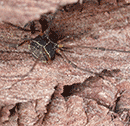
Wow! I actually work with every single one of these animals every day in my job. Let me take this opportunity to clear some things up.
Reactions?

[youtube]http://www.youtube.com/watch?v=Zu7xpq7uoh0[/youtube]
Yes, I know they can't be much bigger than they already are, due to their pneumatic leg systems, but there is still some room for healthy growth, I'm sure. I mean, look how strong and fast this one is, at 11-inches in legspan!
Actually, 12in. is the max natural legspan of a female Theraphosa blondi, so yeah they do get bigger. Some say the species of spider in this clip is the largest spider in the world, but it is in contest. Females of T. apophysis and the much more docile Salmon-pink Bird eater (L. parahybana) also grow to over 10 inches in the wild as well.
The only problems I see with breeding these species to favor large size are related to time and also physiology. It takes a relatively short time (probably about two years in this species) for a male tarantula to reach sexual maturity, where as a female takes probably more than twice that time. So it'll be at best about 4 times slower than breeding dogs. Also, keep in mind that your average egg sag will yield about 200 slings (baby tarantulas). You'd need a decent facility to house even the first batch long enough (over 6 years) to figure out who will reach max size. Second, physiologically, tarantulas (like other terrestrial arthropods) are relatively limited in size due to their semi-open respiratory systems. Get supper big and diffusion gets harder (they don't have nice little things called capillaries like we do). It probably doesn't help that even a tarantula of that size could rupture its fluid-filled abdomen and die from even a 6-inch fall. The bigger that abdomen gets, the more risk there is, unless you can breed one with a heartier exoskeleton somehow.
Now if you'll excuse me, I'm going to crawl under a blanket and think of puppies.
Yes, but the large ones aren't the ones that can kill you. In fact, I'm pretty sure that no one in recorded history has ever died from a tarantula's bite. You'd do better to worry about swarming insects like bees and wasps. They kill hundreds each year and they have wings.

I just wanted to point out that this species is harmless to humans. Its venom has no medical significance and it would run like hell from you if disturbed.

This is a Solifugid. Not only are they not spiders, but they even lack venom. They too are pretty much harmless. Also, that is two of them linked together with a perspective trick being played on all of you. Even the biggest species found in the middle-east are only about 3.5 in max. Don't believe me? look at his hand.
 03 Dec 2011, 2:48 am
Should I or should I not?
Another issue would still be the fact that it would take much longer for the nerve signals to transmit, and invertebrates are not fond of having myelin to speed up the connections. That little insulation can increase the speed tenfold for the same diameter, which is why the nerves of invertebrates can reach a millimeter in diameter. Now imagine that already-large but relatively thin neuron handling the transmission of the neurotransmitters and think about high likely lysis is to occur.
04 Dec 2011, 1:42 am
Should I or should I not?
Another issue would still be the fact that it would take much longer for the nerve signals to transmit, and invertebrates are not fond of having myelin to speed up the connections. That little insulation can increase the speed tenfold for the same diameter, which is why the nerves of invertebrates can reach a millimeter in diameter. Now imagine that already-large but relatively thin neuron handling the transmission of the neurotransmitters and think about high likely lysis is to occur.
You know, I am inclined to believe you since you seem to know a lot more about nerves than I do. However, I'm just a little confused. If most invertebrates posses nerves lacking myelin sheath, and if this causes them to be inefficient for their size at sending rapid signals, then why are the two fastest reaction times ever recorded belonging to two arthropods that aren't even large enough to have a 1mm nerve inside of them? (I'm not trying to nitpick, I am just genuinely curious)
[youtube]http://www.youtube.com/watch?v=XC6I8iPiHT8[/youtube]
[youtube]http://www.youtube.com/watch?v=G89IcZ3PluE&feature=related[/youtube]
04 Dec 2011, 1:59 am
Should I or should I not?
Another issue would still be the fact that it would take much longer for the nerve signals to transmit, and invertebrates are not fond of having myelin to speed up the connections. That little insulation can increase the speed tenfold for the same diameter, which is why the nerves of invertebrates can reach a millimeter in diameter. Now imagine that already-large but relatively thin neuron handling the transmission of the neurotransmitters and think about high likely lysis is to occur.
You know, I am inclined to believe you since you seem to know a lot more about nerves than I do. However, I'm just a little confused. If most invertebrates posses nerves lacking myelin sheath, and if this causes them to be inefficient for their size at sending rapid signals, then why are the two fastest reaction times ever recorded belonging to two arthropods that aren't even large enough to have a 1mm nerve inside of them? (I'm not trying to nitpick, I am just genuinely curious)
[Don't worry about nitpicking. I'd rather catch my mistakes early than have counterproductive hubris.]
It's a matter of scale (smaller=less arithmetic (+/- vs */÷) impact of not using myelin), and it was never stated that invertebrates do not actually possess myelin. Many of them do, and the usage of myelin seems to be somewhat irregular between the many varieties, and even the ones that do possess myelin usually utilize it for specialized functions. Among the ones that use myelin, even the type of binding to the membrane of the nerve differs. Many varieties of shrimp, for example, are myelinated, while lobsters and crabs tend to lack it. Even earthworms possess myelin when leeches don't. As disgusting as many of the representatives of the invertebrates are, I recognize their large amounts of diversity in ecological niches, anatomical designs, and clear differences between even similar species. However, many, if not most, invertebrates do not use myelin nearly as much as vertebrates (with a few jaw-less fish as exceptions), and even vertebrates leave many nerves unmyelinated. Pistol shrimp always interested me, but I still imagine it would be painful to be near one. I should think that the mechanism behind the actions of pistol shrimp are highly specialized. Also, keep in mind that the mention of scale was concerning the giant insects found in cheesy insect attack movies.
 04 Dec 2011, 2:17 pm
Maybe a little more accurate description of what I'm talking about -- and including in this description all of the helpful info everyone here has provided:
No, I'm not talking about making tarantulas several times their natural size -- definitely not. Just a couple to a few inches extra in legspan, bringing along all other necessary traits to sustain this.
What I am saying is that amazingly-different creatures (I'm not really talking about spiders) HAVE been created through much selective breeding, such as the Rhodesian Ridgeback dog:
By the 1860s, European settlers had brought a variety of dog breeds to this area of Africa, including Bloodhounds, Greyhounds, terriers, and Foxhounds. These breeds were bred with the indigenous African dogs, including the dog of the Khoikhoi people, which resulted in the Boer hunting dogs, a forerunner to the modern Rhodesian Ridgeback.
Reverend Charles Helm traveled to the Hope Fountain Mission in Southern Rhodesia in the 1870s, taking two ridged dogs with him. It was there that Cornelius van Rooyen, a big–game hunter, saw them and decided to breed his own dogs with them to incorporate their guarding abilities. The offspring were dogs with red coats and ridges. They became the foundation stock of a kennel which developed dogs over the next thirty five years with the ability to bay lions, that is, to hold them at bay while the hunter makes the kill. The dogs were used to hunt not only lions but also other game, including wild pigs and baboons. (They have the ability to kill a baboon independent of a human hunter.) The first breed standard was written by Mr F.R. Barnes in Bulawayo, Rhodesia in 1922. Based on that of the Dalmatian, it was approved in 1926 by the South African Kennel Union.
http://en.wikipedia.org/wiki/Rhodesian_Ridgeback
I'm talking about that level of creativity and imagination being applied to cross-breeding several of the very best specimens of, say, theraphosa blondi (but it doesn't have to be that species) over many generations. As mentioned by Fern, this would take many years, and I certainly wouldn't have the patience myself, but I know there are people in such a position to do this, and for that reason I kind of wonder if anyone already has -- although my query on http://www.arachnoboards.com has not turned up any such evidence.
I'm being much more scientific than I am being imaginative, in that I am simply suggesting following the standard steps for creating any "better" breed of an animal. ("Better" being of course subjectively defined, but for our purposes bigger while not significantly weaker or less healthy.)
For instance, you take a specimen which has particularly healthy/robust nerves, another which has an impressively strong exoskeleton, another which has a particularly strong respiratory system, another which has a particularly high capacity to take in and process food, etc, etc. The idea is the same with any animal -- you take the "best" (for whatever your purposes) specimen for each necessary improvement, in such a way that proper balance among the bred traits is preserved -- specimens with the highest strength, fortitude, biochemistry, biomechanics, etc, bred with those specimens with high appetite, high ability to ingest, large size, etc.
The point is if you keep everything properly compensatory, healthy change producing a new overall creature is possible.
And, no, I wouldn't want to be anywhere near such a thing!
 It's just an interest, an intellectual exercise for now (and probably never anything more), though I do admit I would like to actually see it happen, AS LONG AS I was very far away from it at the time!
_________________
Christianity is different than Judaism only in people's minds -- not in the Bible.

 04 Dec 2011, 2:41 pm
Tarntulas aren't scary, they live in Oklahoma and Arizona, I am pretty familiar with them, we would put different spots of paint on there back to see if we would see the same ones again.
Camel Spider bites!


Apparently they chased the soldiers in Iraq, but it turned out they just wanted the shade of the the Humvees' and soldiers' shadows!
04 Dec 2011, 5:43 pm
In the case of simply trying to breed bigger arachnids, I suppose that will work. One factor to remember is that the farther one selects from the, "average," the harder it is to maintain the changes. Perhaps it would be much easier to see how much one can enhance standard spiders that appear in homes because of the decreased lag between generations.
06 Dec 2011, 1:20 am
@shrox - Those are some terrible images! I am not a doctor, but those look like necrotic wounds to me. Secondary infection can set in wherever skin is broken, especially if it is not kept clean. I've seen worse from a cat bite. It's true about the shadows though! We had one in my workplace for a while, and it was so difficult to get him out in the open where people could see him! All he wanted to do was get under anything in his exhibit.
ValentineWiggin
Veteran


Joined: 15 May 2011
Age: 38
Gender: Female
Posts: 4,907
Location: Beneath my cat's paw
06 Dec 2011, 1:26 am
Spiders are little pieces of evil wrapped in death.
_________________
"Such is the Frailty
of the human Heart, that very few Men, who have no Property, have any Judgment of their own.
They talk and vote as they are directed by Some Man of Property, who has attached their Minds
to his Interest."


