
Copy and paste stuff you like/find interesting into this thr





SilverProteus
Veteran


Joined: 20 Jul 2007
Gender: Female
Posts: 7,915
Location: Somewhere Over The Rainbow
 17 Mar 2008, 9:11 pm

On systems where all users who are not logged in share one such account name, confusion may often result in discussions. It is also notable that in Slashdot's moderation system, "Anonymous Cowards" post at a default score of minus one, which means that their posts are hidden from the default view unless they are moderated up by other users.
Slashdot, Scoop and Plastic (when so configured) allow even logged in users to post anonymously, thereby providing selective anonymity (e.g. to avoid embarrassment, or legal repercussions). On Slashdot and Scoop these posts are still associated with the user (so that they can't moderate their own posts), and might not be safe if the site receives a subpoena.
Variations on the name "Anonymous Coward" are also sometimes used by trolls to mock the dummy name and/or confuse other users into thinking that they are posting as Anonymous Coward.
In Barrapunto, a Spanish-language clone of Slashdot, the anonymous user was Pendejo sin nombre, "nameless a**hole". The editors later thought it was too offensive and changed it to Pobrecito Hablador, literally "poor little talker", that was also one of the pseudonyms used by Mariano José de Larra, a Spanish journalist in the 19th century. In Bandaancha.st, a Spanish-language page about DSL, cable, satellite etc, the anonymous user is called BocaDePez which stands for "FishMouth".
Online communities vary with their stances on anonymous postings. Wikipedia allows anonymous editing in most cases, but does not label users "Anonymous Cowards" (users who are not signed in are identified with their IP addresses in order to distinguish one anonymous user from another); Slashdot permits the practice and employs the label; Meatball Wiki permits the practice but discourages it[citation needed]. Many online bulletin boards require users to be signed in to write (and, in some cases, even to read) posts by others. channel and other Futaba-based image boards take an opposite stance, encouraging the anonymity, and calling those who use usernames and tripcodes "namefags" and "tripfags," respectively.
_________________
"Lightning is but a flicker of light, punctuated on all sides by darkness." - Loki
SilverProteus
Veteran
Joined: 20 Jul 2007
Gender: Female
Posts: 7,915
Location: Somewhere Over The Rainbow
18 Mar 2008, 2:11 pm
From Wikipedia:
A mummy is a corpse whose skin and dried flesh have been preserved by either intentional or incidental exposure to chemicals, extreme cold, very low humidity, or lack of air when bodies are submerged in bogs. Mummies of humans and animals have been found throughout the world, both as a result of natural preservation through unusual conditions, and as cultural artifacts to preserve the dead.


Etymology
The English word mummy is derived from medieval Latin mumia, a borrowing of the Persian or Arabic word mūmiyyah (مومية), which means "bitumen". Because of the blackened skin of mummies, bitumen was once thought to be used extensively in ancient Egyptian embalming procedures.
Ancient Egypt
A mummy in the British Museum.Although mummification existed in other cultures, eternal life was the main focus of all Ancient Egyptians, which meant preserving the body forever. Egyptian culture believed the body was home in the afterlife to a person's Ka and Ba, without which it would be condemned to eternal wandering.
The earliest known Egyptian "mummified" individual dates back to approximately 3300 BC. This individual, nicknamed 'Ginger' because of the colour of his hair, is not internationally renowned despite being older than other famous mummies, such as Rameses II or Seti I. Currently on display in the British Museum, Ginger was discovered buried in hot desert sand. Desert conditions can naturally preserve bodies so it is uncertain whether the mummification was intentional or not. However, since Ginger was buried with some pottery vessels it is likely that the mummification was a result of preservation techniques of those burying him. Stones might have been piled on top to prevent the corpse from being eaten by jackals and other scavengers and the pottery might have held food and drink which was later believed to sustain the deceased during the journey to the other world. While there are no written records of religion from that time, the beliefs of those who buried Ginger could have resembled the later religion to some extent.
The earliest technique of deliberate mummification, as used ca. 3000 BC, was minimal and not yet mastered. The organs were eventually removed (with the exception of the heart) and stored in canopic jars, allowing the body to be more well-preserved as it rested. Occasionally embalmers would break the bone behind the nose, and break the brain into small pieces in order that it could be pulled out through the nasal passage. The embalmers would then fill the skull with thick plant-based resin or plant resin sawdust.[citation needed]
It also wasn’t until the Middle Kingdom that embalmers used natural salts to remove moisture from the body. The salt-like substance natron dried out and preserved more flesh than bone. Once dried, mummies were ritualistically anointed with oils and perfumes. The 21st Dynasty brought forth its most advanced skills in embalming and the mummification process reached its peak. The bodies' abdomens were opened and all organs, except for the heart, were removed and preserved in Canopic jars. The brain, thought to be useless, was pulled out through the nose with hooks, then discarded. It was also drained through the nose after being liquefied with the same hooks.
The emptied body was then covered in natron, to speed up the process of dehydration and prevent decomposition. Often finger and toe protectors were placed over the mummies fingers and toes to prevent breakage. They were wrapped with strips of white linen that protected the body from being damaged. After that, they were wrapped in a sheet of canvas to further protect them. Many sacred charms and amulets were placed in and around the mummy and the wrappings. This was meant to protect the mummy from harm and to give good luck to the Ka of the mummy. Once preserved, the mummies were laid to rest in a sarcophagus inside a tomb, where it was believed that the mummy would rest eternally. In some cases the mummy's mouth would later be opened in a ritual designed to symbolize breathing, giving rise to legends about revivified mummies.
Egyptian mummies as a commodity
In the Middle Ages, based on a mis-translation from Arabic it became common practice to grind mummies preserved in bitumen into a powder to be sold and used as medicine. When actual mummies became unavailable, the sun-desiccated corpses of criminals, slaves and suicidal people were substituted by mendacious merchants. The practice developed into a wide-scale business which flourished until the late 16th century. Two centuries ago, mummies were still believed to have medicinal properties against bleeding, and were sold as pharmaceuticals in powdered form as in Mellified Man.
Artists also made use of Egyptian mummies; the brownish paint known as Caput mortuum (Latin for death's head) was originally made from the wrappings of mummies. It was most popular in the 17th century but was discontinued in the early 19th century when its composition became generally known to artists.
In the 19th century, European aristocrats would occasionally entertain themselves by purchasing mummies, having them unwrapped, and holding observation sessions. These sessions destroyed hundreds of mummies, because the exposure to the air caused them to disintegrate.
An urban myth of mummies being used as fuel for locomotives was popularized by Mark Twain, but the truth of the story remains a debate.
During the American Civil War, mummy-wrapping linens were said to have been used to manufacture paper. Evidence for the reality of these claims is still equivocal.
Many thousands of mummified cats were sent from Egypt to England to be processed for use in fertilizer.
Scientific study of Egyptian mummies
Mummy in the British MuseumEgyptian mummies became much sought-after by museums worldwide in the 19th and early 20th centuries and many exhibit mummies today. Notably fine examples are exhibited at the Egyptian Museum in Cairo, at the Ägyptisches Museum in Berlin, and at the British Museum in London. The Egyptian city of Luxor is also home to a specialized Mummification Museum. The mummified remains of what turned out to be Ramesses I ended up in a "Daredevil Museum" near Niagara Falls on the United States–Canada border; records indicate that it had been sold to a Canadian in 1860 and exhibited alongside displays such as a two-headed calf for nearly 140 years, until a museum in Atlanta, Georgia, which had acquired the mummy along with other artifacts, determined it to be royal and returned it to Egypt's Supreme Council of Antiquities. It is currently on display in the Luxor Museum.
More recently, science has also taken interest in mummies. Dr. Bob Brier, an Egyptologist, has been the first modern scientist attempted to recreate a mummy using the ancient Egyptian method. Mummies have been used in medicine to calibrate CAT scan machines at levels of radiation that would be too dangerous for use on living people. In fact, mummies can be studied without unwrapping them using CAT scan and X-ray machines to form a digital image of what's inside. They have been very useful to biologists and anthropologists, as they have provided a wealth of information about the health and life expectancy of ancient people.
Scientists interested in cloning the DNA of mummies have recently reported findings of clonable DNA in an Egyptian mummy dating to circa 400 BC. Although analysis of the hair of Ancient Egyptian mummies from the Late Middle Kingdom has revealed evidence of a stable diet, Ancient Egyptian mummies from circa 3200 BC show signs of severe anaemia and hemolytic disorders.


_________________
"Lightning is but a flicker of light, punctuated on all sides by darkness." - Loki
SilverProteus
Veteran
Joined: 20 Jul 2007
Gender: Female
Posts: 7,915
Location: Somewhere Over The Rainbow
23 Mar 2008, 11:06 am
Interesting info on Old Hags!
Hag in folklore
A hag, or "the Old Hag", was a nightmare spirit in British and Anglophone North American folklore. This variety of hag is essentially identical to the Anglo-Saxon mæra — a being with roots in ancient Germanic superstition, and closely related to the Scandinavian mara. According to folklore, the Old Hag sat on a sleeper's chest and sent nightmares to him or her. When the subject awoke, he or she would be unable to breathe or even move for a short period of time. Currently this state is called sleep paralysis, but in the old belief the subject had been "hagridden". It is still frequently discussed as if it were a paranormal state.
In Irish and Scottish mythology, the Cailleach is a hag goddess concerned with creation, harvest, the weather and sovereignty. In partnership with the goddess Brìde, she is a seasonal goddess, seen as ruling the winter months while Brìde rules the summer. In Scotland, a group of hags, known as The Cailleachan (The Storm Hags) are seen as personifications of the elemental powers of nature, especially in a destructive aspect. They are said to be particularly active in raising the windstorms of spring, during the period known as A Chailleach.
Hags as sovereignty figures abound in Irish mythology. The most common pattern is that the hag represents the barren land, who the hero of the tale must approach without fear, and come to love on her own terms. When the hero displays this courage, love, and acceptance of her hideous side, the sovereignty hag then reveals that she is also a young and beautiful goddess.
The Three Fates (particularly Atropos) are often depicted as hags.
In Persian folklore, the Bakhtak has the same role as that of "the Old Hag" in British folklore. The Bakhtak sits on a sleeper's chest, awakening them and causing them to feel they are unable to breathe or even to move. Bakhtak also is used metaphorically to refer to "nightmare" in the modern Persian language.
Many stories about hags seem to have been used to frighten children into being good. Peg Powler, for example, was a river hag who lived in river trees and had skin the color of green pond scum. Parents who wanted to keep their children away from the river's edge told them that if they got too close to the water she would pull them in with her long arms, drown them, and sometimes eat them. Peg Powler has other regional names, such as Jenny Greenteeth from Yorkshire and Nellie Longarms from several English counties.
Many tales about hags do not describe them well enough to distinguish between an old woman who knows magic or a supernatural being.
In neurobiology
The expression Old Hag Attack refers to a hypnagogic state in which paralysis is present and, quite often, it is accompanied by terrifying hallucinations. When excessively recurrent, some consider them to be a disorder; however many populations treat them as simply part of their culture and mythological world-view, rather than any form of disease or pathology.
In popular culture
In the Dungeons & Dragons game, "hags" are at least three races of female creatures, sort of female counterparts to ogres. They are the annis (named from an analogous creature from the British folklore), the green hag (a green-skinned version of the Slavic Baba Yaga), and the sea hag (sort of a sea witch, not a mermaid). All three sorts are evil, but not overly powerful.
Hags are occasionally mentioned in the Harry Potter series, but never in any great detail (the prologue of "Fantastic Beasts and Where to Find Them" mentions that they are classed as beings (as opposed to beasts) that children are part of their diet and that they can glide). Hags are occasionally encountered in the wizarding village Hogsmeade, where they are distinguished from "conventional" wizards and witches. It is unclear if such Hags live in Hogsmeade or simply visit the village for business and/or social reasons.
Hags are also mentioned in the Chronicles of Narnia. In The Lion, the Witch and the Wardrobe, Hags are one of the various kinds of evil creatures whom the White Witch has present at the killing of Aslan. Later, in Prince Caspian, a Hag, along with a Werewolf and the dwarf Nikabrik, tries to persuade Caspian to summon the Witch back to life. They attack after being refused, and are killed.
In the Popeye comics and cartoons, Popeye is sometimes pursued by a villainous witch called Sea Hag, who has an unrequited love for the sailor.

_________________
"Lightning is but a flicker of light, punctuated on all sides by darkness." - Loki
Last edited by SilverProteus on 23 Mar 2008, 7:50 pm, edited 1 time in total.


SilverProteus
Veteran
Joined: 20 Jul 2007
Gender: Female
Posts: 7,915
Location: Somewhere Over The Rainbow
23 Mar 2008, 8:12 pm
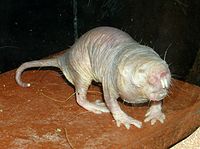
I never thought Naked Mole Rats were so interesting!
The naked mole rat (Heterocephalus glaber), also known as the sand puppy, or desert mole rat is a burrowing rodent native to parts of East Africa and the only species currently classified in genus Heterocephalus. It is notable for its eusocial lifestyle, nearly unique among mammals, and for a highly unusual set of physical traits that enables it to thrive in a harsh, underground environment; including a lack of pain sensation in its skin, and a nearly cold-blooded metabolism.
Physical description
Typical individuals are 8–10 cm long and weigh 30–35 g. Queens are larger and may weigh well over 50 g, the largest reaching 80 g. They are well-adapted for their underground existence. Their eyes are just narrow slits, and consequently their eyesight is poor. However, they are highly adapted to moving underground, and can move backwards as fast as they move forwards. Their large, protruding teeth are used to dig. Their lips are sealed just behind their teeth while digging to avoid filling their mouths with soil. Their legs are thin and short. They have little hair (hence the common name) and wrinkled pink or yellowish skin.
The naked mole rat is well adapted for the limited availability of oxygen within the tunnels that are its habitat: its lungs are very small and its blood has a very strong affinity for oxygen, increasing the efficiency of oxygen uptake. It has a very low respiration and metabolic rate for an animal of its size, thus using oxygen minimally. In long periods of hunger, such as a drought, its metabolic rate can reduce by up to 25 percent.
The naked mole rat is unique among mammals in that it is virtually cold-blooded; it cannot regulate its body temperature at all and requires an environment with a specific constant temperature in order to survive.
The skin of naked mole rats lacks a key neurotransmitter called Substance P that is responsible in mammals for sending burning pain signals to the central nervous system. When naked mole rats are exposed to acid or capsaicin, they feel no pain. When injected with Substance P, however, the pain signaling works as it does in other mammals, but only with capsaicin and not with the acids. This is proposed to be adaptation to the animal living in high levels of carbon dioxide due to poorly ventilated living spaces, which would cause acid to build up in their body tissues.
Distribution and habitat
The naked mole rat is native to the drier parts of the tropical grasslands of East Africa, predominantly South Ethiopia, Kenya, and Somalia.
Clusters averaging 75-80 live together in complex systems of burrows in arid African deserts. The tunnel systems built by naked mole rats can stretch up to two or three miles in cumulative length
Social structure and reproduction
Naked mole rats are one of the two mammals that exhibit eusociality. They have a complex social structure in which only one female (the queen) and one to three males reproduce, while the rest of the members of the colony function as workers. As in certain bee species, the workers are divided along a continuum of different worker-caste behaviors instead of discrete groups. Some function primarily as tunnelers, expanding the large network of tunnels within the burrow system, and some primarily as soldiers, protecting the group from outside predators.
This eusocial organisation social structure, similar to that found in ants, termites, and some bees and wasps, is very rare among mammals. The Damaraland Mole Rat (Coetomys damarensis) is the only other eusocial mammal currently known, although it has been argued that humans, too, are eusocial (Foster and Ratnieks 2005).
The relationships between the queen and the breeding males may last for many years. A behaviour called reproductive suppression is believed to be the reason why the other females do not reproduce, meaning that the infertility in the working females is only temporary, and not genetic. Queens live from 13 to 18 years, and are extremely hostile to other females behaving like queens, or producing hormones for becoming queens. When the queen dies, another female takes her place, sometimes after a violent struggle with her competitors.
Males and females are able to breed at one year of age. Gestation is about 70 days. A litter typically ranges from three to twelve pups, but may run as large as 25. In the wild, naked mole-rats usually breed once a year, if the litter survives. In captivity, they breed all year long. The young are born blind and weigh about 2 g. The queen nurses them for the first month; after which the other members of the colony feed them feces until they are old enough to eat solid food.
Diet
Radicivores, the naked mole rats feed primarily on very large tubers (weighing as much as 1000 times the body weight of a typical mole rat) that they find deep underground through their mining operations, though they also eat their own feces (coprophagia). A single tuber can provide a colony with a long-term source of food—lasting for months, or even years, as they eat the succulent inside but leave the outside, allowing the tuber to regenerate. Symbiotic bacteria in their intestines help them digest the fibres.
Longevity
The naked mole rat is also of interest because it is extra-ordinarily long lived for a rodent of its size. The secret of their longevity is debated, but is thought to be related to the fact that they can shut down their metabolism during hard times, and so prevent oxidative damage. Todd Karhu, an expert on the species, explains this by saying "They're living their life in pulses."
Conservation status
Naked mole rats are not threatened. Despite their tough living conditions, naked mole rats are quite widespread and numerous in the drier regions of East Africa. Though seen living up to 20 years, their lifestyles in those situations consist of mostly sleep.

_________________
"Lightning is but a flicker of light, punctuated on all sides by darkness." - Loki
 23 Mar 2008, 8:41 pm
You scored as a Avoidant
Avoidant personality disorder is characterized by extreme social anxiety. People with this disorder often feel inadequate, avoid social situations, and seek out jobs with little contact with others. Avoidants are fearful of being rejected and worry about embarassing themselves in front of others. They exaggerate the potential difficulties of new situations to rationalize avoiding them. Often, they will create fantasy worlds to substitute for the real one. Unlike schizoid personality disorder, avoidants yearn for social relations yet feel they are unable to obtain them. They are frequently depressed and have low self-confidence.
Avoidant
70%
Paranoid
65%
Borderline
60%
Dependant
60%
Narcissistic
50%
Obsessive-Compulsive
50%
Histronic
45%
Schizoid
35%
Schizotypal.
30%
Antisocial
20%
Disorder quiz results  Pretty accurate
 23 Mar 2008, 9:50 pm
Life is a misery, don't know how it's come to be
Death, the epitome of all of our days
In the past we had no choice to hear or to be the voice
Close your eyes and visualize the demon to arise
You know that sanity is not as it was meant to be
And now that misery has taken a new stand
In the land of a thousand souls we will carry on through the rain
In the sun we will move along with the memories of the slain
When I see this humanity and the evil that they have come to be
We've come to the point of no return and you beg for just...
One more time to escape from all this madness
One more time to be set free from all this sadness
And one last time to be the one who understands
My soul and my spirit will go on, for all of eternity
Foreign the currency, your payment in blood to be
Death is the destiny for all of our ways
In the dark you hide away for who or what you can't say
When I see the power of the demon come alive
You know that sanity is not as it was meant to be
And now that misery has taken a new stand
On the wings of eagles flying staring on to the sun
Reaching for the gold horizon when the war shall be won
Can you see the debauchery and the blade of death that has come for thee
In winds of torment forever more you will cry for just...
One more time to escape from all this madness...
My spirit will go on - Dragonforce
_________________
If Jesus died for my sins, then I should sin as much as possible, so he didn't die for nothing.
SilverProteus
Veteran
Joined: 20 Jul 2007
Gender: Female
Posts: 7,915
Location: Somewhere Over The Rainbow
30 Mar 2008, 10:42 am
UNWRAPPING THE MUMMIES
The Egyptian pharaohs, who went to such lengths to preserve their bodies and provide possessions for the afterlife (which they thought would be just like life on earth), would be shocked to see how their plans went awry. Their very forethought did them in. Perhaps things would have been different if they had not, in their kingly greed, had entombed with them such great wealth--the gold, the jewelry, the gold leaf-covered furniture, the armies of workmen symbolized by little figures, the chariots, the games, and musical instruments. Cheops, who built the Great Pyramid at Giza, even tried to take a large boat with him. The wealth attracted equally greedy, and much poorer, grave robbers, who managed over the centuries to get into every tomb, even that of young King Tutankhamen, who was discovered, however, unscathed in a 2,448-lb. pure gold coffin inside three other nested coffins, which in turn were inside several shrines, arranged like Chinese boxes, one inside the other. His tomb of four rooms may have been modest enough to escape attention, in spite of the great wealth it contained. At any rate, it was not until 1922 that archaeologist Howard Carter unearthed it after a long search.
In the process of grave robbing, which was rife from the beginning, the robbers often desecrated the wrapped mummies of the pharaohs and their families to get at the precious amulets tucked away in the bandagings. The practice was so common that Egyptian royalty took elaborate precautions to prevent it. They were buried in pyramids (later in caves), in rooms reached by trapdoors blocked with rocks weighing as much as 45 tons. But the thieves got in anyway. When in 1200 B.C. a corrupt government was allowing grave robbers to escape punishment, those concerned with the safety of the royal mummies moved several of them to an obscure tomb in Qurneh. The tomb was found accidentally in the 1800s by an Egyptian peasant, who did not report his find to the authorities; instead, he and his confederates slowly and carefully robbed its contents over the years until they were caught by French Egyptologist Gaston Maspero and his detectives in 1889. In the tomb were 30 mummies, among them Seti I, Amenhotep I, Ahmose, and Ramses II. Each in its sarcophagus, they were moved by 300 workmen to a boat which carried them north to Cairo. On the shore as the boat sailed by, fellahin (peasants) put dust on their heads and wailed to mourn the kings 3,000 years dead. Now these pharaohs, along with a group of others, lie in oak coffins, under glass, in the Cairo Museum, without their bejeweled raiment and precious possessions.
The mummies are remarkable in their lifelike detail. Some are 5,000 years old, though not many, since mummification was not perfected until the millennium before the birth of Christ. Their faces bear the stamp of the people they were; some have hair, its color still bright; their bodies, even to the genitals, are desiccated but intact.
The most complete account of the process of mummification comes down to us from the Greek Herodotus, who observed it as an eyewitness on a trip to Egypt in 484 B.C.
Essential to its success were the dry, hot climate of Egypt, which acted to preserve organic material, and a natural substance called natron, a hydrated sodium carbonate, used first in solution and later dry to desiccate and preserve the bodies. (The dry method was far more efficient, as proved by 19th-century scientist Alfred Lucas in an experiment involving chickens.)
The procedure combined religious ritual and surgical techniques highly sophisticated for their time. (Practicing mummification made Egyptian doctors the best in the ancient world.)
First the corpse's brain was removed by inserting a hook through the nose and into the cranial cavity to draw out the gray matter bit by bit. After the nostrils were plugged with wax, the viscera were removed, all but the kidneys and the heart, which, as the sacred seat of mind and emotions, had to stay in the body for the day when, in heaven, it would be weighed on a scale against a symbol for truth. In earlier times, for a brief while, the viscera were eliminated from the body with a gruesome enema of oleoresin, much like turpentine, which dissolved the organs. Later they were cut out with a knife. The body cavity was cleaned, often treated with molten resin, then, like a Thanksgiving turkey, was stuffed, in one period with the wrapped-up organs and in later periods with spices, linen, sawdust, and even onions. The organs were treated always with respect; they were kept in special canopic jars, which were put inside the body or placed with the body inside the wrappings. Covered with natron, the body was left for weeks to desiccate. Once dried, it was rubbed with cedar oil and spice, then wrapped in an intricate bandaging of 150 yd. or more of linen (Ramses III was done up in 350 yd.). All was accompanied by rituals, many meant to insure perpetuation of the dead person's identity. The whole process took 70 days or more.
From the 13th to the 17th century, "mummy," chopped or powdered, was used in Europe as a cure for bone fractures, tuberculosis, paralysis, and many other ailments. Sir Francis Bacon took it, and it was one of the ingredients in the witches' brew in Shakespeare's Macbeth. Some 16th-century doctors were against it; Ambroise Pare said it was the cause of such symptoms as "paine of the heart or stomake, vomitting, and stinke of the mouth." When Egypt made it illegal to export mummies, black marketeers started faking them from the fresh bodies of people who had died, many of them from infectious diseases.
A Maine papermaker, Augustus Stanwood, imported mummies to make rag paper from their bandages; these turned out to be too stained to produce anything but brown wrapping paper, which, undaunted, he sold to butchers and grocers. When a cholera epidemic was traced to his mill, the practice came to an end.
In 1834, Dr. Thomas J. Pettigrew, later known as "Mummy" Pettigrew, performed his first public mummy unwrapping in London's Royal College of Surgeons. For the next 20 years, he unwrapped mummy after mummy, always to packed houses. One of his mummies was gilded from head to toe, including the genitals; another held an onion in its hand; still another was fake, made of sawdust, rags, a stick, and part of the backbone of a cat, all wrapped cleverly in bandages. In 1852 Pettigrew mummified the body of Alexander, Duke of Hamilton, as the duke had requested. The mummy was kept in an Egyptian sarcophagus in a mausoleum on the duke's estate.
Some of the most interesting discoveries about mummies have been made in the 20th century by scientists studying the bodies for evidence of disease. As far back as 1909, mummy tissue was dissected and showed evidence in the royal Egyptian families of smallpox, kidney disease, black lung, hardening of the arteries, and arthritis. In 1960, through x-ray examination of many wrapped mummies, orthodontist-scientist James E. Harris and archaeologist Kent R. Weeks confirmed those findings and reached a few of their own.
From their work, and that of other archaeologists and scientists, we now know that:
Sequenre Tao, of the 17th Dynasty, who may have been Nubian, died violently, perhaps of a scalp wound sustained in a war with a Hyksos king over a trumped-up complaint about noise made by the hippos of Thebes. His son, Ahmose I, was not circumcised, which gives rise to the conjecture that he may have been a hemophiliac. Ahmose's son, Amenhotep I, may also have been uncircumcised, though there is less conclusive evidence in his case; when his body was taken from its museum case, it smelled of the delphiniums which had been wrapped with it thousands of years before. Ahmose's grandmother, Tetisheri, whose mummy was beautified with false hair to hide her bald spot, had buckteeth, as did many of her descendants.
In the 19th Dynasty, Ramses II (the Great), who inspired Shelley's "Ozymandias" with his colossal ego (expressed in large statues of himself), had quite ordinary blackheads, arthritis, and hardening of the arteries. Siptah, who died when he was 20, had polio as a child, not a clubfoot as had been supposed before the x-raying.
Ramses V of the 20th Dynasty was stuffed with sawdust; had been a fat man as evidenced by the folds of his skin; was a victim of smallpox; and judging by the size of his scrotum, suffered from a hernia. Ramses VI, whose body had been hacked by grave robbers, was partially bald and had pierced ears.
The mummy buried with priestess-queen Makare of the 21st Dynasty, thought previously to be a human baby, was revealed by x-ray to be a female baboon. No one knows why it was buried with her, though one romantic and unproven suggestion is that perhaps she died in childbirth or shortly after, that her baby lived, and that for solace the baboon was entombed with her.
Though Egyptians were the kings of mummification, other societies have also practiced it. In Peru, members of royal families were eviscerated after death, dried out with herbs, then clothed and put on golden thrones in the Temple of the Sun in Cuzco. The conquering Spanish destroyed these mummies.
Recently, the Chinese opened a tomb from 127 B.C. containing the body of a 50-year-old woman, probably the wife of the wealthy Marquis of Tai. The body was in a remarkable state of preservation, its tissues soft, its femoral artery resembling that of someone only recently dead. It lay partly in a preservative solution, within six nested coffins, and around it was a fabulous array of treasure, also beautifully preserved--still wearable fragile silk, lacquered vessels, 150 small figures including a 23-piece song-and-dance group, and identifiable remains of food. The burial chamber was at the bottom of a 50-ft. pit under tons of charcoal, a thick layer of white clay (which, because it kept out moisture, may have acted as a preservative), red clay, and earth.
In the American West, morticians often mummified unclaimed bodies. The mummy of hobo Anderson McCrew turned up in a carnival in a tuxedo as a petrified man, then became the property of a nurse, who named him Sam and kept him in her basement because she could not afford to bury him. Later a sympathetic undertaker did the job. In 1977 the mummified body of outlaw Elmer McCurdy, thought previously to be a dummy, was discovered in Long Beach. After he was killed by a sheriff's posse in 1912, he was mummified and had a long postmortem career as a wax museum and carnival attraction.
As the song inscribed on Egyptian tombs says: "Make holiday and never tire of it! Behold, no man can take his property with him; no man who has gone can return again."
_________________
"Lightning is but a flicker of light, punctuated on all sides by darkness." - Loki
SilverProteus
Veteran
Joined: 20 Jul 2007
Gender: Female
Posts: 7,915
Location: Somewhere Over The Rainbow
03 Apr 2008, 12:32 pm
Hagfish
How can you tell a hagfish if you see one?
-They look kind of like eels or lamprey, being long, slender and light pinkish grey in colour.
-They are elegantly simple in design, having no fins (except for a primitive tail fin), knobby protrusions, and few accessories to speak of.
-Their eyes are reduced but they have good senses of touch and smell.
-They have a ring of short sensitive tentacles around their mouths.
Large slime glands line their sides along the length of their bodies.
What do they do?
For a long time, people thought of hagfish as scavengers and parasites, probably due to their habit of burrowing into dead or dying animals and eating them from the inside out. In fact, most of their diet is made up of marine worms and other invertebrates. Scientists used to think the hagfish looked primitive as a result of the loss of characteristics often associated with being a parasite. Now common belief is that hagfish just haven't needed to change for the last couple of hundred million years. Now that's a successful body plan and lifestyle!
Another ability that had won fame for hagfish is the mass amounts of slime almost instantly secreted as a defense mechanism.
Where are they found?
-Hagfish can be found in the chilly waters of the antitropical north and south.
-They tend to live on and in muddy sea floors in very dense groups (up to 15,000 in an area). Because females tend to produce large eggs in small numbers, their population sizes suggest a low death rate.
What kind of tricks can they do?
One very useful trick hagfish have developed is the ability to tie themselves in knots, and be able to slide in and out of this knot. This can be used to escape predators, to clean themselves of slime, and to work their way into a carcass.They can also sneeze to unclog their nostrils of their own slime.
What else makes them special?
Hagfish don't really have jaws. Instead they have two pairs of rasps on top of a tongue. They pull meat into their mouths with the tongue, then tear it off the prey with the rasps.
Newly hatched hagfish look just like the adults, but have both male and female sex organs. When they mature, they will be either male or female, but have the ability to change from one to the other if the population structure demands it.
They have a very low metabolism. Once they eat, they may not have to again for up to seven months.
Although hagfish have a partial skull, they have no back bone, so are not true vertebrates. What skeleton they do have is made of cartilage.
How are they used by people?
Yes, humans will find a way to exploit even these seemingly useless and repulsive animals.
-In Korea, almost 5 million pounds of hagfish meat are consumed each year.
-Hagfish skin is processed into "eelskin" boots, bags, wallets, purses, and other products.
-Overfishing in Asia has decimated their local hagfish stocks, so the Asian hagfish fishery has turned its eyes towards North America, where these "slime eels" are considered a worthless bycatch.
-It could mean a boost of over $2 million to the local fisheries, but care must be taken not to damage these stocks as well. Hagfish may not be pretty in most people's eyes, but they serve a purpose and are slow to reproduce. It would take them a long time to recover from over-harvesting. Who can tell what removing them from the local food web would do?
From: http://oceanlink.island.net/oinfo/hagfish/hagfish.html
_________________
"Lightning is but a flicker of light, punctuated on all sides by darkness." - Loki


