
NHS & Diagnosis


 28 Jan 2017, 4:37 pm

Ask yourself this: How many people will you go to for a diagnosis, in the hope that you eventually get the answer you want? 3, 10, 100?
And how confident will you feel in a diagnosis when multiple professionals have told you that you don't have a specific disorder, and then one does? Suddenly, the one that does is the correct one?
You seem very defensive and angry, but the simple fact so far is that you have been told on multiple occasions that you don't fit the criteria for autism. You disagree, so you want to keep asking more people until one of them says that you do.
iliketrees is giving you a very reasonable response, regarding the tests that you've mentioned. And yet, 9 exclamation marks?
I have sent Phil information of where he needs to get sent, in West Sussex, to be accurately registered with the AS...
 28 Jan 2017, 4:39 pm
Ask yourself this: How many people will you go to for a diagnosis, in the hope that you eventually get the answer you want? 3, 10, 100?
And how confident will you feel in a diagnosis when multiple professionals have told you that you don't have a specific disorder, and then one does? Suddenly, the one that does is the correct one?
You seem very defensive and angry, but the simple fact so far is that you have been told on multiple occasions that you don't fit the criteria for autism. You disagree, so you want to keep asking more people until one of them says that you do.
iliketrees is giving you a very reasonable response, regarding the tests that you've mentioned. And yet, 9 exclamation marks?
I have sent Phil information of where he needs to get sent, in West Sussex, to be accurately registered with the AS...
Why are you quoting me in this?


 28 Jan 2017, 4:56 pm
ArielsSong, the number of people he's seen has nothing to do with how likely he is to have AS. Most people, including doctors, have no idea what AS even is.
The child psychiatrist who diagnosed me only did it when she was about to leave the practice. Before that she said to my mother that I needed discipline. Before she left, she apologised and said her department didn't care about their clients, and then she diagnosed me with AS. It was as if she wasn't allowed to say anything before.
_________________
I've left WP.
 28 Jan 2017, 5:07 pm
Of course I've heard of misdiagnosis. I'm just saying that the private psychologist and the autism specialists can all be correct - it may be that you have symptoms of autism but don't meet the criteria. That seems more likely than multiple professionals and evaluations being wrong.
Including specialists in autism like OP has seen?
28 Jan 2017, 5:30 pm
Of course I've heard of misdiagnosis. I'm just saying that the private psychologist and the autism specialists can all be correct - it may be that you have symptoms of autism but don't meet the criteria. That seems more likely than multiple professionals and evaluations being wrong.
Including specialists in autism like OP has seen?
Specialists? Ha! Another child psychologist said I didn't have AS, and then asked his nurse, "What is Asperger's again? Get me that book", and checked the symptoms again.
I also went to a place run by the National Autistic Society that specialized in autism and AS diagnosis, and they got my symptoms wrong.
And the Maudsley? Their diagnosis was specifically for boys. That's right, THE specialist place, had only a symptoms checklist for men. Pathetic. And their service, which was supposed to test people within a day, was compacted to just two hours because of lack of funds, and heavy staff cutting.
Yes. Specialists. They're so much more professional than us morons, who are so below such places of excellence to be able to self diagnose.
_________________
I've left WP.
28 Jan 2017, 5:39 pm
Of course I've heard of misdiagnosis. I'm just saying that the private psychologist and the autism specialists can all be correct - it may be that you have symptoms of autism but don't meet the criteria. That seems more likely than multiple professionals and evaluations being wrong.
Including specialists in autism like OP has seen?
Specialists? Ha! Another child psychologist said I didn't have AS, and then asked his nurse, "What is Asperger's again? Get me that book", and checked the symptoms again.
I also went to a place run by the National Autistic Society that specialized in autism and AS diagnosis, and they got my symptoms wrong.
And the Maudsley? Their diagnosis was specifically for boys. That's right, THE specialist place, had only a symptoms checklist for men. Pathetic. And their service, which was supposed to test people within a day, was compacted to just two hours because of lack of funds, and heavy staff cutting.
Yes. Specialists. They're so much more professional than us morons, who are so below such places of excellence to be able to self diagnose.
What year was this?
 29 Jan 2017, 4:23 am
As people have said, the AQ is only a screening tool. In the original trial 80% of participants with ASD scored 32 or above while the other 20% scored below that. Some even scored below 26 which is considered the minimum cutoff. This suggests a very small percentage of people can have very few of these traits yet still meet the criteria for diagnosis. In the same way, you can score above 32 but not meet the criteria. 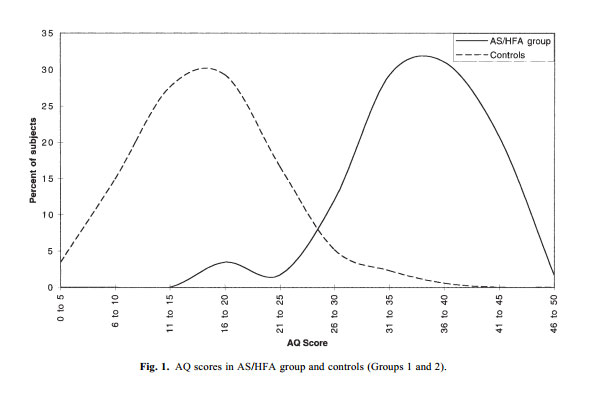
Your best bet may be to find a professional who is trained in ASDs and will spend time going through a diagnostic measure with you such as the AAA, ADI, DISCO, or ADOS-4. A trained clinician could also take you through the RAADS-r which is far more accurate than taking a quiz online.
Unfortunately you do get clinicians that seem lazy, ignorant, or in some cases are misinformed or inexperienced.
My advice would be to keep an open mind. Maybe you're autistic, maybe you're not. Good luck either way.
_________________
Diagnosed ASD Aug 2016, confirmed Dec 2016.
Also have OCD and various 'issues'.
29 Jan 2017, 7:58 am
All sorts of thoughts occur to me.
I recall an observation in another thread that apparently out there it is fashionable to think one has Aspergers. Somewhat puuzling.
I suspect this may not be the case.
It is also often the case that as knowledge of the breadth of the autism spectrum becomes more widely known, and some of the traits common across the spectrum become widely known, more and more people find a few too many moments of recognition and suspicions are planted and people being some further researchescinto their own life experiences.
The Autism Spectrum is recognisedcas a disability. Some presentations raise significant obstacles, one could think of the difficulties if it obstructs ease of spoken language, ability to handle lots of information all arriving at once, and so on.
It may at times be the case that a person's cognitive profile is autistic. At the same time it is sometimes the case that lots of circumstances conspired, (one could think of a particular style of upbringing, education, a deep interest which is also relevant and translated to secure employment) where someone has winged things so well that in the snapshot taken in the diagnostic assessment, there is no visible hardship in an area like employment, housing, social life to indicate that the person's autistic profile has resulted in significant hardships in important areas of life.
Such a situation does not always recognise that reaching such a position with a cognitive profile which is Autistic may be no small achievement. Intelligence has probable been called on to get an understanding of things other people just wing through intuitively and success without thinking. There may well be many moments of 'There but for fortune' as well. Some if us have the good fortune of a valuable set of knowledge and skills combined with an employer with a paternalistic ethos. Others may miss that combination; a meltdown or serious people type difficulty may result in suspension, disciplinary hearing on a Gross Misconduct charge and dismissal in the space of a week or fortnight, and the same pattern in a whole series of jobs and the injuries to the mind a pattern such as this can cause.
Diagnosis in the clinical sense has its own autistic feature (sly smile here) in that it is somewhat black and white. One is Either autistic or not autistic, and then if one is, a code for the severity is allocated. Diagnosis is asked to act as a gatekeeper for benefits and compensations, because Autism is recognised as a disability. It can raise the rather bizzare paradox that if one is autistic, and has used whatever strengths one finds within ones autistic profile to enable one to succeed in life, then by the diagnostic criteria which require that profile to have disabled one in some way, then one is officially not autistic ( in the strict sense set out in the full criteria).
In the gloriously messy world of life however, despite those successes ruling out being diagnosed as Autistic, the way one's brain works, they way one manages social stuff, sensory stuff, one may be decidedly autistic, in deed gloriously so, and the strengths it sometimes gives in onescprifile means one has worked damm hard and sometimes quite ingeniously to ensure an autistic brain has not disabled one from achieving successes.
It seems that in the strict clinical application, the diagnostic process' job of controlling access to benefits and the label "Disabled" may take priority over giving the person a good understanding of their cognitive profile which would help the success or continue to succede.
29 Jan 2017, 8:28 am
I agree with the general sentiments you are expressing. One comment, concerning the left-hand curve in that plot from the Baron-Cohen paper on the AQ screening test. It is an AQ score distribution plot for controls, which I think means a essentially randomly selected group of people from the population. They did not screen out individuals with ASD, and so it is conceivable that the tail on the right-hand side of the dotted curve could be largely caused by a small number of controls who in fact have ASD. (After all, according to the CDC approximately 1 in 68 children, and presumably by extension adults, have ASD.)
So the probability of an NT person getting a fairly high AQ score may be significantly lower than might at first appear from that left-hand curve. It would have been very interesting if they had gone back and tested the (actually rather small number of) people who were responsible for that right-hand tail, to see if they in fact were on the ASD spectrum.
29 Jan 2017, 9:00 am
...
It would have been very interesting if they had gone back and tested the (actually rather small number of) people who were responsible for that right-hand tail, to see if they in fact were on the ASD spectrum.
Instead of assuming your speculation is correct, you could read the report.
http://docs.autismresearchcentre.com/pa ... tal_AQ.pdf
"As shown in the subsample of students in Group 3 above, 80% of those scoring 32+ met DSM-IV criteria for HFA, but did not merit a diagnosis as they were not suffering any significant distress. If an adult scores above 32 on the AQ, and is suffering some distress, we suggest this merits a referral to an expert clinician for a full diagnostic assessment."
(Group 3 were 840 students in Cambridge University, which did not differ from the randomly selected control group which is group 2 on that chart posted)
"6% of the student sample scored 32+ on the AQ. On interview, 11 out of 11 of these met three or more DSM-IV criteria for AS/HFA, and all were studying sciences/mathematics, and 7 of the 11 met threshold on these criteria"
If I understand correctly (I've only glanced over it), they did test that tail end for those that weren't anonymous.
29 Jan 2017, 11:50 am
http://docs.autismresearchcentre.com/pa ... tal_AQ.pdf
"As shown in the subsample of students in Group 3 above, 80% of those scoring 32+ met DSM-IV criteria for HFA, but did not merit a diagnosis as they were not suffering any significant distress. If an adult scores above 32 on the AQ, and is suffering some distress, we suggest this merits a referral to an expert clinician for a full diagnostic assessment."
(Group 3 were 840 students in Cambridge University, which did not differ from the randomly selected control group which is group 2 on that chart posted)
"6% of the student sample scored 32+ on the AQ. On interview, 11 out of 11 of these met three or more DSM-IV criteria for AS/HFA, and all were studying sciences/mathematics, and 7 of the 11 met threshold on these criteria"
If I understand correctly (I've only glanced over it), they did test that tail end for those that weren't anonymous.
I think I did read it reasonably carefully. As stated in the caption of that plot, the dashed line (controls) comprises Group 2 in their study. And in the text of the paper, it is stated "We cannot determine the rate of false negatives in Group 2 (general population controls), as the majority of these completed the AQ anonymously."
So the control group whose AQ scores are displayed in the dashed-line plot in that figure were not screened for ASD. That was the only point I was trying to make.
29 Jan 2017, 12:00 pm
http://docs.autismresearchcentre.com/pa ... tal_AQ.pdf
"As shown in the subsample of students in Group 3 above, 80% of those scoring 32+ met DSM-IV criteria for HFA, but did not merit a diagnosis as they were not suffering any significant distress. If an adult scores above 32 on the AQ, and is suffering some distress, we suggest this merits a referral to an expert clinician for a full diagnostic assessment."
(Group 3 were 840 students in Cambridge University, which did not differ from the randomly selected control group which is group 2 on that chart posted)
"6% of the student sample scored 32+ on the AQ. On interview, 11 out of 11 of these met three or more DSM-IV criteria for AS/HFA, and all were studying sciences/mathematics, and 7 of the 11 met threshold on these criteria"
If I understand correctly (I've only glanced over it), they did test that tail end for those that weren't anonymous.
I think I did read it reasonably carefully. As stated in the caption of that plot, the dashed line (controls) comprises Group 2 in their study. And in the text of the paper, it is stated "We cannot determine the rate of false negatives in Group 2 (general population controls), as the majority of these completed the AQ anonymously."
So the control group whose AQ scores are displayed in the dashed-line plot in that figure were not screened for ASD. That was the only point I was trying to make.
And my point is that group 3, which did not vary statistically from group 2, was tested.
29 Jan 2017, 12:44 pm
"And my point is that group 3, which did not vary statistically from group 2, was tested."
Well, up to a point. Judging from table VI in the paper, something like 26 people in group 3 had scores of 32+. Of those, 11 agreed to be interviewed, and of those "7 met criteria for HFA or AS." The 11 interviews did not amount to diagnoses, since for one thing they didn't have access to developmental data from the subjects. The other 15 or so with 32+ were apparently not interviewed at all.
In any case the numbers of subjects in these studies were relatively small, and so especially in the "tails," such as the high-scoring end of the controls, it is hard to say anything very precisely. It would be very interesting if there were much larger-scale studies from which some really statistically significant features in the AQ score distributions could be extracted.


