
What do you call it when your AS symptoms are no longer...


 15 Aug 2010, 1:39 am

Disability is an interaction between an individual with a certain skill set and an environment which requires a different skill set.
Autism is a type of brain wiring which makes it easier to develop an atypical skill-set.
As the environment is usually set up to accommodate the majority, an atypical skill-set often (but not always; omnipotence is atypical) results in an interaction between individual and environment which we call disability.
It is not impossible to find autistic ways of doing NT things. It is also not impossible to simply brute-force your way through learning certain things. For instance, probably through constant practice, I've developed a workable ability to recognize faces to the point that I can see something on TV and go "oh, that's the same actor who plays..." (an impressive achievement for someone who once couldn't recognize her parents' faces). I doubt I'm as good at it as an NT, but I'm good enough that it doesn't matter in my day-to-day life.
It's also not impossible to engineer your environment so that it suits your skill-set as well as the "default" environment suits the average NT. I seem to recall some eccentric noble scientist who ran his household so his servants would do all their work while he wasn't looking, so he would never need to see a human being. He might have had (probably did have) the worst social skills of anyone who has ever lived, but that didn't bother him in his little bubble!
More likely is that you'll use a combination of those strategies to free up enough brainpower that the extra work you put in remains well below your maximum and you even have room to spare.
If you're not familiar with spoon theory, the basic idea is that one spoon is some amount of ability to do work. One or more spoons are used doing everything and anything-- opening your eyes and getting out of bed in the morning requires a spoon (or spoons). Smiling requires a spoon (or spoons). Climbing Mt Everest requires a large number of spoons, as does going to a party. Not having a meltdown requires spoons. Having a meltdown (as opposed to shutdown) requires spoons.
Suppose normal people have 100 spoons. Otherwise-typical NTs and Aspies have 100 spoons to start off with each day. (People with Chronic Fatigue Syndrome, for instance, would have fewer spoons each day, but that's beyond the scope of this post.)
The average NT, let's call her Entie (hi, Entie!), had an easier time learning certain things (like socializing) and needs to use fewer spoons to do so once the behaviors are learned. Entie also has a hard time learning to multiply eight-digit numbers in her head, and if she learns to do so, she'll have to use a lot of spoons every time. And Entie has to use spoons up to keep from having a meltdown when she's alone (the number of spoons she uses for not going crazy while alone is greater than the number of spoons she uses for socializing).
The average Aspie, let's call him Hans, has a different set of starting talents, and even once certain things (like socializing) are learned, he has to use up a lot of spoons every time he does them. On the other hand, he uses absolutely no spoons to keep himself sane while he's alone, and he has other things he can do more easily than Entie.
Unfortunately, society is set up to accommodate people who have the difficulties Entie has, and willingly makes allowances for her inability to multiply eight digit numbers in her head. It is not set up to accommodate people who have the difficulties Hans has.
So Hans is disabled. What does that mean? Well, Hans and Entie wake up one fair Friday morning.
(Lose a spoon each. Hans: 99; Entie: 99)
They both have breakfast. (Hans: 98; Entie: 98)
They both go to work. At work, both Hans and Entie use 20 spoons doing their jobs. (Hans: 78; Entie: 78)
Entie socializes with customers and coworkers easily. Hans struggles to figure out how to do the same. (Hans: 58; Entie: 77)
From all that socializing, Entie is in a good mood. Her evening is easier because of that. Hans, on the other hand, is in a bad mood, and struggles with poor executive function as he tries to decide what to eat for dinner. (Hans: 48; Entie: 76) Hans goes hungry. Tomorrow, he will start the day with fewer than 100 spoons.
Email needs to be answered. Entie is not particularly computer-savvy, and would rather be out with friends, but this is important. (Hans: 47; Entie: 66)
Suddenly, both receive calls from their mothers. Entie chats and reassures her mother about her welfare. Hans is awkward, and has been caught by surprise. (Hans: 27; Entie: 65) Because he fails to "read between the lines" of the conversation, Hans accidentally tells his mother he's suicidal (he isn't).
Both shower. Hans finds the sensory aspects difficult to deal with, while Entie is used to this and finds it trivial. Both enjoy the hot water. (Hans: 17; Entie: 63)
Hans is cutting it fine with the day's spoons. He goes to bed exhausted and hungry, but when he wakes up at midnight, he doesn't have the executive function to figure out anything to do about it, or even to move if he could plan his actions.
Saturday morning dawns. Hans is hungry and still somewhat tired from sleeping poorly. Entie is refreshed and ready to face the day. (Hans: 60; Entie: 100)
Both get out of bed. (Hans: 59; Entie: 99)
Hans's mother convinces him to see a shrink. The conversation is difficult. Meanwhile, Entie eats breakfast. (Hans: 49; Entie: 98)
Hans forgets to eat, and feels tired and distracted from talking to his mother again. His routine is thrown all into disarray. Meanwhile, Entie goes out to meet some friends. (Hans: 44; Entie: 97)
Hans sees the shrink his mother insists he see. His overly-literal thinking and failure to grasp subtleties, as well as a desire to please, causes him to raise the shrink's red flags. Hans notices that this is not going well. Meanwhile, Entie makes a witty remark at which all her friends laugh and hits on a hunk. (Hans: 34; Entie: 96)
The shrink raises the possibility of having Hans committed. Hans tries to avoid this, but is unable to grasp what mannerisms would indicate that he should return to his life. Meanwhile, he still has not eaten, and so asks the shrink (again failing to grasp social graces) for some fried chicken. Entie asks her friend where she got that gorgeous miniskirt. (Hans: 20; Entie: 94)
Hans begins to bang his head, with predictable results from the shrink. Entie feels like she's doing the same when she tries to get her friend to spill a certain secret. Hans is forced to stop his stimming. Entie is thinking how much she loves Saturdays. (Hans: 10; Entie: 93)
Hans can no longer cope. Involuntarily, he jettisons emotional control. Hans has a meltdown. Entie continues to enjoy herself. (Hans: 9; Entie: 93)
Hans is 5150'd (committed) and continues to have a meltdown. Entie goes out for lunch. (Hans: 1; Entie: 91)
Bear in mind that Hans's Saturday could have gone as well as Entie's, under two conditions:
1. If Hans's mother had not called
2. If Hans had devised a system which would allow him to make sure he was eating. For instance, he could have had the same thing every day plus some vitamins, or rotated foods on a preplanned schedule.
The first would have saved Hans about 63 spoons and a 5150, and the second would have saved several spoons as well, and possibly also the 5150.
Hans would still be Hans if his mother hadn't called. Hans would still have poor executive function if he devised a workaround. Even if both conditions were met (and Hans was therefore not impaired), that wouldn't change what Hans brought to the table in terms of neurological wiring.
_________________
I'm using a non-verbal right now. I wish you could see it. --dyingofpoetry
NOT A DOCTOR
Last edited by DandelionFireworks on 15 Aug 2010, 6:58 pm, edited 1 time in total.

 15 Aug 2010, 1:54 am
I was going to explain that you all are looking at it slightly wrong, but post above takes care of that very well.
Looking merely at the pathetically generalized DSM criteria isn't that productive. What's productive is understanding the talents that result from spectrum traits and using them to devise adaptation systems critical to daily success.
_________________
http://youhaventmetyourselfyet.blogspot.com/
Learn the answers to all your wondering... get Complete Guide to asperger's by Dr. Tony Attwood.
http://www.aspiescentral.com/member.php/75-eon
ADHDer since 1990. Diagnosed Aspie 8/2010
 15 Aug 2010, 2:24 am
I have overcome alot and can actually speak to people now.
I can do things I couldn't do in the past.
There are still other problems though that won't change no matter how hard I try but for those problems I can just find other approaches to make it work.
To the person who claims having a job, family and friends makes someone no longer fit the criteria, that's not true either.

leejosepho
Veteran


Joined: 14 Sep 2009
Gender: Male
Posts: 9,011
Location: 200 miles south of Little Rock
15 Aug 2010, 11:21 am
Adaptive, improvisational ... things like that. I did that for many years without having any clue as to what was going on either inside me or in the world around me, but people tend to see other people (such as ourselves) as "normal" as long as we can at least *act* that way some/part/most of the time.
If something like that is presently happening for you, just keep doing that if you can be content with things as they are. However, be wise and prepare for the future *now* because I have found that all eventually wears on us and we cannot keep it going forever.
_________________
I began looking for someone like me when I was five ...
My search ended at 59 ... right here on WrongPlanet.
==================================
jojobean
Veteran

Joined: 12 Aug 2009
Age: 49
Gender: Female
Posts: 3,341
Location: In Georgia sipping a virgin pina' colada while the rest of the world is drunk
15 Aug 2010, 12:04 pm
I have a similar delimia where ppl dont think I have autism when they first meet me, but then they start to notice things. I have a hard time with executive functioning. I have learned to cope well, but I still dont like interacting with ppl I dont know.
More than likely you learned to cope with it and are working twice as hard to achieve the same means while not being aware of it.
You can use coping mechanisms that can fool a test...if you cope well enough. That is like someone who is deaf who lip reads well enough to fool the person they are talking to (if they had alot of speech therapy) Does that make that person any less deaf???
Nope. I tend to think that AS is like social deafness, there are ways to lip read, socially. But does it mean that you have been healed, cured, or otherwise void of autism? Can a lip-reading deaf person hear although he/she can communicate? See the analogy.
_________________
All art is a kind of confession, more or less oblique. All artists, if they are to survive, are forced, at last, to tell the whole story; to vomit the anguish up.
-James Baldwin
t0
Veteran
Joined: 23 Mar 2008
Age: 52
Gender: Male
Posts: 726
Location: The 4 Corners of the 4th Dimension
15 Aug 2010, 12:33 pm
No matter how you feel about the DSM (or its equivalent in other countries) - it's all we have. Looking at the criteria is all we have. If you don't fit the criteria, it doesn't matter how many spoons you have left at the end of the day. There is no other definition.
The definition of AS in the DSM is not based on neurological wiring. There is no mention of it. It is currently unmeasurable. If you want to define AS in terms of an unspecified scale then there is no point in defining the disorder. You're basically furthering the agenda of those who think there's no such thing as AS - you're creating a disorder that anyone can claim to have and noone can refute.
The definition of "deafness" has to do with whether or not a person can detect sound in a particular frequency range. Speech therapy does not change this. It's a broken analogy.
The original question was - what do you call it when a person diagnosed with AS no longer fits the DSM. The closest answer I've seen so far was "Shadow Syndromes". The concept seems to describe the area between NT and diagnosis. I guess the question there would be - is AS an actual disorder or just a "shadow syndrome" of low-functioning autism?
15 Aug 2010, 2:38 pm
The DSM-IV-TR criteria are an attempt to apply a test of measurable behavior to determine whether you have a certain wiring. Having an autistic brain makes you vastly more likely to fit the criteria, because it makes it hard to learn certain things and more alluring to do others. However, a lifetime of learning to fake it can cause you to no longer fit the criteria because they were designed for children and are behavioral rather than measuring what is actually different about us (but currently not often measurable, though advances are being made in that direction).
The analogy to deafness is unsound because of our current tools for diagnosing it. However, if we couldn't measure hearing (as we can't measure your brain), it is conceivable that we could have a set of behavioral criteria, and that deaf people could learn to not fit those. In this world, it's impossible because we can measure hearing directly; in another world, ceasing to be on the spectrum might be impossible because in that world your neurological wiring could be measured directly.
I would rather see criteria based on subjective experience, or possibly based on processing (like the test where you see a letter made of another letter in a much smaller font repeated many times). It would be much harder to just learn your way out of fitting those, and autism isn't something you stop having.
_________________
I'm using a non-verbal right now. I wish you could see it. --dyingofpoetry
NOT A DOCTOR
 15 Aug 2010, 3:00 pm
If your are still searching where the line is between NT and autistic by means of deduction, here is what I personally found out to be correspontdent to NT's (have treated brain tumors, got overwhelming empathic sense - costed me years to control!):
- Empathic ability for animate object and surroundings, not to be confussed with sympathizing where you understand anothers feelings because you have experienced it yourself. - Has to do with mirror neurons according to the latest science. -
- Lacking the strong systematic thinking that autists have, this doesn't mean it isn't there in a form - it is most of the time set aside because of the emotional impressions (Limbic system precedes Neocortex in standard brain priority).
Because NT's do more with emotions* then someone with autism usually would plus they are a majority on Earth, the chance their feelings** (personal and interpersonal) are better developed then someone with autism is greater. Ofcourse in contrast it means people with autism do more with systematics and are better with that sort of things.
In answering your question straight-up:
Autism Spectrum Disorder (AS - short for ASD) in a actual disorder according to DSM-IV-TR, it is a BIG spectrum ranging in differences in intelligence, co-morbidity, severity, etcetera. From low-functioning autism to high-functioning autism, so to speak from a shadow syndrome is a matter where you stand on the scale.
I still see myself as autistic, although much of the behaviour is gone. Simply because of the strong systematic core that makes me who I am, now the new addition of the empathic sense simply makes an supplement next to the other senses.
Confirmations from NT's very much appreciated!
Cheerfully,
Wallourdes
* expression of feelings
** interpretation of percieved emotions of self and others, 'signals' from your own body
_________________
"It all start with Hoborg, a being who had to create, because... he had to. He make the world full of beauty and wonder. This world, the Neverhood, a world where he could live forever and ever more!"
 15 Aug 2010, 3:11 pm
I don't think there is a line to be drawn. As unsettling as it may seem.
When I read the book about shadow syndromes, well that was more than 10 years ago, there was a man described as a shadow of a Asperger's (I think.. or of autism.. was long ago I read it). However, this dude sounded quite quirky and a situation was described and I felt that is exactly what I do! So I was thinking... OK, maybe I have a slight touch of Asperger's... you know. Because I guess that is where the line was then. Now it's more or less decided people who were once seen as in the shadow, are now seen as full blown aspies. I never changed, the line was changed.
It's man made. You can never draw a line on a spectrum. That is my opinion I guess.
15 Aug 2010, 3:32 pm
Of course you can draw a line. It'll just be arbitrary and useless. But diagnosis itself is proof that you can draw a line.
And now that I think about it, I believe the word you're looking for is subclinical.
_________________
I'm using a non-verbal right now. I wish you could see it. --dyingofpoetry
NOT A DOCTOR
 15 Aug 2010, 6:31 pm
I call it "subclinical traits". Your brain wiring is still autistic; but you can no longer be diagnosed because of a lack of impairment. Most likely, you still have more in common with autistics than with NTs.
It happens fairly often, though in the majority of cases the diagnosis is lost by the age of eight. If you're still diagnosably autistic when you hit the teen years, you'll probably always be diagnosable--though there's nothing that says you can't get to the point where you don't need any outside help, and compensate purely by the use of technology, specialized strategies, a higher level of effort, and using strengths to cover for weaknesses. That case would be analogous to a person who uses a wheelchair and is completely independent, having learned all the strategies necessary to live without having to walk.
_________________
Reports from a Resident Alien:
http://chaoticidealism.livejournal.com
Autism Memorial:
http://autism-memorial.livejournal.com
 15 Aug 2010, 7:01 pm
Actually the DSM/equivalents AREN'T all we have, t0. We have the knowledge and opinion of true experts who have studied and worked with people who have the traits. These opinions transcend diagnostic criteria by providing a platform through which everyone can better understand those who have autistic neurology, and thereby better support them as valuable members of society.
Diagnosis is just a tool that society currently uses at times to box in and minimize. Discovery is a way of understanding talents.
When you are diagnosed, it is because you are seeking to understand the root of some problem you are facing.
You would use discovery to understand the root of the talents that define your personality.
For ANYONE who feels they have struggled when trying to engage with people in a social setting, whether for socializing or professional reasons, an exploration for the purposes of discovery is the ONLY method by which they will be able to develop effective adaptation for this scenario. I don't believe anyone is incapable at the core of having good social skills (social skills as defined by social thinking - the act of sharing space effectively).
_________________
http://youhaventmetyourselfyet.blogspot.com/
Learn the answers to all your wondering... get Complete Guide to asperger's by Dr. Tony Attwood.
http://www.aspiescentral.com/member.php/75-eon
ADHDer since 1990. Diagnosed Aspie 8/2010
 16 Aug 2010, 8:17 am
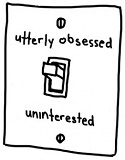
This might say it best.
If you have AS, you have AS, but the ones with a more mild affliction can effectively learn to overcome many of the traits that define the condition. You still have them, but you learned to adapt. Since diagnosis depends on observable outward traits, it muddies the waters.
If we could restrict Dx to brain scans that define if the condition is present, then your status would be indisputable...the only question would be how blatantly the condition affects your life.


