Basically it's like army training you get trained to adapt to think more about strategies and methods and skills to do something that others may naturally have instead of using pure instinct you learn to interpret the signals to a degree...
As to the programming thing unless you repair the damage (under developed, none existing, the other pathways in some places that have more than they should are unknown on what they pick up) *Not everyone has this type of cortex in the As *, to the cortex very unlikely just learn to heighten your other skills as a blind person would, Be better at picking up but you will still feel autistic on the inside...
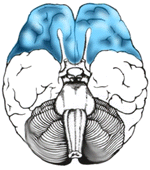
http://www.waiting.com/brainfunction.html
Brain Structure, Function, Associated Signs and Symptoms
If anyone is interested in the dif disorders, to the dif parts of the brain not all listed I don't think
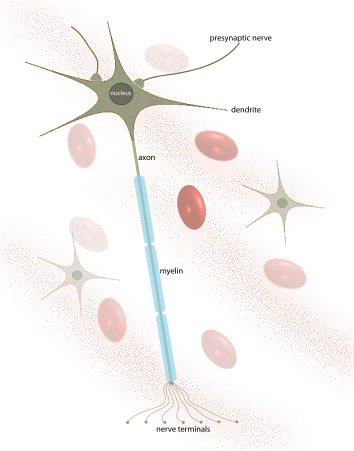
Diagram of a single motor neurone
The neuron is the basic functional unit of the nervous system. The brain consists of several hundred billion neurons, communicating by billions of interconnections. All neurons consist of four distinct parts: cell body, dendrites, axons and axon terminals.
The cell body (or soma) contains the nucleus of the cell, as well as the essential cellular organelles, such as the energy generating mitochondria. The cell body has many branches, called dendrites, which receive signals from other cells, and are often covered in dendritic spines. Extending from the cell body in one direction is an axon. The length of axons can be several centimetres or longer. Axons carry information from one neuron to another, and are terminated at the synaptic knob, which is attached to the dendrites or cell body of another neuron. Signals are transferred across the synapse by means of a chemical neurotransmitter.
Signals travel along the axon by generating and propagating an action potential. This is produced by letting the delicate balance of sodium, potassium and chloride ions across the cell membrane be altered, thus generating an electrical signal that flows along the axon. If the axon is coated in a fatty sheath, called myelin, the signal travels at higher speeds of anything up to 120 ms-1. When the signal reaches the synapse, the synaptic knob emits a neurotransmitter which acts either to encourage the next neuron to 'fire' (excitatory) or discourage the neuron to fire (inhibitory).
The CNS contains a number of different types of neurons, which are tailored to the job they perform. Signals from sensory receptors over the body feed along the spinal cord to the brain, and signals are sent from the brain to make muscles contract. Many medical conditions are caused by the failure of the CNS to function correctly, for example in Parkinson's disease there is a deficiency of the neurotransmitter dopamine.
For every neuron in the CNS there are also ten glial cells. These cells provide support for neurons, for example the microglia which perform a scavenger role, and oligodendrocytes which form the myelin sheath around the axons.
They is no quick def of As as its a complex disorder that has tones of problems, that I find it interesting they don't even bother try to help out problem's you might have that have treatments and things that can lower the problem or even fix it. Thats why you join the charitys or groups and read the national ones as they will have all the information they.
Heres a tip Never Ask, Allways demand or they won't get off they a$$





