
The Broader Amish Autism Phenotype vs. The Autistic Matrix



 15 Apr 2013, 4:47 pm

At this point in time with the loose criteria that exists, it does seem from the evidence that exists, that prevalence rates of ASD, using the DSMIV diagnostic tools designed to assess ASD, in Amish Counties, are substantially lower. That includes all forms of Autism.
The reasons for that are not clear.
There could be many, but for purposes here I was providing a suggestion of general impact of increased factors of social stress and other environmental factors associated with increased stimulus.
I figured that you were arguing towards non-social enviromental factors, while I personally disagree, I'm not opposed to discussing it.
I actually am not arguing toward non-social environmental factors. The environmental factor of Stimulus that I am referring to is byproducts of human collective intelligence, and culture.
Factors of those cultural byproducts of Stimulus are illustrated to the extreme in the Video from South Korea I provided verses the "Farming" Video that provides more of a balance of cultural byproducts of stimulus.
However, again, some people are more resilient to these factors of stimulus and other factors of general social stress than others.
That is not an issue specific to any named disorder. However, it is an issue in successful adaptation to the overall environment for all.
I do not believe that basic human nature is that hard to understand, and I think most humans are adequately equipped to understand it.
It is culture, in all its forms and expressions that can make life extremely complicated and stressful to adapt to for many people. It doesn't have to be that way, in many cases, but it is.
The value of research could be in determining what factors of the cultural environment could be adjusted to provide a higher potential for people to adapt.
If culture was not as complex as it currently is, that research might not be necessary.
_________________
KATiE MiA FredericK!iI
Gravatar is one of the coolest things ever!! !
http://en.gravatar.com/katiemiafrederick
 15 Apr 2013, 5:49 pm
People do not usually get a diagnosis, unless they are having substantial problems adapting. They often remain on that broader autism phenotype.
I got hung up on this. It seems to me that you're saying that people only get diagnosed when they start having problems, but I don't think this is true. r.
Absolutely.
I was diagnosed in my fifties, not because im 'starting' to have problems, but because I had problem all my life. The reason for the delay in the dx was because none of the dozen shrinks Ive ever had had ever even HEARD of aspergers.
The diagnosis did not even exist until around the year 2000 (atleast in anyplace outside of Austria). And even after that year most mental health workers in America were too incompetent to know about it.
People over 40 are not getting dx'd because 'society is changing' - we in that group are getting dx'd because we always had problems, but there was no label for it for most of our lives.
So that line in the OP is seriously stupid.
To repeat: 20 years ago the category of aspergers didnt even exist- so that was why NO ONE in the USA was dxd with it then.
Hopefully, I adequately addressed most of the points you are making here in my last post.
My suggestion is not one that the inherent problems or propensity toward problems of adaptation do not exist. That seems clear even among individuals with substantial traits of introversion, discussed in detail in the Time Magazine article on Introversion, I linked in the previous post.
One person's stress is another person's pleasure where the stimulus of social environment and other sources of stimulus in the environment are increased.
Currently, it is also identified in clinical practice that, overall, across what is currently identified as a spectrum, per DSMIV criteria, the majority of individuals are actually hypo-sensitive to the environment and some seek stimulus through "stimming" rather than stimming to focus attention away from other sources of overwhelming stimulus.
It is also worth noting that online Autism Communities, such as this community and many others are far from representative from all the different identified Autism Subgroups that exist. The results I linked from the Myers-Briggs Informal Poll are restricted to that limitation.
There are likely relatively few of those responses coming from individuals clinically sub-typed among the 25% of individuals with Regressive Autism in Childhood, the 5% assessed with Fragile X syndrome, the 38% assessed with co-morbid intellectual disability, or even the 24% assessed with co-morbid borderline intellectual disability in childhood.
I agree that if I made the statement you paraphrased from my quote below that "People over 40 are not getting dx'd because 'society is changing' ", it would not be a reasonable one but I am not suggesting a universal phenomenon for all people on the spectrum.
I am suggesting that an increasing demand from the social environment is POTENTIALLY having an impact among SOME people currently identified on the spectrum, from the DSMIV Criteria that exists now. The DSMIV has been in effect close two decades now.
That is part of the reason I restricted my suggestion specific to a two decade generational gap, in specifying age 40 vs. age 20, not those individuals over age 40.
Considering factors of new diagnostic criteria and increasing social stress and environmental stress from increasing stimulus and social demands, this would be the generation up to age 20 most likely impacted by an actual diagnosis taking new factors of social environment into account along with more loosely described DSMIV criteria for some type of ASD.
However, I still see a potential impact across the life span.
People do not usually get a diagnosis, unless they are having substantial problems adapting. They often remain on that broader autism phenotype.
The Gillberg Criteria adequately captures a neurodevelopmental disorder from Childhood for Asperger's syndrome, because motor development impairments and language development delay and/or speech impairment are mandatory criterion elements.
As described in my last post, the DSMIV does not do that in the more loosely defined and described disorders.
The DSM5 criteria for ASD is more restricted but it still has the potential to capture more environmental influenced factors than the Gillberg Critera because it is based on observed behavioral impairment, rather than inherent issues of motor development impairment and verbal language development and/or speech impairment that will continue to be captured under Gillberg Criteria.
The new "mandatory" requirement of non-verbal impairment, taken to the clinically significant level, instead of common behavior seen in the general population such as looking away when focusing on memory in conversation to avoiding distracting stimulus from the facial expressions of others, is more likely to capture an inherent condition in the DSM5 than what was defined as minimum diagnostic requirements for DSMIV ASD in PDDNOS.
Link on common elements of eye aversion among people on the spectrum and the general population:
http://www.myhealthnewsdaily.com/2321-a ... avior.html
The diagnostic inefficiencies in the current DSMIV criteria and designed assessment tools is described better in the analysis provided in the two links below, than what I have seen from any other Autism Research Scientist or other associated Professional.
http://crackingtheenigma.blogspot.com/2 ... usion.html
http://crackingtheenigma.blogspot.com/2 ... o-get.html
Three out of three instead of two out of four, previously described Social Interaction Criterion Elements now described as Social-Communication Criterion is much more restrictive.
According to the APA representative, Sue Swedo, chair of the DSM5 ASD committee, the three mandatory Social Communication elements are required observed at time of diagnosis, not met by history alone, whereas RRBI's can be met by history alone, no longer necessary as observed clinically significant impairments at the time of diagnosis.
Gillberg Criteria, overall, is still a more restrictive criteria, to meet diagnosis of Asperger's than what the DSM5/APA representative , Sue Swedo, now describes as ASD, in the link below:
http://www.psychiatry.org/practice/dsm/ ... m-disorder
Link to Gillberg Criteria:
http://www.bbbautism.com/asp_gillberg.htm
All that said, as stated at the end of my last post, the substantial problems remain. The needs of appropriate accommodation and support remain.
I do not think the new Social Communication disorder will adequately capture the issues of difficulty some people have that remain that in some cases will also no longer be captured by the DSM5 ASD criteria.
The potential to do further research associated with other cultures like the Amish, capturing the full scale of difficulties, will likely be significantly reduced in the US, after DSM5 criteria goes into effect.
For some time to come, a similar existing potential remains in countries where the ICD10 continues to be used for diagnosis, where criteria is more loosely described.
A) Thanks for admitting that you're 'full of it". If you cant state what you're saying in plain English- then you're admitting that you have nothing to say.
B) Thanks for reminding of us the aburdity of your sentence.
"People who are getting diagnosed to today at age 40 who wouldve been diagnosed TODAY at age 20-had they been born 20 years later.."
Thats like saying "people who are celebrating their 40th birthday today WOULDVE been celebrating their 20th birthday today- if they had been born 20 years later."
Its a laughable tautology.
Its certainly not evidence of society changing.
Maybe you MEANT to say "people are getting dx'd today at age 40 who would NOT have been dx'd 20 years earlier when they were 20 because they didnt have problems back then" ( or the problems werent as manifest)." And that is somehow evidence of this goofy theory of yours.
That would in theory make sense.
But 20 years ago NO body got dx'd with aspergers because the label would still be nonexistant for the next almost decade. And even if you're talking about autism in general folks just werent as aware of neurodiversity 20 years ago anyway ( like folks were atleast as neurotic in the thirties as in the sixties- but going to a shrink was not as socially acceptable in the earlier decade as the later hense lower rate of folks going ot shrinks in the thirties compared to the 60's).
15 Apr 2013, 8:07 pm
People do not usually get a diagnosis, unless they are having substantial problems adapting. They often remain on that broader autism phenotype.
I got hung up on this. It seems to me that you're saying that people only get diagnosed when they start having problems, but I don't think this is true. r.
Absolutely.
I was diagnosed in my fifties, not because im 'starting' to have problems, but because I had problem all my life. The reason for the delay in the dx was because none of the dozen shrinks Ive ever had had ever even HEARD of aspergers.
The diagnosis did not even exist until around the year 2000 (atleast in anyplace outside of Austria). And even after that year most mental health workers in America were too incompetent to know about it.
People over 40 are not getting dx'd because 'society is changing' - we in that group are getting dx'd because we always had problems, but there was no label for it for most of our lives.
So that line in the OP is seriously stupid.
To repeat: 20 years ago the category of aspergers didnt even exist- so that was why NO ONE in the USA was dxd with it then.
Hopefully, I adequately addressed most of the points you are making here in my last post.
My suggestion is not one that the inherent problems or propensity toward problems of adaptation do not exist. That seems clear even among individuals with substantial traits of introversion, discussed in detail in the Time Magazine article on Introversion, I linked in the previous post.
One person's stress is another person's pleasure where the stimulus of social environment and other sources of stimulus in the environment are increased.
Currently, it is also identified in clinical practice that, overall, across what is currently identified as a spectrum, per DSMIV criteria, the majority of individuals are actually hypo-sensitive to the environment and some seek stimulus through "stimming" rather than stimming to focus attention away from other sources of overwhelming stimulus.
It is also worth noting that online Autism Communities, such as this community and many others are far from representative from all the different identified Autism Subgroups that exist. The results I linked from the Myers-Briggs Informal Poll are restricted to that limitation.
There are likely relatively few of those responses coming from individuals clinically sub-typed among the 25% of individuals with Regressive Autism in Childhood, the 5% assessed with Fragile X syndrome, the 38% assessed with co-morbid intellectual disability, or even the 24% assessed with co-morbid borderline intellectual disability in childhood.
I agree that if I made the statement you paraphrased from my quote below that "People over 40 are not getting dx'd because 'society is changing' ", it would not be a reasonable one but I am not suggesting a universal phenomenon for all people on the spectrum.
I am suggesting that an increasing demand from the social environment is POTENTIALLY having an impact among SOME people currently identified on the spectrum, from the DSMIV Criteria that exists now. The DSMIV has been in effect close two decades now.
That is part of the reason I restricted my suggestion specific to a two decade generational gap, in specifying age 40 vs. age 20, not those individuals over age 40.
Considering factors of new diagnostic criteria and increasing social stress and environmental stress from increasing stimulus and social demands, this would be the generation up to age 20 most likely impacted by an actual diagnosis taking new factors of social environment into account along with more loosely described DSMIV criteria for some type of ASD.
However, I still see a potential impact across the life span.
People do not usually get a diagnosis, unless they are having substantial problems adapting. They often remain on that broader autism phenotype.
The Gillberg Criteria adequately captures a neurodevelopmental disorder from Childhood for Asperger's syndrome, because motor development impairments and language development delay and/or speech impairment are mandatory criterion elements.
As described in my last post, the DSMIV does not do that in the more loosely defined and described disorders.
The DSM5 criteria for ASD is more restricted but it still has the potential to capture more environmental influenced factors than the Gillberg Critera because it is based on observed behavioral impairment, rather than inherent issues of motor development impairment and verbal language development and/or speech impairment that will continue to be captured under Gillberg Criteria.
The new "mandatory" requirement of non-verbal impairment, taken to the clinically significant level, instead of common behavior seen in the general population such as looking away when focusing on memory in conversation to avoiding distracting stimulus from the facial expressions of others, is more likely to capture an inherent condition in the DSM5 than what was defined as minimum diagnostic requirements for DSMIV ASD in PDDNOS.
Link on common elements of eye aversion among people on the spectrum and the general population:
http://www.myhealthnewsdaily.com/2321-a ... avior.html
The diagnostic inefficiencies in the current DSMIV criteria and designed assessment tools is described better in the analysis provided in the two links below, than what I have seen from any other Autism Research Scientist or other associated Professional.
http://crackingtheenigma.blogspot.com/2 ... usion.html
http://crackingtheenigma.blogspot.com/2 ... o-get.html
Three out of three instead of two out of four, previously described Social Interaction Criterion Elements now described as Social-Communication Criterion is much more restrictive.
According to the APA representative, Sue Swedo, chair of the DSM5 ASD committee, the three mandatory Social Communication elements are required observed at time of diagnosis, not met by history alone, whereas RRBI's can be met by history alone, no longer necessary as observed clinically significant impairments at the time of diagnosis.
Gillberg Criteria, overall, is still a more restrictive criteria, to meet diagnosis of Asperger's than what the DSM5/APA representative , Sue Swedo, now describes as ASD, in the link below:
http://www.psychiatry.org/practice/dsm/ ... m-disorder
Link to Gillberg Criteria:
http://www.bbbautism.com/asp_gillberg.htm
All that said, as stated at the end of my last post, the substantial problems remain. The needs of appropriate accommodation and support remain.
I do not think the new Social Communication disorder will adequately capture the issues of difficulty some people have that remain that in some cases will also no longer be captured by the DSM5 ASD criteria.
The potential to do further research associated with other cultures like the Amish, capturing the full scale of difficulties, will likely be significantly reduced in the US, after DSM5 criteria goes into effect.
For some time to come, a similar existing potential remains in countries where the ICD10 continues to be used for diagnosis, where criteria is more loosely described.
A) Thanks for admitting that you're 'full of it". If you cant state what you're saying in plain English- then you're admitting that you have nothing to say.
B) Thanks for reminding of us the aburdity of your sentence.
"People who are getting diagnosed to today at age 40 who wouldve been diagnosed TODAY at age 20-had they been born 20 years later.."
Thats like saying "people who are celebrating their 40th birthday today WOULDVE been celebrating their 20th birthday today- if they had been born 20 years later."
Its a laughable tautology.
Its certainly not evidence of society changing.
Maybe you MEANT to say "people are getting dx'd today at age 40 who would NOT have been dx'd 20 years earlier when they were 20 because they didnt have problems back then" ( or the problems werent as manifest)." And that is somehow evidence of this goofy theory of yours.
That would in theory make sense.
But 20 years ago NO body got dx'd with aspergers because the label would still be nonexistant for the next almost decade. And even if you're talking about autism in general folks just werent as aware of neurodiversity 20 years ago anyway ( like folks were atleast as neurotic in the thirties as in the sixties- but going to a shrink was not as socially acceptable in the earlier decade as the later hense lower rate of folks going ot shrinks in the thirties compared to the 60's).
Natural Plastic, it appears that you are reading more out my statement than the intended communication. I am off by one year, technically, as the Asperger's diagnosis was not available until 1994. I apologize for that discrepancy.
But to that regard, my statement is not one of evidence at all. It is a statement of analogy in potentiality, and possibility, not evidence.
There is no evidence because there is no research.
The DSM5 recognizes that symptoms in early childhood may not manifest for diagnosed disorder until social demands exceed social capacity to meet those demands.
As stated earlier, this is not applicable to forms of Autism that are related to more severe conditions, however it is applicable to whatever it is in the environment that is part of that social demand associated with SOME people on the spectrum who eventually are diagnosed. Whether that be at 5, 10, 15, 20, or 60 years old.
My suggestion is research to determine what those factors may be. That research is already well underway for medical association of contributing factors that contribute to what is currently diagnosed as ASD's. The Social Environment is certainly a factor in play as a contributing factor in what may eventually be part of associated factors that lead to an observed NEED for diagnosis in SOME people on the spectrum.
_________________
KATiE MiA FredericK!iI
Gravatar is one of the coolest things ever!! !
http://en.gravatar.com/katiemiafrederick
15 Apr 2013, 9:30 pm
People do not usually get a diagnosis, unless they are having substantial problems adapting. They often remain on that broader autism phenotype.
I got hung up on this. It seems to me that you're saying that people only get diagnosed when they start having problems, but I don't think this is true. r.
Absolutely.
I was diagnosed in my fifties, not because im 'starting' to have problems, but because I had problem all my life. The reason for the delay in the dx was because none of the dozen shrinks Ive ever had had ever even HEARD of aspergers.
The diagnosis did not even exist until around the year 2000 (atleast in anyplace outside of Austria). And even after that year most mental health workers in America were too incompetent to know about it.
People over 40 are not getting dx'd because 'society is changing' - we in that group are getting dx'd because we always had problems, but there was no label for it for most of our lives.
So that line in the OP is seriously stupid.
To repeat: 20 years ago the category of aspergers didnt even exist- so that was why NO ONE in the USA was dxd with it then.
Hopefully, I adequately addressed most of the points you are making here in my last post.
My suggestion is not one that the inherent problems or propensity toward problems of adaptation do not exist. That seems clear even among individuals with substantial traits of introversion, discussed in detail in the Time Magazine article on Introversion, I linked in the previous post.
One person's stress is another person's pleasure where the stimulus of social environment and other sources of stimulus in the environment are increased.
Currently, it is also identified in clinical practice that, overall, across what is currently identified as a spectrum, per DSMIV criteria, the majority of individuals are actually hypo-sensitive to the environment and some seek stimulus through "stimming" rather than stimming to focus attention away from other sources of overwhelming stimulus.
It is also worth noting that online Autism Communities, such as this community and many others are far from representative from all the different identified Autism Subgroups that exist. The results I linked from the Myers-Briggs Informal Poll are restricted to that limitation.
There are likely relatively few of those responses coming from individuals clinically sub-typed among the 25% of individuals with Regressive Autism in Childhood, the 5% assessed with Fragile X syndrome, the 38% assessed with co-morbid intellectual disability, or even the 24% assessed with co-morbid borderline intellectual disability in childhood.
I agree that if I made the statement you paraphrased from my quote below that "People over 40 are not getting dx'd because 'society is changing' ", it would not be a reasonable one but I am not suggesting a universal phenomenon for all people on the spectrum.
I am suggesting that an increasing demand from the social environment is POTENTIALLY having an impact among SOME people currently identified on the spectrum, from the DSMIV Criteria that exists now. The DSMIV has been in effect close two decades now.
That is part of the reason I restricted my suggestion specific to a two decade generational gap, in specifying age 40 vs. age 20, not those individuals over age 40.
Considering factors of new diagnostic criteria and increasing social stress and environmental stress from increasing stimulus and social demands, this would be the generation up to age 20 most likely impacted by an actual diagnosis taking new factors of social environment into account along with more loosely described DSMIV criteria for some type of ASD.
However, I still see a potential impact across the life span.
People do not usually get a diagnosis, unless they are having substantial problems adapting. They often remain on that broader autism phenotype.
The Gillberg Criteria adequately captures a neurodevelopmental disorder from Childhood for Asperger's syndrome, because motor development impairments and language development delay and/or speech impairment are mandatory criterion elements.
As described in my last post, the DSMIV does not do that in the more loosely defined and described disorders.
The DSM5 criteria for ASD is more restricted but it still has the potential to capture more environmental influenced factors than the Gillberg Critera because it is based on observed behavioral impairment, rather than inherent issues of motor development impairment and verbal language development and/or speech impairment that will continue to be captured under Gillberg Criteria.
The new "mandatory" requirement of non-verbal impairment, taken to the clinically significant level, instead of common behavior seen in the general population such as looking away when focusing on memory in conversation to avoiding distracting stimulus from the facial expressions of others, is more likely to capture an inherent condition in the DSM5 than what was defined as minimum diagnostic requirements for DSMIV ASD in PDDNOS.
Link on common elements of eye aversion among people on the spectrum and the general population:
http://www.myhealthnewsdaily.com/2321-a ... avior.html
The diagnostic inefficiencies in the current DSMIV criteria and designed assessment tools is described better in the analysis provided in the two links below, than what I have seen from any other Autism Research Scientist or other associated Professional.
http://crackingtheenigma.blogspot.com/2 ... usion.html
http://crackingtheenigma.blogspot.com/2 ... o-get.html
Three out of three instead of two out of four, previously described Social Interaction Criterion Elements now described as Social-Communication Criterion is much more restrictive.
According to the APA representative, Sue Swedo, chair of the DSM5 ASD committee, the three mandatory Social Communication elements are required observed at time of diagnosis, not met by history alone, whereas RRBI's can be met by history alone, no longer necessary as observed clinically significant impairments at the time of diagnosis.
Gillberg Criteria, overall, is still a more restrictive criteria, to meet diagnosis of Asperger's than what the DSM5/APA representative , Sue Swedo, now describes as ASD, in the link below:
http://www.psychiatry.org/practice/dsm/ ... m-disorder
Link to Gillberg Criteria:
http://www.bbbautism.com/asp_gillberg.htm
All that said, as stated at the end of my last post, the substantial problems remain. The needs of appropriate accommodation and support remain.
I do not think the new Social Communication disorder will adequately capture the issues of difficulty some people have that remain that in some cases will also no longer be captured by the DSM5 ASD criteria.
The potential to do further research associated with other cultures like the Amish, capturing the full scale of difficulties, will likely be significantly reduced in the US, after DSM5 criteria goes into effect.
For some time to come, a similar existing potential remains in countries where the ICD10 continues to be used for diagnosis, where criteria is more loosely described.
A) Thanks for admitting that you're 'full of it". If you cant state what you're saying in plain English- then you're admitting that you have nothing to say.
B) Thanks for reminding of us the aburdity of your sentence.
"People who are getting diagnosed to today at age 40 who wouldve been diagnosed TODAY at age 20-had they been born 20 years later.."
Thats like saying "people who are celebrating their 40th birthday today WOULDVE been celebrating their 20th birthday today- if they had been born 20 years later."
Its a laughable tautology.
Its certainly not evidence of society changing.
Maybe you MEANT to say "people are getting dx'd today at age 40 who would NOT have been dx'd 20 years earlier when they were 20 because they didnt have problems back then" ( or the problems werent as manifest)." And that is somehow evidence of this goofy theory of yours.
That would in theory make sense.
But 20 years ago NO body got dx'd with aspergers because the label would still be nonexistant for the next almost decade. And even if you're talking about autism in general folks just werent as aware of neurodiversity 20 years ago anyway ( like folks were atleast as neurotic in the thirties as in the sixties- but going to a shrink was not as socially acceptable in the earlier decade as the later hense lower rate of folks going ot shrinks in the thirties compared to the 60's).
Natural Plastic, it appears that you are reading more out my statement than the intended communication. I am off by one year, technically, as the Asperger's diagnosis was not available until 1994. I apologize for that discrepancy.
But to that regard, my statement is not one of evidence at all. It is a statement of analogy in potentiality, and possibility, not evidence.
There is no evidence because there is no research.
The DSM5 recognizes that symptoms in early childhood may not manifest for diagnosed disorder until social demands exceed social capacity to meet those demands.
As stated earlier, this is not applicable to forms of Autism that are related to more severe conditions, however it is applicable to whatever it is in the environment that is part of that social demand associated with SOME people on the spectrum who eventually are diagnosed. Whether that be at 5, 10, 15, 20, or 60 years old.
My suggestion is research to determine what those factors may be. That research is already well underway for medical association of contributing factors that contribute to what is currently diagnosed as ASD's. The Social Environment is certainly a factor in play as a contributing factor in what may eventually be part of associated factors that lead to an observed NEED for diagnosis in SOME people on the spectrum.
So im misunderstand you, but Im NOT misunderstanding you- is the ghist of what your saying.
The diagnosis of "aspergers" came to america in 1994 but few psychotherapists in America became aware of aspergers before 2005.
The public were even less aware.
So thats the main reason few people of any age were diagnosed prior to eight or ten years ago ( forget about going back to 1994).
Your hypothesis is that society has become more demanding ( or sensorily overloading or something) and that that causes older people to find that they cant coup who wouldve been able to coup 20 years ago- and that drives them to seek a shrink- and that then the shrinks discover that these people have aspergers.
( which actually doesnt even make sense-if they had been able to coup by 20 years ago standards- and they were being tested today by therapists who be applying the same standards today that were used 20 and 80 years ago- its unlikely that they would be found to have aspergers).
Thats what I 'read' into what you're saying.
And that is what you keep stating IS in fact what you ARE saying.
So apparently AM correctly understanding what you are saying.
Your only problem with what I am saying is that I interpret at as "alot of people", and you cry that you only meant "some" people.
Lets say you found a village in New Guinea that never had a doctor until five years ago.
The stats from that village would show a dramatic rise in the number of doctor visits starting five years ago. Your theory is like concluding that the reason for the sudden upward spike in the number of doctor visits is that the villagers must be getter sicker in recent times than before- because society is getting less healthy. Rather than the obvious common sense conclusion that "there were no doctor before five years ago- so no one in the village couldve gone to a doctor whether they were sick or not.
15 Apr 2013, 10:19 pm
Your hypothesis is that society has become more demanding ( or sensorily overloading or something) and that that causes older people to find that they cant coup who wouldve been able to coup 20 years ago- and that drives them to seek a shrink- and that then the shrinks discover that these people have aspergers.
Very close, Natural Plastic, but not fully what I am suggesting as a potential contributing factor leading to diagnosis.
I do not think this would be nearly as applicable if the Gillberg Criteria that assesses Asperger's was the criteria used for a diagnosis. However, that is not the case.
Additionally, PDDNOS is loosely described and specifically identified by research scientists associated with the APA as currently a source of misdiagnosis. The bottom line is that lends to the capture of more social/environmental stress as a potential contributing factor leading to a diagnosis as opposed to inherent neurodevelopmental factors.
The Autism Spectrum conditions currently assessed is not the ASD that will be diagnosed in the future. That Disorder is described by the DSM5 with much more restrictive criteria, as detailed previously in the thread. My points in that regard may not be nearly as applicable to that new Diagnostic criteria, as previously indicated.
In regard to Asperger's syndrome, even at this point, technically speaking, one is not to be diagnosed with DSMIV guidelines unless the Autistic Characteristics/symptoms work together to substantially impair one in an important area of life functioning.
As we speak there are many people functioning well. in the general population, in every facet of life with a level of all the Criterion elements observable that are not potentially diagnosable as a disorder, because they do not have the level of impairment of functioning in an important area of life functioning required for diagnosis.
In regard to your assessment of what I was suggesting specific to Asperger's syndrome, I do not think that from an anecdotal perspective many people visiting this site, would argue that social stress and social stimulus do not contribute to their difficulties in functioning in important areas of life.
My interest in this issue was spurred by the unusually low numbers of prevalence, at 1 in 271 of what is currently assessed as ASD's with a DSMIV diagnostic tool, door to door, among children ages 3 to 21, in two Amish Counties, in the most comprehensive method for assessment to date.
Some people have suggested a vaccine connection for this disparity in the much higher levels of assessment in a school wide scan in South Korea, among children ages 7 to 12, at 1 in 38 as opposed to the 1 in 271, prevalence assessment in the two Amish Counties. I do not agree with that suggestion.
Never the less, the reality is what it is.
It would be interesting to find answers. It might be helpful to some people on the spectrum to find those answers. Perhaps not for me or not for you, but for others somewhere currently identified or yet to be identified on a spectrum.
I appreciate the points of disagreement.
I am far from an adequate social communicator. It helps me to better formulate my communication and clarify all the thoughts swimming around in my head, in writing.

_________________
KATiE MiA FredericK!iI
Gravatar is one of the coolest things ever!! !
http://en.gravatar.com/katiemiafrederick
 16 Apr 2013, 10:30 am
I think you have interesting theories, OP, but I've lived in Amish Country for most of my life and can tell you the Amish Community as a collective whole does not deal well with non-conformity. (Are you familiar with the concept of 'shunning,' as it's used in Amish communities?) I would think that anyone who has difficulty understanding and conforming to social norms would have a very difficult time in their culture.
Something else to consider is that because the Amish community is so small and closed-off, they have a much, much smaller genetic 'pool' than the general population. Because of this, there are (a) some genetic conditions that are common in Amish communities that are rare in the general population and (b) some genetic conditions that are rare in the Amish population that are fairly common in the general population. That said, it's possible the low Amish incidence of ASD is due to nature (ie. genetics), rather than nurture (ie. environmental or culturally-related triggers).
17 Apr 2013, 12:55 am
Something else to consider is that because the Amish community is so small and closed-off, they have a much, much smaller genetic 'pool' than the general population. Because of this, there are (a) some genetic conditions that are common in Amish communities that are rare in the general population and (b) some genetic conditions that are rare in the Amish population that are fairly common in the general population. That said, it's possible the low Amish incidence of ASD is due to nature (ie. genetics), rather than nurture (ie. environmental or culturally-related triggers).
I think those are valid points, and part of why it would likely be difficult to start any type of "Autistic country" in what was the initial origin of these thoughts, from another thread where there was an ideal perspective of a peaceful quite way of life and cooperation that in itself requires substantial conformity and adherence in social rules and roles to keep the culture, overall, peaceful and productive for needs of subsistence.
Most often when that subject is brought past that point, there is difficulty finding agreement among people on the spectrum of how it could even potentially work per agreement among more than a very few people. That in itself provides some anecdotal evidence for the inherent difficulty of even coming to an agreement on what such a culture might look like.
As suggested earlier, it is not a way of life I think I could adapt to, but I was curious what other people thought about it as an option to what some might describe as an "Autistic Matrix".
As far as prevalence rates in Amish Counties, it is also worth noting, again, that the current diagnostic criteria for ASD's potentially capture a wide range of genetic disorders, co-morbid disease, and many potential environmental factors including cultural ones of adaptation to over stimulating ways of life.
That makes the issue very complex, and certainly one that can be adequately assessed without in-depth scientific research.
The greatest factor of hypothesis that has been provided to date by some others is a reduced level of vaccination, which I see as the smallest of potential correlation in anything other than assessed "severity" of Autism "symptoms" as a result of the already identified side effects of vaccines per high fever and seizures in 1 in 3000 people in the general population, which a potential relative few may be more vulnerable to on the spectrum most specifically correlated with regressive autism.
_________________
KATiE MiA FredericK!iI
Gravatar is one of the coolest things ever!! !
http://en.gravatar.com/katiemiafrederick
17 Apr 2013, 4:34 am
In regard to your assessment of what I was suggesting specific to Asperger's syndrome, I do not think that from an anecdotal perspective many people visiting this site, would argue that social stress and social stimulus do not contribute to their difficulties in functioning in important areas of life.
This is just the kind of sentence that makes me smell blood and go on the attack!
Lol!
You do NOT think..that from an anecdotal perspective...many people visiting this site WOULD argue..that stress and social stimulus do NOT contribute to thier difficulties...in functioning in blah blah...
In plain English that would be: most folks here would say that "stress and social stimulus DO contribute to their problems".
Their problems in WHAT though?
The defining problems of autistics and aspies are social awkwardness and fitting in. So you're just saying that social pressure causes problems with ...social pressure! Which is a tautology.
Am I the only one here who finds it hilarious that you take that much verbiage to say so little- and what little you're saying- is essentially a self evident tautology?
I realize that we are speaking in different languages: you in socialsciencese, and I in colloguial english. But still. It sounds like you're trying to snow either the reader, or snow yourself, or both. So thats why I see red.
You might be on to something- that living in a slow paced more insular community causes spectrumites to stay in the woodwork and not stand out as being dysfunctional the way they might in the wider society.
But there are so many variables that it would take alot to tease that theory out for testing. As blueroses said-there is the genetic issue, And as Im saying- our grandparents werent into going to shrinks, and niether are the modern Amish- so ofcourse they are not going to get diagnosed with neurolgical labels as often as the rest of americans (or even as often as South Koreans).

 17 Apr 2013, 10:04 am
Did you seriously post on an Aspergers forum complaining about wordiness? lol
Why not drop the useless criticism of his communication and get straight to your comments on his theory? You have some interesting points, but they are obscured behind an aggressive approach. How is that better than being wordy?
BTW- Aghogday already addressed "the Amish not visiting shrinks" by using data from a door to door assessment done on Amish children.
_________________
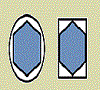
A hexagonal peg can go in a round hole or a square hole, but it never really fits.
17 Apr 2013, 8:10 pm
In regard to your assessment of what I was suggesting specific to Asperger's syndrome, I do not think that from an anecdotal perspective many people visiting this site would argue that social stress and social stimulus do not contribute to their difficulties in functioning in important areas of life.
This is just the kind of sentence that makes me smell blood and go on the attack!
Lol!
You do NOT think..that from an anecdotal perspective...many people visiting this site WOULD argue..that stress and social stimulus do NOT contribute to thier difficulties...in functioning in blah blah...
In plain English that would be: most folks here would say that "stress and social stimulus DO contribute to their problems".
Their problems in WHAT though?
The defining problems of autistics and aspies are social awkwardness and fitting in. So you're just saying that social pressure causes problems with ...social pressure! Which is a tautology.
Am I the only one here who finds it hilarious that you take that much verbiage to say so little- and what little you're saying- is essentially a self evident tautology?
I realize that we are speaking in different languages: you in socialsciencese, and I in colloguial english. But still. It sounds like you're trying to snow either the reader, or snow yourself, or both. So thats why I see red.
You might be on to something- that living in a slow paced more insular community causes spectrumites to stay in the woodwork and not stand out as being dysfunctional the way they might in the wider society.
But there are so many variables that it would take alot to tease that theory out for testing. As blueroses said-there is the genetic issue, And as Im saying- our grandparents werent into going to shrinks, and niether are the modern Amish- so ofcourse they are not going to get diagnosed with neurolgical labels as often as the rest of americans (or even as often as South Koreans).
If I had all the answers, I would not pursue brain storming sessions with others.
I found the low prevalence of ASD, in door to door Scans in Amish Counties, intriguing since about a half a year ago, when I read the study.
I do not claim to come close to know all the reasons and I do not experience Autism the way many others do as currently assessed by DSMIV criteria.
The person that got me thinking about this before I found the study was a Motorcycle Biker and Deep Thinker that often visits this site. He Brain storms better than any person I have come across in writing. His user name is Inventor.
I suspect there are many more on this site. That hypothesis has already been confirmed, at least for me.
Yes, you are correct, this issue is much more complicated than social roles and social stimulus, however that was a point I felt I could start on that everyone could agree on.
Other than that, I am not sure how many more words or how many more ways I can find to confirm that yes I do realize I am not a good social communicator nor am I usually artful in the use of "colloquial terms".
"What you See is What you Get", and in my case it is "more or less" an "advanced form of echolalia", mixed with "Google" and "a sprinkle" of "Human Algorithm" that comes from every source imaginable, at least for me.
Some of those "colloquial terms", are mine alone, which "in effect" makes them "oxymorons".
In conclusion, it is hard to make a "Human Algorithm" angry.
However, they can learn to say thank you and apologize.
It seems through your written communication I am making you angry from my communication style. I apologize for that offense not intended.
To be as honest as a "human algorithm" can, at least in my case, I have no idea why you continue to seem to be angry from my form of communication here.
Thank you, in advance, for understanding that, if you can.
_________________
KATiE MiA FredericK!iI
Gravatar is one of the coolest things ever!! !
http://en.gravatar.com/katiemiafrederick
Last edited by aghogday on 18 Apr 2013, 6:28 am, edited 3 times in total.
17 Apr 2013, 8:12 pm
Why not drop the useless criticism of his communication and get straight to your comments on his theory? You have some interesting points, but they are obscured behind an aggressive approach. How is that better than being wordy?
BTW- Aghogday already addressed "the Amish not visiting shrinks" by using data from a door to door assessment done on Amish children.
I appreciate your help in clarifying my communication.
_________________
KATiE MiA FredericK!iI
Gravatar is one of the coolest things ever!! !
http://en.gravatar.com/katiemiafrederick
 17 Apr 2013, 9:18 pm
I'm following both sides of this one (aghogday, channeling Inventor) and NaturalPlastic. This is one of the most entertaining threads going at the moment.
Where's my popcorn?
_________________
Our first challenge is to create an entire economic infrastructure, from top to bottom, out of whole cloth.
-CEO Nwabudike Morgan, "The Centauri Monopoly"
Sid Meier's Alpha Centauri (Firaxis Games)
17 Apr 2013, 10:07 pm
Where's my popcorn?
Thank you for that. I have come to understand that not everyone enjoys or more often "fully" appreciates my "light" hearted comments.
_________________
KATiE MiA FredericK!iI
Gravatar is one of the coolest things ever!! !
http://en.gravatar.com/katiemiafrederick
18 Apr 2013, 9:13 am
Why not drop the useless criticism of his communication and get straight to your comments on his theory? You have some interesting points, but they are obscured behind an aggressive approach. How is that better than being wordy?
BTW- Aghogday already addressed "the Amish not visiting shrinks" by using data from a door to door assessment done on Amish children.
I appreciate your help in clarifying my communication.
No problem.
I probably should have stayed out of it, but natures attitude irritated me.
_________________
A hexagonal peg can go in a round hole or a square hole, but it never really fits.
19 Apr 2013, 6:00 pm
One thing I have wondered about....do supporters of "Aspie Acres" actually like agriculture?
http://www.wrongplanet.net/postp5256811.html#5256811
_________________
Our first challenge is to create an entire economic infrastructure, from top to bottom, out of whole cloth.
-CEO Nwabudike Morgan, "The Centauri Monopoly"
Sid Meier's Alpha Centauri (Firaxis Games)

 19 Apr 2013, 7:55 pm
Every child, later diagnosed with Autism, starts on a broader autism phenotype first.
There can be many associated factors that lead to the actual diagnosis, including superficial issues such as how the condition may be defined, how it is subjectively assessed, and awareness and accessibility of health care leading to a diagnosing professional.
I was simply going to read along without commenting, but this has piqued my curiosity. And candidly confused me. What are the observable physical characteristics [phenotype] that would put someone, child or adult, into this "broader autism phenotype" without also placing them automatically on the autistic spectrum? Is something coming akin to the sub-categories of ADHD (Combined, Primarily Inattententive, etc.?) Or is this autism phenotype simply a synonym for someone with undiagnosed autism?
_________________
"The man who has fed the chicken every day throughout its life at last wrings its neck instead, showing that more refined views as to the uniformity of nature would have been useful to the chicken." ? Bertrand Russell
| Similar Topics | |
|---|---|
| Having Autism |
11 Jul 2026, 11:01 pm |
| Autism influencers on IG, X, TikTok, etc. |
15 Jul 2026, 3:36 am |


