
The Tipping Point for Mental Illness



 24 Dec 2012, 8:43 am

With respect to gun control I would love the world conduct let's say a 5-10 year experiment. Let's get a list of all countries that exist today and divide them up randomly into 2 groups. Group A will have a total ban on guns for 5-10 years. Group B's population will be allowed to own semis and automatics. After this certain length of time let's reverse it to where Group A's population will be allowed to own semis and autos and Group B will have this ban.
After the results are collated and collected I bet this is what will happen. These are the combinations first of all
a. gun ban to increase in crime
b. gun ban to decrease in crime
c. gun allow to increase in crime
d. gun allow to decrease in crime.
a and d are members of subset 1. b and c are members of subset 2. I believe the culture of a particular country or region will make the country or region fit into subset 1 or fit into subset 2.
IMHO, my hypothesis is that the country or region's culture should be the determiner of whether the country or region should have gun bans or gun allows.
 24 Dec 2012, 3:55 pm
You never answered my question. Would you sentence those people to death?
http://guncite.com/gcdgklec.html
Empirical evidence on the use of guns defensively from the Northwest University School of law.
More Studies
http://guncite.com/kleckandgertztable1.html
And just in case you think they are too biased, they are not.
http://guncite.com/gun_control_gcbogus.html

 24 Dec 2012, 5:50 pm
It's true there are virtually no public resources in the US for care of the mentally ill UNTIL they prove themselves a danger to themselves or others, and those environments aren't really nurturing environments, they're institutions and programs operating on skeleton budgets. If you're wealthy and have a schizophrenic loved one who needs a high level of care, you can get them care before (or at least as soon as) they're a danger to anyone. If you're not wealthy, you're almost entirely on your own. Insurance companies seem to want to rely on 10-minute visits with psychiatrists, quick evaluations and prescriptions, and very little talk-therapy.
I knew someone whose oldest son was a low-functioning paranoid schizophrenic. He qualified for a VA pension (he'd served two tours in Vietnam prior to his illness becoming so severe and it was believed the stress of combat contributed to it becoming active), but his mother was still saddled with a lot of difficult decisions, at a time when she still had younger children at home, an elderly mother to care for, her own health issues, and a husband dealing with his own work-related disability. Her oldest son couldn't hold a job, couldn't manage his own budget or make sure the rent and bills for his apartment were paid from his disability pension, and had numerous run-ins with neighbors and landlords. Still he was only hospitalized on occasion, when he had his very worst episodes, and he never got the quality of long-term care he needed. He would go from hospital to half-way house, but (IMO) too soon into his own care (translate his mother's care). Over and over again. It's too much to expect a family to bear on its own.
I would like to see truly nurturing public institutions and programs that offer realistically in-depth care - inpatient and outpatient - including talk therapy, appropriate medication adjustment (which I don't think the person I describe ever got), occupational therapy and/or meaningful work programs, and a lot of other things you just don't find in County Mental Health or the VA Hospital, and for the help to really be there, instead of pushing people too soon into situations where they aren't ready to care for themselves.
The people staffing our public facilities are, I'm fairly certain, doing the best job they can with the resources at hand, but it's not enough. They don't have the resources they need.
Unless one's family has a LOT of money and can afford private care, they're not likely getting very good or very comprehensive care, and are too often released into their own care before they're ready. But it often seems that the only people who give a damn about this situation are their families - if they're lucky enough to have family members who care. Others shy away, avoiding anything to do with this very real issue. This is why we have so many mentally ill people living on the streets.
The same is true, by the way, of elder care. Anyone who has to rely on Social Security alone to get nursing care is in trouble. We are not taking care of the most needy people in our country very well. We're quick to take away their rights, but not to actually care for them.
Verdandi
Veteran


Joined: 7 Dec 2010
Age: 56
Gender: Female
Posts: 12,275
Location: University of California Sunnydale (fictional location - Real location Olympia, WA)
25 Dec 2012, 1:49 am
Taxpayers.
But so what?
Better to spend billions protecting Americans from real threats within our own borders, than to spend billions protecting Americans from threats that have not existed for over 20 years outside our borders.
$1,000,000,000 ... I wonder how many doses of Demerol that could buy?
Lol solid pseudo trolling I don't think their's an aspie alive that's advocating for more expenditure on the military whether they be con or lib.
25 Dec 2012, 1:51 am
Agreed.
What we also need to bring back is a greater emphasis on the "Common Good" over the rights of schizophrenic individuals.
Lol that's the kind of reasoning that hitler used, and rarely do I make that comparison, but it's hard to avoid the slope your on with this.
As an aspie it's bizarre to think you can even say this.
 25 Dec 2012, 2:23 am
The title suggests that at a certain point, one tips over into certifiable mental illness
Presently that point is defined the first time a nut job does something illegal
Up until that illegal act, the nut job is still technically eccentric or just a bit weird.
The believe the writer wishes to set the point lower, lower than this legal actions tipping point, in hope of catching crimes before they are committed, and preventing a further decline into mental ill-health.
I'm all for health focused interventions, but where is the money in that??
 25 Dec 2012, 5:45 am
Results:
US at 88.8 and 4.2
Switzerland at 45.7 and 0.7
Finland at 32 and 0.6
Sweden at 31.6 and 1.0
Norway at 31.6 and 0.6
Canada at 30.8 and 1.6
Austria at 30.4 at 0.6
Germany at 30.3 and 0.8
New Zealand: 22.6; 0.9
Greece at 22.5 and 1.5
UAE at 22.1 and 0.8
Belgium: 17.2 at 1.7
Average firearms owned: 33.8
Average murder rate: 1.25
http://www.guardian.co.uk/world/2012/ju ... l-violence
Singapore: 0.3; 0.5
Japan: 0.6; 0.3
South Korea: 1.1; 2.6
Netherlands: 3.9; 1.1
Israel: 7.3; 2.1
Ireland: 8.6; 1.2
Spain: 10.4; 0.8
Italy: 11.9; 0.9
Denmark: 12; 0.9
Oz at 15 at 1.0
Luxembourg at 15.3 at 2.5
Czech Republic: 16.3; 1.7
Average firearms owned: 7.3
Average murder rate: 1.3
If you can come up with any correlation between murders per year and firearms owned, be my guest (other than, "barely anything noteworthy"). I really want to know the truth about these things, rather than just accepting the loudest opinions and agendas.
http://en.wikipedia.org/wiki/List_of_co ... ation_rate
The US has three times the incarceration rate of the next highest ranking country in this list of 24, which is Israel. The US is at #1, Israel is at #55. Many of the other countries rank close to the bottom of the list, in incarceration rates.
The murder rates among countries doesn't tell the whole story. Incarceration rates are not a factor addressed in the research linked below from Harvard, that studied a similar comparison between countries.
http://www.hsph.harvard.edu/research/hi ... index.html
The crack wars of the 80's, with extreme gun violence associated among some individuals that were more economically disadvantaged in the US, were effectively ended by tougher drug laws and longer sentences for repeat offenders in the early 90's.
However, the result is a prison population that is moving beyond capacity of the overall justice system to keep up with. There is an overall tipping point in gun homicides, that one can see in these graphs, but it appears to be among a substantial number of young individuals ages 14 to 24, who may be economically disadvantaged and become involved in drug trafficking and substance abuse, more so, than those that are more vulnerable to psychotic breaks from reality.
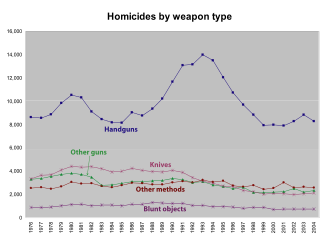
The criminal justice system has found a way to bandage part of this issue in society, but it is not likely a fix that is going to continue too much longer, as gun related fatalities were at the lowest peak in the year 2000, and have started creeping up in the last decade. The impact of rampage killings, in terms of life lost, strictly by numbers, is not close to the gravity of this issue. And from the graphs below it does not appear to be an "assault weapons" rifle issue.
And most unfortunately, the quick fix methods of the 90's in the criminal justice system appears to be predisposed to take some people over others in the prison systems, for relatively similar offenses.
There are no quick fixes for those severely impacted by mental illness, that will work. The Prison System, has long since replaced the institutions of the past for many individuals with mental illness, that have no where else to turn or go. It has already become the destination for those have long since passed their individual tipping points in life.
These younger folks of recent years in rampage killings are described overall as individuals of prior passive temperment that have not been in trouble with the law before, and have not yet been involuntarily committed with a mental crisis to a short term mental crisis facility. They are described as having the resources and family support to avoid the destination in prison that many other individuals, that may have a mental illness, that do not have sufficient family and financial resources have already found, if not homeless in the streets. Those stories don't often make the headlines.
It's also worth noting that while it is common for a small percentage of young adult males to have a psychotic break and later be diagnosed with schizophrenia, the ICD10 also recognizes psychotic episodes associated with young adults diagnosed with Asperger's syndrome.
http://en.wikipedia.org/wiki/Gun_violen ... ted_States

http://en.wikipedia.org/wiki/Incarcerat ... Inequality

http://en.wikipedia.org/wiki/Incarcerat ... ted_States

 25 Dec 2012, 6:13 am
Yes, only focusing on the homicides is a limitation of what I did.
Of note though, the Harvard study is in contention with mine regarding murders rates and firearms ownership (top 24 developed countries for mine; an unknown 26 developed countries for theirs), unless they mean a minute difference. You could throw in one more country in both of my groups and it could affect the outcome, even though it won't be a difference worth noting. So technically, you could pick 16 of each based on firearms ownership and say, more firearms = more murders, or you could grab 23 of either and say, less firearms = more murders. It's so close for both groups (within 1 order of magnitude, and we're dealing with single digits for the murder rate)
I can't find a correlation worth noting.
It might be different with other violent crimes; I don't know if murders and other violent crimes follow a linear track.
25 Dec 2012, 6:25 am
O, and that graph was interesting (most common weapons used in murders in the US):
Not surprising that knives are used as often as long arms, and this goes back to a study I read regarding murder back in the old days -- bows were the most common cause of death on the battlefield, but daggers were the most common cause for murders (before widespread adoption of rifles and pistols); the author theorized that the improvised nature of many murders was why bows were rarely used but knives were. Even with widespread ownership of bows, no one carried them around, but people concealed knives often.
Not surprising that pistols are #1 by far. Concealable, much like the daggers of times past, whereas rifles are like the bows.
25 Dec 2012, 6:52 am
Not surprising that knives are used as often as long arms, and this goes back to a study I read regarding murder back in the old days -- bows were the most common cause of death on the battlefield, but daggers were the most common cause for murders (before widespread adoption of rifles and pistols); the author theorized that the improvised nature of many murders was why bows were rarely used but knives were. Even with widespread ownership of bows, no one carried them around, but people concealed knives often.
Not surprising that pistols are #1 by far. Concealable, much like the daggers of times past, whereas rifles are like the bows.
Yes, and the school shooter that used the bow and arrow earlier in the month, was bizarre, and the only school shooting noted in Wiki that used that extremely non-concealed weapon in the historical records in a school shooting. I think one of the biggest differences between a rampage killing and the type of gun violence graphed above, is that in the majority of cases, they are not individuals that are looking to commit violence and escape unharmed. It can make the risk one is willing to take, much different.
I think the steep spike in gun violence in the 80's and early 90's, was in large part due to drug trafficking related homicides associated with the crack wars, and I don't think that most other violent crimes saw the same kind of spike, as homicides are in general measured less frequently than most other types of violent crimes.
Last edited by aghogday on 26 Dec 2012, 4:21 am, edited 1 time in total.
AardvarkGoodSwimmer
Veteran

Joined: 26 Apr 2009
Age: 63
Gender: Male
Posts: 7,665
Location: Houston, Texas
25 Dec 2012, 3:17 pm
I knew someone whose oldest son was a low-functioning paranoid schizophrenic. He qualified for a VA pension (he'd served two tours in Vietnam prior to his illness becoming so severe and it was believed the stress of combat contributed to it becoming active), but his mother was still saddled with a lot of difficult decisions, at a time when she still had younger children at home, an elderly mother to care for, her own health issues, and a husband dealing with his own work-related disability. Her oldest son couldn't hold a job, couldn't manage his own budget or make sure the rent and bills for his apartment were paid from his disability pension, and had numerous run-ins with neighbors and landlords. Still he was only hospitalized on occasion, when he had his very worst episodes, and he never got the quality of long-term care he needed. He would go from hospital to half-way house, but (IMO) too soon into his own care (translate his mother's care). Over and over again. It's too much to expect a family to bear on its own.
I would like to see truly nurturing public institutions and programs that offer realistically in-depth care - inpatient and outpatient - including talk therapy, appropriate medication adjustment (which I don't think the person I describe ever got), occupational therapy and/or meaningful work programs, and a lot of other things you just don't find in County Mental Health or the VA Hospital, and for the help to really be there, instead of pushing people too soon into situations where they aren't ready to care for themselves.
The people staffing our public facilities are, I'm fairly certain, doing the best job they can with the resources at hand, but it's not enough. They don't have the resources they need. . . .
Excellent point. We aren't allocating the resources even for people who want to get treatment and who want to get help. And since medication will likely require adjustment (everyone's biochem a little different), the entire situation will work a heck of a lot better if it's something the person is choosing to try, rather than something the person is pressured, conned, or forced into trying.
25 Dec 2012, 11:52 pm
I did not know about that. 3 murders. Seems that it was targeted rather than a desire to kill as many people as possible though (whether the targets were selected specifically or by chance), i.e., no wounded (people running often equates to poor shot placement, which increases the incidence of non-fatal wounds).
I'm guessing if firearms and other explosives were never invented, bows would probably be the weapon of choice for rampage murders (no need to conceal a weapon if all you want to do is kill as many people as possible). Crossbows would be a very poor choice due to the terrible rate of fire.
26 Dec 2012, 4:19 am
I did not know about that. 3 murders. Seems that it was targeted rather than a desire to kill as many people as possible though (whether the targets were selected specifically or by chance), i.e., no wounded (people running often equates to poor shot placement, which increases the incidence of non-fatal wounds).
I'm guessing if firearms and other explosives were never invented, bows would probably be the weapon of choice for rampage murders (no need to conceal a weapon if all you want to do is kill as many people as possible). Crossbows would be a very poor choice due to the terrible rate of fire.
I miss-spoke, that incident was classified as a school shooting, not a rampage killing.
 27 Dec 2012, 9:22 am
Exactly. The vast, vast majority of the severely mentally ill aren't "dangerous." During acute psychosis, most schizophrenics and manics are much more at risk for harming THEMSELVES than anybody else. Secondly, after the first psychotic episode, once a patient has been educated on the importance of medication and keeping in touch with mental health services to watch for warning signs, it is largely the responsibility of the patient, their family, and the mental health industry to make sure the patient stays well.
Many severely mentally ill individuals in the prison system are who my heart really goes out to. The sad reality is that many of these individuals are homeless due to severe/untreated mental illness, will be thrown in jail for commiting a crime while psychotic (because they can't afford medication), will become perfectly well in jail when given medication, and upon release from jail, will quickly become psychotic and land in jail again once the 2-week supply of prison anti-psychotics have been used. It is an extremely sad thing, and it sickens me how much stigma against mental illness still exists.
Another big issue is medication itself. Yes, the patient needs to be responsible and comply with medication regimens to avoid causing harm to themself or others, but what most people don't understand is how horrible the side effects of the anti-psychotics are. Many schizophrenics have stated that they feel as though they have to choose to be obese and diabetic in order to be well. And some psychiatrists and family members have no idea what the side effects are like. Besides better mental health facilities, what we need the most is better medications. All of the neuropsych meds are awful- it's just that the anti-psychotics are the most awful. This "trial-and-error" nonsense needs to put to an end soon.
_________________
Helinger: Now, what do you see, John?
Nash: Recognition...
Helinger: Well, try seeing accomplishment!
Nash: Is there a difference?
Sweetleaf
Veteran

Joined: 6 Jan 2011
Age: 36
Gender: Female
Posts: 35,278
Location: Somewhere in Colorado
27 Dec 2012, 1:05 pm
Exactly. The vast, vast majority of the severely mentally ill aren't "dangerous." During acute psychosis, most schizophrenics and manics are much more at risk for harming THEMSELVES than anybody else. Secondly, after the first psychotic episode, once a patient has been educated on the importance of medication and keeping in touch with mental health services to watch for warning signs, it is largely the responsibility of the patient, their family, and the mental health industry to make sure the patient stays well.
Many severely mentally ill individuals in the prison system are who my heart really goes out to. The sad reality is that many of these individuals are homeless due to severe/untreated mental illness, will be thrown in jail for commiting a crime while psychotic (because they can't afford medication), will become perfectly well in jail when given medication, and upon release from jail, will quickly become psychotic and land in jail again once the 2-week supply of prison anti-psychotics have been used. It is an extremely sad thing, and it sickens me how much stigma against mental illness still exists.
Another big issue is medication itself. Yes, the patient needs to be responsible and comply with medication regimens to avoid causing harm to themself or others, but what most people don't understand is how horrible the side effects of the anti-psychotics are. Many schizophrenics have stated that they feel as though they have to choose to be obese and diabetic in order to be well. And some psychiatrists and family members have no idea what the side effects are like. Besides better mental health facilities, what we need the most is better medications. All of the neuropsych meds are awful- it's just that the anti-psychotics are the most awful. This "trial-and-error" nonsense needs to put to an end soon.
If the medication makes things worse why do they 'need' to comply with taking them...I mean I can see that if a medication is helping and not totally intolerable its best if they keep taking it. Also though wouldn't taking a harmful medication be harming themself? I just get so angry at the idea that some people are forced to take meds with horrible side effects regardless of how bad they are or how they feel or even if there might be alternatives to try. Aside from that I agree with your post.
_________________
Tis the time to melt the Ice.
| Similar Topics | |
|---|---|
| Stigmatizing deep thinking as "obsession/illness" |
05 Jul 2026, 4:34 pm |
|
Mental health crisis
in Bipolar, Tourettes, Schizophrenia, and other Psychological Conditions |
10 Jul 2026, 6:58 pm |


