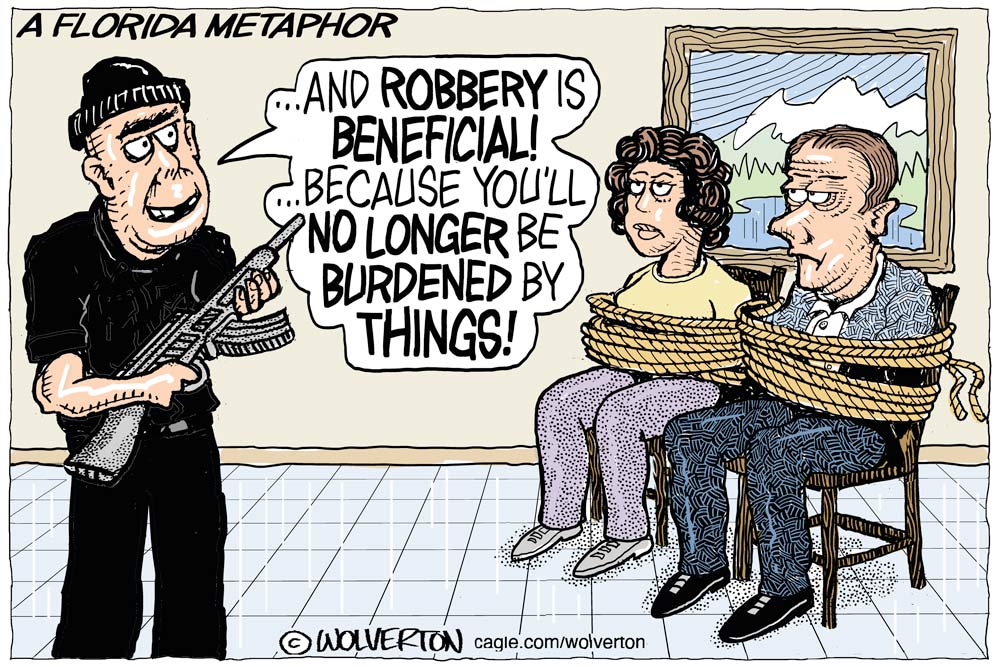
florida school curriculum to teach "slavery was beneficial"
goldfish21
Veteran
Joined: 17 Feb 2013
Age: 43
Gender: Male
Posts: 22,612
Location: Vancouver, BC, Canada
https://www.history.com/this-day-in-his ... -2023-0819
On August 19, 1791, the accomplished American mathematician and astronomer Benjamin Banneker pens a letter to then-Secretary of State Thomas Jefferson. Jefferson corresponds prolifically with luminaries from around the world, but Banneker is unique among them: the son of a free Black American woman and a formerly enslaved African man from Guinea, Banneker criticizes Jefferson’s hypocritical stance on slavery in respectful but unambiguous terms, using Jefferson’s own words to make his case for the abolition of slavery.
Banneker himself was born free in what is now Ellicott City, Maryland, and was encouraged in his studies of astronomy and mathematics by the Ellicotts, a Quaker family who owned a mill and much of the land in the area. Predicting a solar eclipse and constructing a functioning clock that struck on the hour were among his early achievements. His prowess caught the eye of Jefferson after Major Andrew Ellicott chose Banneker to assist him in surveying the original boundaries of what would become the District of Columbia. Banneker also compiled several ephemerides (a type of astronomical chart) and almanacs.
In August of 1791, Banneker sent Jefferson, who was known both as a Founding Father and a devoted scientist, a draft of an almanac he was readying for publication. He felt compelled to include a personal note. In this letter, Banneker quoted the famous preamble to the Declaration of Independence (“We hold these truths to be self-evident, that all men are created equal…”) and said plainly that he was disappointed in the hypocrisy of Jefferson, a slaveowner:
"…but Sir how pitiable is it to reflect, that altho you were so fully convinced of the benevolence of the Father of mankind, and of his equal and impartial distribution of those rights and privileges which he had conferred upon them, that you should at the same time counteract his mercies, in detaining by fraud and violence so numerous a part of my brethren under groaning captivity and cruel oppression, that you should at the same time be found guilty of that most criminal act, which you professedly detested in others, with respect to yourselves."
Jefferson’s response, eleven days later, was cordial and complimentary but also condescending and racist. Jefferson praised the almanac and informed Banneker that he was sending it along to the Marquis de Condorcet, a French philosopher, mathematician, and abolitionist. The future president praised Banneker as a credit to the Black race, essentially telling him that he considered the almanac evidence that African American’s inferiority was owed “merely to the degraded condition of their existence both in Africa and America” and not to their innate inferiority, a paternalistic sentiment that was a frequent topic of debate among whites.
After Banneker’s death, Jefferson expressed doubt that a Black man could have written the almanac. He continued to own enslaved workers, despite decrying slavery in some of his writings, until his own death in 1826. Shortly after they were written, a Philadelphia publisher circulated a pamphlet containing Banneker’s eloquent argument for abolition and Jefferson’s non-committal response, which made the rounds among the nascent abolitionist movement. Contrary to the myth that slavery was universally accepted among educated and elite circles in the early United States, Banneker’s letter stands as proof that one of the nation’s founders received first-hand criticism of his hypocritical and contradictory stance on slavery in his lifetime.
_________________
"We are all gonna die." --Senator Joni Ernst
https://www.history.com/this-day-in-his ... -2023-0820
_________________
"We are all gonna die." --Senator Joni Ernst
I also assume this is as much about the future as about the past. As stagnant as they have been, wages still cost a lot.
_________________
Of course, it's probably quite a bit more complicated than that.
You know sometimes, between the dames and the horses, I don't even know why I put my hat on.
https://www.yahoo.com/news/proud-purple ... 13931.html
_________________
"We are all gonna die." --Senator Joni Ernst
MuddRM
Velociraptor
Joined: 2 Sep 2021
Gender: Male
Posts: 484
Location: Beautiful(?) West Manchester Township, PA
https://www.youtube.com/watch?v=VZs9Aqf ... el=ATTN%3A
_________________
"We are all gonna die." --Senator Joni Ernst
CockneyRebel
Veteran
Joined: 17 Jul 2004
Age: 51
Gender: Male
Posts: 121,245
Location: In my own little country
goldfish21
Veteran
Joined: 17 Feb 2013
Age: 43
Gender: Male
Posts: 22,612
Location: Vancouver, BC, Canada
It’s not beneficial to the enslaved person, but it certainly can be to the people exploiting slave labour. Much of the world was built on the backs of slave labour.. slaves have actually accomplished a lot, really.
Even Indigenous North Americans would enslave people from other tribes/nations. And there’s still plenty of active slavery today. It’s unfortunately been a part of human civilization for thousands of years - or longer. Obviously it sucks to be enslaved, but slaves have actually benefited society, countries, their direct “masters,” etc quite a lot.
_________________
No
funeralxempire
Veteran
Joined: 27 Oct 2014
Age: 41
Gender: Non-binary
Posts: 34,243
Location: Right over your left shoulder
It's worth pointing out that slavery in societies where livestock ownership isn't the norm tends to be quite different from chattel slavery as practiced in Rome, Carthage, the US and Latin America, the Islamic world, etc.
It's more like being forcibly adopted and assimilated, which is also terrible, but isn't multi-generational and doesn't reduce the person to someone else's private property.
_________________
The Party told you to reject the evidence of your eyes and ears. It was their final, most essential command.
If you're not careful, the newspapers will have you hating the people who are being oppressed, and loving the people who are doing the oppressing. —Malcolm X
Just a reminder: under international law, an occupying power has no right of self-defense, and those who are occupied have the right and duty to liberate themselves by any means possible.
goldfish21
Veteran
Joined: 17 Feb 2013
Age: 43
Gender: Male
Posts: 22,612
Location: Vancouver, BC, Canada
It's worth pointing out that slavery in societies where livestock ownership isn't the norm tends to be quite different from chattel slavery as practiced in Rome, Carthage, the US and Latin America, the Islamic world, etc.
It's more like being forcibly adopted and assimilated, which is also terrible, but isn't multi-generational and doesn't reduce the person to someone else's private property.
Hmm.
Interesting differences.. buuuut, if they're not free to return home, are they not the property of those that took and kept them?
Maybe different conditions than the stereotypical slave.. but they're still not free, and thus, sort of owned by default - no?
_________________
No
funeralxempire
Veteran
Joined: 27 Oct 2014
Age: 41
Gender: Non-binary
Posts: 34,243
Location: Right over your left shoulder
It's worth pointing out that slavery in societies where livestock ownership isn't the norm tends to be quite different from chattel slavery as practiced in Rome, Carthage, the US and Latin America, the Islamic world, etc.
It's more like being forcibly adopted and assimilated, which is also terrible, but isn't multi-generational and doesn't reduce the person to someone else's private property.
Hmm.
Interesting differences.. buuuut, if they're not free to return home, are they not the property of those that took and kept them?
Maybe different conditions than the stereotypical slave.. but they're still not free, and thus, sort of owned by default - no?
Who owns them if no one has ownership over them?
Likewise, serfs aren't free, but also aren't chattel slaves.
This is the problem when trying to apply the term slavery in contexts where the concept isn't really applicable.
Serfs aren't chattel slaves because they're bound to the land they work, not an owner; they can't be sold or bought or traded.
In 'primitive slavery', the concept of chattel doesn't exist, so it's impossible for chattel slavery to exist.
Slavery is a very imprecise term for describing a variety of different economic and social institutions across a wide range of societies.
If we include the practices of hunter-gatherers and semi-settled farming peoples who lacked livestock as slavery, we should also include serfdom, any sort of debt-bondage, any sort of indentured service, etc. Apprenticeships historically were a form of indentured servitude but it would be inappropriate to describe a medieval apprentice as a slave.
Since we tend to separate those forms of bondage as being distinct from slavery, we should also be mindful that often when encountering foreign versions of those same practices the term slavery was applied regardless.
If only chattel slavery counts when practiced by some peoples, why does the definition become so much broader when describing other peoples practices?
_________________
The Party told you to reject the evidence of your eyes and ears. It was their final, most essential command.
If you're not careful, the newspapers will have you hating the people who are being oppressed, and loving the people who are doing the oppressing. —Malcolm X
Just a reminder: under international law, an occupying power has no right of self-defense, and those who are occupied have the right and duty to liberate themselves by any means possible.

goldfish21
Veteran
Joined: 17 Feb 2013
Age: 43
Gender: Male
Posts: 22,612
Location: Vancouver, BC, Canada
It's worth pointing out that slavery in societies where livestock ownership isn't the norm tends to be quite different from chattel slavery as practiced in Rome, Carthage, the US and Latin America, the Islamic world, etc.
It's more like being forcibly adopted and assimilated, which is also terrible, but isn't multi-generational and doesn't reduce the person to someone else's private property.
Hmm.
Interesting differences.. buuuut, if they're not free to return home, are they not the property of those that took and kept them?
Maybe different conditions than the stereotypical slave.. but they're still not free, and thus, sort of owned by default - no?
Who owns them if no one has ownership over them?
Likewise, serfs aren't free, but also aren't chattel slaves.
This is the problem when trying to apply the term slavery in contexts where the concept isn't really applicable.
Serfs aren't chattel slaves because they're bound to the land they work, not an owner; they can't be sold or bought or traded.
In 'primitive slavery', the concept of chattel doesn't exist, so it's impossible for chattel slavery to exist.
Slavery is a very imprecise term for describing a variety of different economic and social institutions across a wide range of societies.
If we include the practices of hunter-gatherers and semi-settled farming peoples who lacked livestock as slavery, we should also include serfdom, any sort of debt-bondage, any sort of indentured service, etc. Apprenticeships historically were a form of indentured servitude but it would be inappropriate to describe a medieval apprentice as a slave.
Since we tend to separate those forms of bondage as being distinct from slavery, we should also be mindful that often when encountering foreign versions of those same practices the term slavery was applied regardless.
If only chattel slavery counts when practiced by some peoples, why does the definition become so much broader when describing other peoples practices?
1. Fear? I assume there would be fear of some sort of consequences should they try to leave and get caught. Violence? Rape? Death? I don't know, just guessing what sort of things people would fear as consequences and thus stay "voluntarily."
2. Not sure I understand your question. I've read it a few times over and not sure how to answer as I'm not sure how to interpret it. Clarification/rephrasing required pls & thx.
_________________
No