Page 6 of 7 [ 101 posts ]  Go to page Previous  1 ... 3, 4, 5, 6, 7  Next

Everchanging
Toucan
Toucan

User avatar

Joined: 2 Nov 2007
Age: 46
Gender: Male
Posts: 295
Location: In my ivory tower where I don't have to pretend to care what you think any more.

28 Sep 2008, 9:13 am

slowmutant wrote:
If you attack my faith, you attack me. Expect a very prickly response.


Image


_________________
So long and thanks for all the pish.


Greyhound
Veteran
Veteran

User avatar

Joined: 9 Apr 2008
Age: 37
Gender: Female
Posts: 1,191
Location: Birmingham, UK

28 Sep 2008, 9:16 am

silentbob15 wrote:
slowmutant wrote:
What about the Shroud of Turin?

Shroud of Turin is thought to be a fake, that radio carbon dating
estimates it was made in the middle ages, 1300 years after Christ

Carbon dating doesn't work. It assumes a constant amount of carbon.


_________________
I don't have Aspergers, I'm just socially inept

Dodgy circuitry! Diagnosed: Tourette syndrome. Suspected: auditory processing disorder, synaesthesia. Also: social and organisation problems. Heteroromantic asexual (though still exploring)


ThatRedHairedGrrl
Veteran
Veteran

User avatar

Joined: 10 May 2008
Age: 57
Gender: Female
Posts: 912
Location: Walking through a shopping mall listening to Half Japanese on headphones

28 Sep 2008, 1:49 pm

The unpleasant truth is that for centuries, the Christian Church has depicted Jesus as very non-Middle-Eastern-looking, because the Christian world in general was busy scapegoating and persecuting the Jews. A Semitic-looking Jesus would have faced Europeans too clearly with the obscenity of what they were doing to his own people.

Marc Chagall painted a Crucifixion in which Jesus was clearly Jewish and wearing a prayer shawl, and with background scenes depicting persecution of Jews. Chagall (who was Jewish himself) had the right idea; God identifying with the suffering of persecuted humans. Not ordering it, or providing a useful rationale for condoning it.

Those artists who paint a black Jesus, or sculpt a female Jesus, are making much the same point. Such images usually engender shock because they contradict traditional ideas of the historical Jesus, but look at the message...
Matthew 25: 44 Then they also will answer, “Lord, when was it that we saw you hungry or thirsty or a stranger or naked or sick or in prison, and did not take care of you?”
45 Then he will answer them, “Truly I tell you, inasmuch as you did not do it unto the least of these, you did not do it to me.”


Inasmuch as you failed to show love and compassion to (insert name of person or group you feel to be most un-God-like), you failed to show it to me.

Images are powerful. Getting rid of them absolutely is a mistake, becaue it we're concrete, visual beings and we need something to put across what we can't otherwise understand. The bigger mistake is to believe that any one image is an accurate picture of the whole Reality.


_________________
"Grunge? Isn't that some gross shade of greenish orange?"


Loborojo
Veteran
Veteran

User avatar

Joined: 19 Aug 2008
Age: 67
Gender: Non-binary
Posts: 1,242
Location: Negombo

29 Sep 2008, 12:08 am

why are there so many threads on Jesus or Christianity, for god's sake 8) :roll:


_________________
Your Aspie score: 152 of 200
Your neurotypical (non-autistic) score: 48 of 200
You are very likely an Aspie


n4mwd
Veteran
Veteran

User avatar

Joined: 7 Jun 2008
Age: 63
Gender: Male
Posts: 871
Location: Palm Beach, FL

30 Sep 2008, 9:40 pm

ouinon wrote:
n4mwd wrote:
There IS hard evidence in the form of historical writings. Some even pre-date the new testament, that Jesus DID walk the Earth.

Please provide links and/or quotes/refs to support this assertion,

.


Here are a few ancient pagan writers (mostly Roman):

Tacticus
Suetonius
Pliny
Epictetus
Lucian *
Aristides
Galenus
Lampridus
Dio Cassius
Emeritus
Annianus
Marcellinus
Eunapius
Zosimus
Celsus *
Porphyry *
Hieracles *
Julian the Apostate *

* These authors wrote entire manuscripts about Christ. Most of them were written in an attempt to discredit His diety.

Remember that these are Historical writings and not religious ones. Many are anti-Christian. They refer to Jesus of Nazareth. Unlike today, there wasn't somebody named Jesus on every street corner.

A few links:
http://www.lewrockwell.com/barnwell/barnwell57.html
http://en.wikipedia.org/wiki/Tacitus_on_Jesus


michel
Veteran
Veteran

User avatar

Joined: 12 Aug 2007
Age: 55
Gender: Male
Posts: 735
Location: Ecuador

30 Sep 2008, 9:51 pm

slowmutant wrote:
patrick6 wrote:
This is what people think that Jesus really looked like:

Image

This is the 'traditional' Jesus, but not the way that Jesus really looked like:

Image


What do you guys think Jesus really looked like?


The top guy is ugly and the bottom guy is handsome. Coincidence?

No coincidence. I read several essays written by scholars who also claim that, according to the descriptions, Jesus was most unattractive, short, hairy and balding with a huge crooked nose. In a very hypocritical move, the Church decided to depict him as a handsome, tall and muscular man with no body hair and beautiful long hair. Religion is a man made institution...


n4mwd
Veteran
Veteran

User avatar

Joined: 7 Jun 2008
Age: 63
Gender: Male
Posts: 871
Location: Palm Beach, FL

30 Sep 2008, 9:57 pm

Phagocyte wrote:
n4mwd wrote:
Again, agnostics ("agnostic" comes from the word "ignorant") don't need or accept scientific proof. They believe what they want to and tend to go whatever way is 'popular' at the time.


No. It actually means "unknown" or "unknowable," from the Greek "gnostos" which means knowledge and the prefix "a" which means without.


You just proved my point. It means lack of knowledge.

American Heritage Dictionary wrote:
ig·no·rant
adj.
1. Lacking education or knowledge.
2. Showing or arising from a lack of education or knowledge: an ignorant mistake.
3. Unaware or uninformed.


The word "agnostic" was coined by Thomas Huxley (Darwin's Bulldog) in 1870. It was intended as a word to describe those without concrete beliefs in any theory, but eventually evolved into a description of those without concrete religious beliefs. The word is formed from "A-" which means "without" and "Gnostic" which means "knowledge". So its literal meaning is indeed "without-knowledge" which is the same as "ignorant".


twoshots
Veteran
Veteran

User avatar

Joined: 26 Nov 2007
Age: 40
Gender: Male
Posts: 3,731
Location: Boötes void

30 Sep 2008, 10:20 pm

Ignorant and Agnostic have very different connotations. Agnostic is not, properly, the absence of belief. It is the affirmation of a lack of knowledge and, generally, the impossibility of knowledge.


_________________
* here for the nachos.


n4mwd
Veteran
Veteran

User avatar

Joined: 7 Jun 2008
Age: 63
Gender: Male
Posts: 871
Location: Palm Beach, FL

02 Oct 2008, 4:00 am

michel wrote:
No coincidence. I read several essays written by scholars who also claim that, according to the descriptions, Jesus was most unattractive, short, hairy and balding with a huge crooked nose. In a very hypocritical move, the Church decided to depict him as a handsome, tall and muscular man with no body hair and beautiful long hair. Religion is a man made institution...


It is very possible that Jesus looked European by today's standards.

There were 12 tribes of Israel and not all of them are now considered "Jewish". I think that only the tribe of Judah is considered Jewish today. The remaining tribes migrated all over the world. For example, the people of European descent are typically called "Anglo-Saxon". The name "saxon" comes from "sax-son" which comes itself from "Isaac's-son" or the pronounciation "I-sac-son". You'll find "-son" names all throughout European phone books. Names like "Johns-son", "Erics-son", and Thomas-son" show that this type of naming practice was common.

But I still agree that the Catholic church may have taken some liberties when it comes to Christ's appearance.


ouinon
Supporting Member
Supporting Member

User avatar

Joined: 10 Jul 2007
Age: 62
Gender: Female
Posts: 5,939
Location: Europe

02 Oct 2008, 6:59 am

n4mwd wrote:
Here are a few ancient pagan writers (mostly Roman):Tacticus, Suetonius, Pliny, Epictetus, Lucian *, Aristides, ... etc ...

I looked up more than half a dozen of these and found that, as I had already said, ( and as stated on the sites I quoted earlier ), all their writings either postdate the gospels, and/or refer convincingly/credibly only to the early Christian church/groups of christians ( which I have at no point denied the existence of ).

Where there are specific references to Jesus they are based without exception on writings, ( the gospels, some post-gospel apocryphal material etc), which do not constitute solid historical records.

None of those that I looked up were born before 60 AD, and thus were already a generation away from the time-period in which the gospels are set.

Most of the writing appears to be a reaction to the emerging church, and suffer from typical roman literal-mindedness, ( it does not occur to them to treat anything as parable) whether satirical as in the case of Lucian, or attempt at sober historical record.

You pointed out that most of these writers were anti-pathetical to christianity/christians as a group, as if hostility towards a creed/group guarantees objective reporting, :? :roll: as if their critical attitude must mean that what they wrote were clear sighted in every way, ( which is a strangely ironic position to take as a christian yourself).

None of the 8 that I looked at have anything to say about Jesus which is not taken from the by then long established "version" of the gospels, including all the "circumstantial detail" designed to add "body" to the story, force to the myth, added at each rewriting.

Most of them wrote their responses/treatments/attacks in the second century, more than 40-50 years after the gospels, and more than 80-90 years after the supposed historical events pictured in them.

What is interesting is how many modern christians are prepared to accept/believe that a lot of Genesis for example is parable/metaphor, but fail to see that the Gospel, ( in whatever version), is one too.

.



n4mwd
Veteran
Veteran

User avatar

Joined: 7 Jun 2008
Age: 63
Gender: Male
Posts: 871
Location: Palm Beach, FL

02 Oct 2008, 8:50 pm

ouinon wrote:
I looked up more than half a dozen of these and found that, as I had already said, ( and as stated on the sites I quoted earlier ), all their writings either postdate the gospels, and/or refer convincingly/credibly only to the early Christian church/groups of christians ( which I have at no point denied the existence of ).
.


Probably the closest one would be Flavius Josephus who was born AD37. He was a jewish writer who wrote in his book Antiquities of the Jews, book 18, chapter 3, section 3: "About this time lived Jesus..."

In Jewish religious texts such as the Gemara, Jesus is referred to as "the illegitimate son of Mary" (Jews do not accept the virgin birth). Although not pro-Christian, it does confirm the existence of Jesus or they would have simply said; "Jesus, a mythical being worshiped by Gentiles." They also mention his crucifixion - although they leave out the part about the resurrection.

Note that just because some of these books were first published in 200 AD doesn't mean they weren't started during the life of Christ by other authors. They didn't have Wordperfect back then so just making a single copy took a whole lifetime by a scribe sometimes.


chever
Veteran
Veteran

User avatar

Joined: 21 Aug 2008
Age: 38
Gender: Male
Posts: 1,291
Location: Earth

02 Oct 2008, 9:06 pm

Jesus

  • Fairly dark skin
  • Curly black hair
  • Aquiline facial features


I'll bet that's what he looked like


_________________
"You can take me, but you cannot take my bunghole! For I have no bunghole! I am the Great Cornholio!"


ouinon
Supporting Member
Supporting Member

User avatar

Joined: 10 Jul 2007
Age: 62
Gender: Female
Posts: 5,939
Location: Europe

03 Oct 2008, 3:01 am

n4mwd wrote:
In Jewish religious texts such as the Gemara, Jesus is referred to as "the illegitimate son of Mary". Although not pro-Christian, it does confirm the existence of Jesus or they would have simply said; "Jesus, a mythical being worshipped by Gentiles".

These writings are already using the Gospels as source material, and treating them as if they were a historical record was probably deliberate so that could say exactly that sort of thing, disparagingly/negatingly/insultingly. The most effective attack against a powerful new myth/parable was to "bring it down" to the merely material world, and make it look ridiculous.

The Gospels deliberately and repeatedly warn the reader, ( with internal pointers, something that certain traditions of ancient/classical literature/storytelling often did ), that its spiritual wisdom would come in parables, which most people will not understand the meaning of. eg: most people will think that the story of the wise virgins is about making sure you have enough oil in your lamp. Thus most people will think that the story of Jesus is about a man called Jesus who died on a cross to save us from our sins etc etc.

.


Last edited by ouinon on 03 Oct 2008, 5:11 am, edited 1 time in total.

n4mwd
Veteran
Veteran

User avatar

Joined: 7 Jun 2008
Age: 63
Gender: Male
Posts: 871
Location: Palm Beach, FL

03 Oct 2008, 3:54 am

ouinon wrote:
These writings are already using the Gospels as source material, and treating them as if they were a historical record was probably deliberate so that could say exactly that sort of thing, disparagingly/negatingly/insultingly. The most effective attack against a powerful new myth/parable was to "bring it down" to the merely material world, and make it look ridiculous.

.


You are making wild assumptions with that statement. Jewish leaders using Christian texts as source material for their own religious texts?? I really don't think many people would buy that argument. If they thought His existence was a myth, they would have left him out completely.

How many references in any religious text refer to Santa Claus or the Easter bunny?


ouinon
Supporting Member
Supporting Member

User avatar

Joined: 10 Jul 2007
Age: 62
Gender: Female
Posts: 5,939
Location: Europe

03 Oct 2008, 5:07 am

n4mwd wrote:
ouinon wrote:
Treating the Gospels as if they were a historical record was deliberate strategy so that could say exactly that sort of thing, disparagingly/negatingly/insultingly. The most effective attack against a powerful new myth/parable was to "bring it down" to the merely material world, and make it look ridiculous.
Jewish leaders using Christian texts as source material for their own religious texts? If they thought his existence was a myth, they would have left him out completely.

Myth has not always had the bad press it has now. Not so long ago myth, ( parable) was taken very seriously, respected for conveying deep truths.

Faced with a new, ( hybrid of monotheist and polytheistic myths ) and increasingly popular one, in which their own religious myths were used/referred to as evidence for its spiritual truth, it might have seemed that the most effective form of attack would be to "pretend" that it was mere historical reality, in which such happenings as a woman giving birth to a child without a man could be described as nothing more than illegitimacy.

They would have felt the need to issue some sort of "official" response/rebuttal to the Gospels, not just because by the time they were writing the Christian story had become widely disseminated causing people to turn away from the Jewish religion, but because it used their own religious texts as support.

To have acknowledged that it was a myth would have been, at the epoch, to accord it importance/value, because new myth does not come along all the time; when it does it is precious, and full of power.

The greatest danger to the old ways was that people would understand it for the original and transformative parable/myth that it is, and treating it as if it was just a romanticised treatment of real events probably seemed the best way to reduce its impact.

Most people still think that by understanding what the internal, "clearly labelled", parables mean they have grasped the principle of "spiritual wisdom being conveyed by parable", but miss the greater meaning of all the little parables which is to indicate how the whole gospel story is one itself.

.


Dogbrain
Toucan
Toucan

User avatar

Joined: 4 Aug 2008
Age: 60
Gender: Male
Posts: 290

03 Oct 2008, 11:22 am

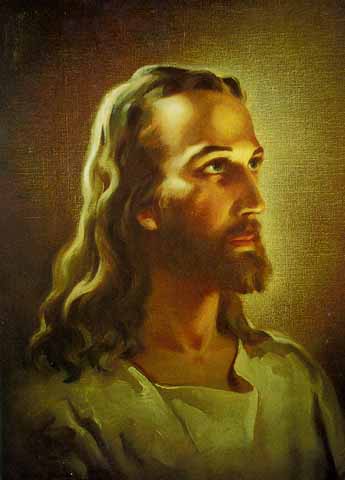
The earliest physical description of Jesus the Christ comes from Justin Martyr, who states that Christ was "without beauty". Clement of Alexandria (presumably passing along an older tradition) described Christ as "unlovely in the flesh". What is accepted as the "traditional" depiction by so many Protestants didn't exist until 1935 (in color--a sketch was done in the 1920s), when Warner Sallman painted "The Head of Christ".