Is it about to esplode?
Betelgeuse Looks Fainter Than Usual. Could It Mean It's About to Go Supernova?
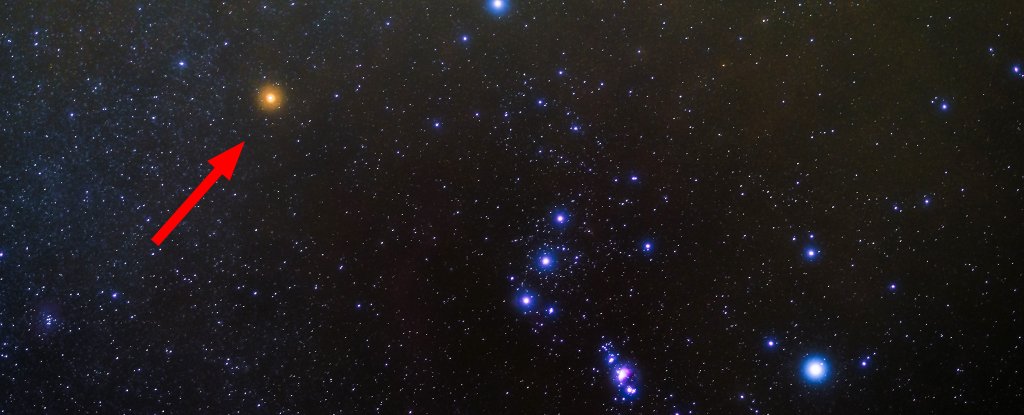
Have you noticed that Orion the Hunter – one of the most iconic and familiar of the wintertime constellations – is looking a little… different as of late? The culprit is its upper shoulder star Alpha Orionis, aka Betelgeuse, which is looking markedly faint, the faintest it has been for the 21st century.
When will this nearby supernova candidate pop, and what would it look like if it did?
The story starts, as all good astronomy and space stories seem to, on Friday night going into a holiday weekend.
We started seeing discussion on Betelgeuse trending on social media on the evening of Friday, December 20th, and dug down to the source of the excitement: a December 8th paper on "The Fainting of the Nearby Red Supergiant Betelgeuse" by researchers at Villanova University.
Light curve estimates courtesy of the American Association of Variable Star Observers (AAVSO) verified the assertion that the star had indeed faded about one magnitude, or a little over one half from its usual magnitude +0.5 to +1.5.
Noticing the sky was clear, we headed up to our parking garage rooftop observing site in downtown Norfolk, Virginia to take a look. Betelgeuse was indeed noticeably fainter, about a shade dimmer than nearby +1st magnitude Aldebaran.
Now, a change in one magnitude isn't unusual for a variable star such as Betelgeuse… but such a large dip always gives the astronomical community pause.
A red giant star 12 times as massive as our Sun and about 700 light years distant, the variability of red-orange Betelgeuse was first noted by astronomer Sir John Herschel in 1836.
Physically, the star is currently bloated out to a radius of perhaps eight Astronomical Units (AU). If you plopped it down in the center of our Solar System, Betelgeuse might extend all the way out to past the orbit of Jupiter....
Betelgeuse is always worth keeping an eye on, as it's one of the closest candidates in our galaxy for a nearby supernova.
We see supernovae frequently in distant galaxies, but such an event has not been witnessed in our galaxy in the telescopic era: Kepler's Star in 1604 in the constellation Ophiuchus was the last supernova observed in the Milky Way, though a supernova in the nearby Large Magellanic Cloud put on a good show in 1987.
A red giant like Betelgeuse lives fast and dies young, exhausting its supply of hydrogen fuel in just under 10 million years. The star is destined to undergo a core implosion and massive collapse and rebound as a Type II supernova.
Such an explosion could occur 100,000 years from now… or tonight.
https://www.sciencealert.com/betelgeuse ... out-to-pop
_________________
There Are Four Lights!